
In the figure, line j is parallel to line k, What is the value of x?
GMAT Geometry & Trigonometry : (Geo_Trig) Questions
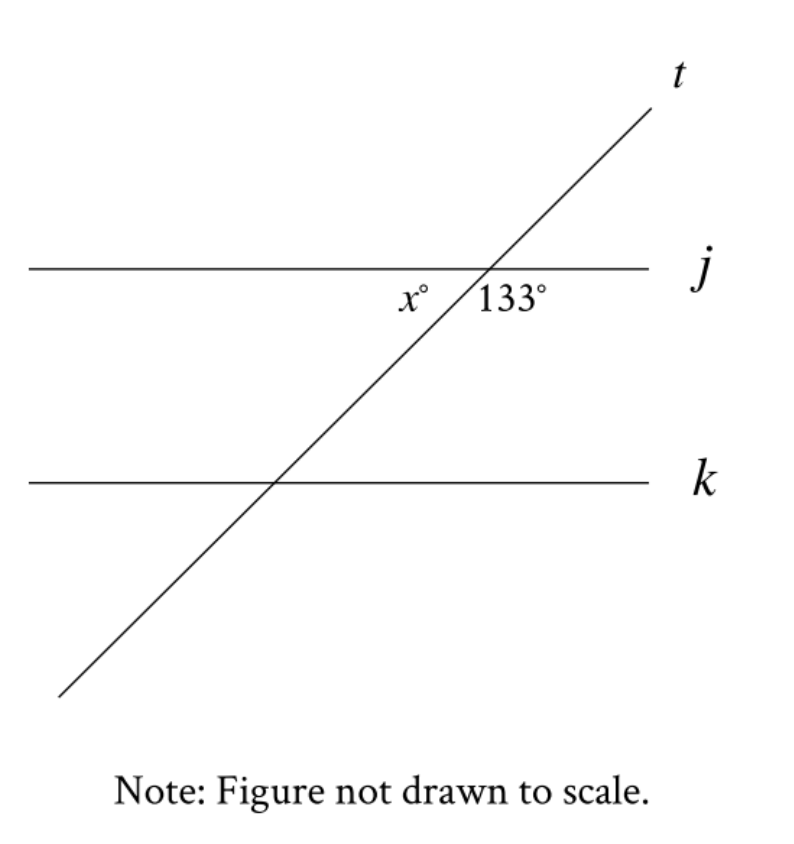
In the figure, line j is parallel to line k, What is the value of x?
1. INFER the angle relationship
Looking at the figure, notice where angles \(\mathrm{x°}\) and \(\mathrm{133°}\) are located:
- Both angles are at the intersection of line t with line j
- They are adjacent to each other
- Together, they form a straight angle along line j
Key insight: These angles form a linear pair, which means they are supplementary.
2. TRANSLATE the supplementary relationship into an equation
Since the angles are supplementary, their measures must sum to \(\mathrm{180°}\):
- \(\mathrm{x + 133 = 180}\)
3. SIMPLIFY to solve for x
Subtract 133 from both sides:
- \(\mathrm{x = 180 - 133}\)
- \(\mathrm{x = 47}\)
Answer: 47
Why Students Usually Falter on This Problem
Most Common Error Path:
Weak INFER skill: Students may attempt to use properties of parallel lines cut by a transversal (like corresponding angles, alternate interior angles, etc.) because the problem mentions that j is parallel to k. They might look for angle relationships between the two parallel lines rather than recognizing the simpler relationship right at the intersection point.
This overthinking can lead to confusion about which angle property to apply, causing them to get stuck and guess, or to set up incorrect angle equations.
Second Most Common Error:
Conceptual confusion: Students may not recognize that \(\mathrm{x°}\) and \(\mathrm{133°}\) form a linear pair. If they don't visualize that these angles are adjacent on a straight line, they won't know how to proceed. Without recognizing the supplementary relationship, they cannot set up the correct equation.
This leads to confusion and guessing, as they have no systematic approach to find x.
The Bottom Line:
The key challenge is filtering out the extraneous information (parallel lines) and focusing on the simple geometric fact right in front of you: two adjacent angles on a straight line must be supplementary. Sometimes the simplest relationship is the right one.