
In the figure, two lines intersect to form angles. If angle w measures 136°, what is the measure of angle...
GMAT Geometry & Trigonometry : (Geo_Trig) Questions
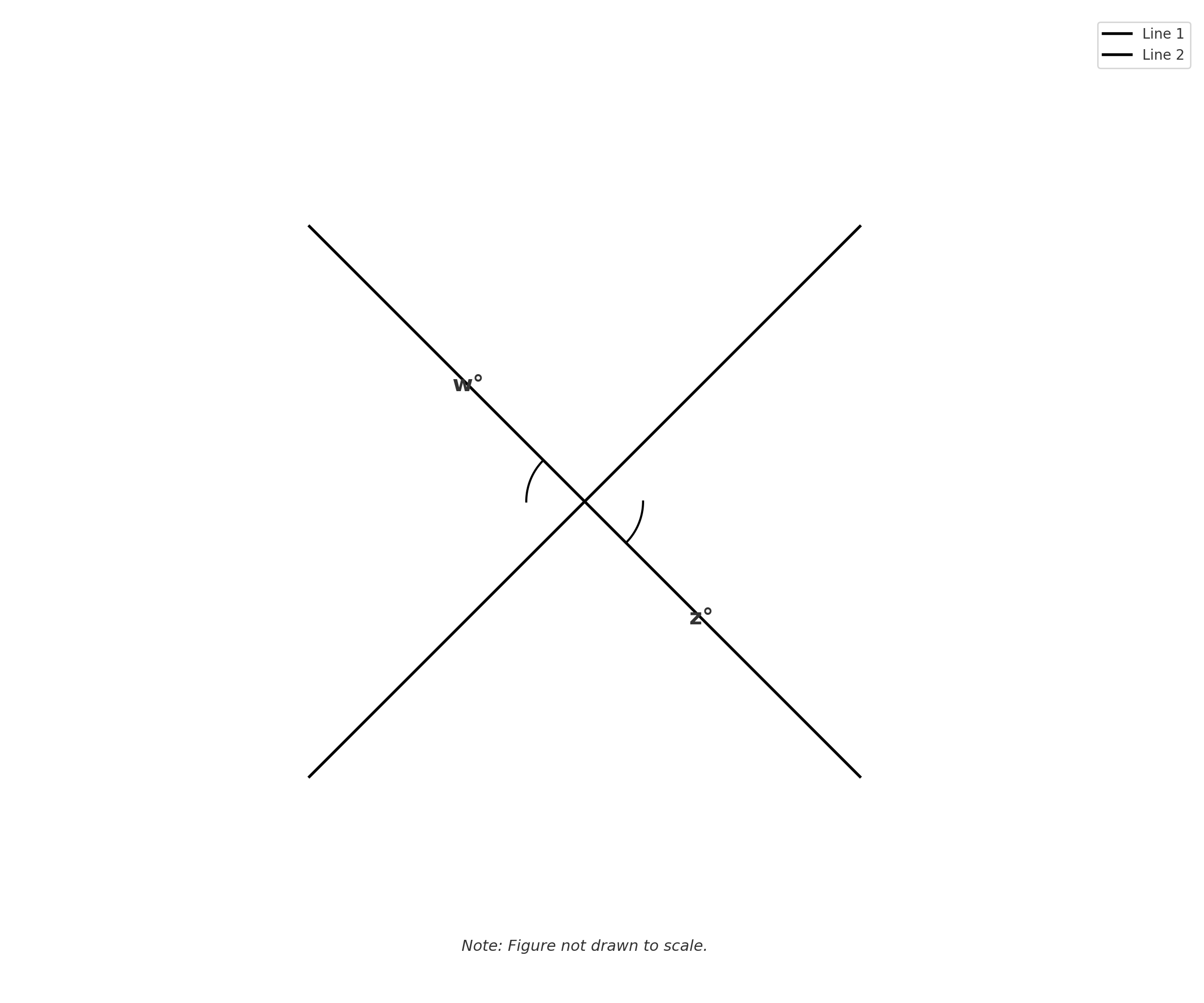
In the figure, two lines intersect to form angles. If angle \(\mathrm{w}\) measures \(\mathrm{136°}\), what is the measure of angle \(\mathrm{z}\)?
\(\mathrm{36°}\)
\(\mathrm{44°}\)
\(\mathrm{68°}\)
\(\mathrm{136°}\)
1. VISUALIZE the angle positions in the diagram
- Given information:
- Two lines intersect
- Angle \(\mathrm{w = 136°}\)
- Angle z is marked at a different position
- What we need to find: The measure of angle z
Key observation: Look at where angles w and z are located. Are they next to each other, or are they across from each other at the intersection?
2. INFER the geometric relationship
From the diagram, angles w and z are positioned opposite each other at the intersection point. This makes them vertical angles.
- Critical insight: Vertical angles are the pairs of opposite angles formed when two lines cross. They're called "vertical" not because they're up-and-down, but because they share the same vertex (intersection point) and are opposite each other.
3. INFER the angle measures using the vertical angles theorem
The vertical angles theorem states that vertical angles are always congruent (equal in measure).
Since w and z are vertical angles:
- \(\mathrm{z = w}\)
- \(\mathrm{z = 136°}\)
Answer: D (136°)
Why Students Usually Falter on This Problem
Most Common Error Path:
Weak INFER skill: Confusing vertical angles with adjacent angles
Students often mix up different angle relationships at intersections. They might see that w and z are at the same intersection and incorrectly assume they must be adjacent angles (angles that share a side). Adjacent angles at a line intersection are supplementary—they add up to 180°.
Using this incorrect reasoning:
- \(\mathrm{w + z = 180°}\)
- \(\mathrm{136° + z = 180°}\)
- \(\mathrm{z = 44°}\)
This may lead them to select Choice B (44°).
Second Most Common Error:
Inadequate VISUALIZE execution: Misidentifying which angles are marked
Students may not carefully trace which angles in the diagram are labeled w and z. If they assume w and z are adjacent angles instead of opposite angles, they'll apply the wrong relationship. Even with correct knowledge of both vertical angles (equal) and adjacent angles (supplementary), misidentifying the actual positions leads to using the supplementary relationship.
This also may lead them to select Choice B (44°).
The Bottom Line:
This problem tests whether students can correctly identify spatial relationships from a diagram and match them to the appropriate geometric theorem. The key is recognizing that "opposite angles" means vertical angles, which are always equal—no calculation needed beyond that recognition.
\(\mathrm{36°}\)
\(\mathrm{44°}\)
\(\mathrm{68°}\)
\(\mathrm{136°}\)