
In the figure, triangles JKL and MNO are shown.The side lengths satisfy JK/MN = KL/NO = 4, and angle angleJKL...
GMAT Geometry & Trigonometry : (Geo_Trig) Questions
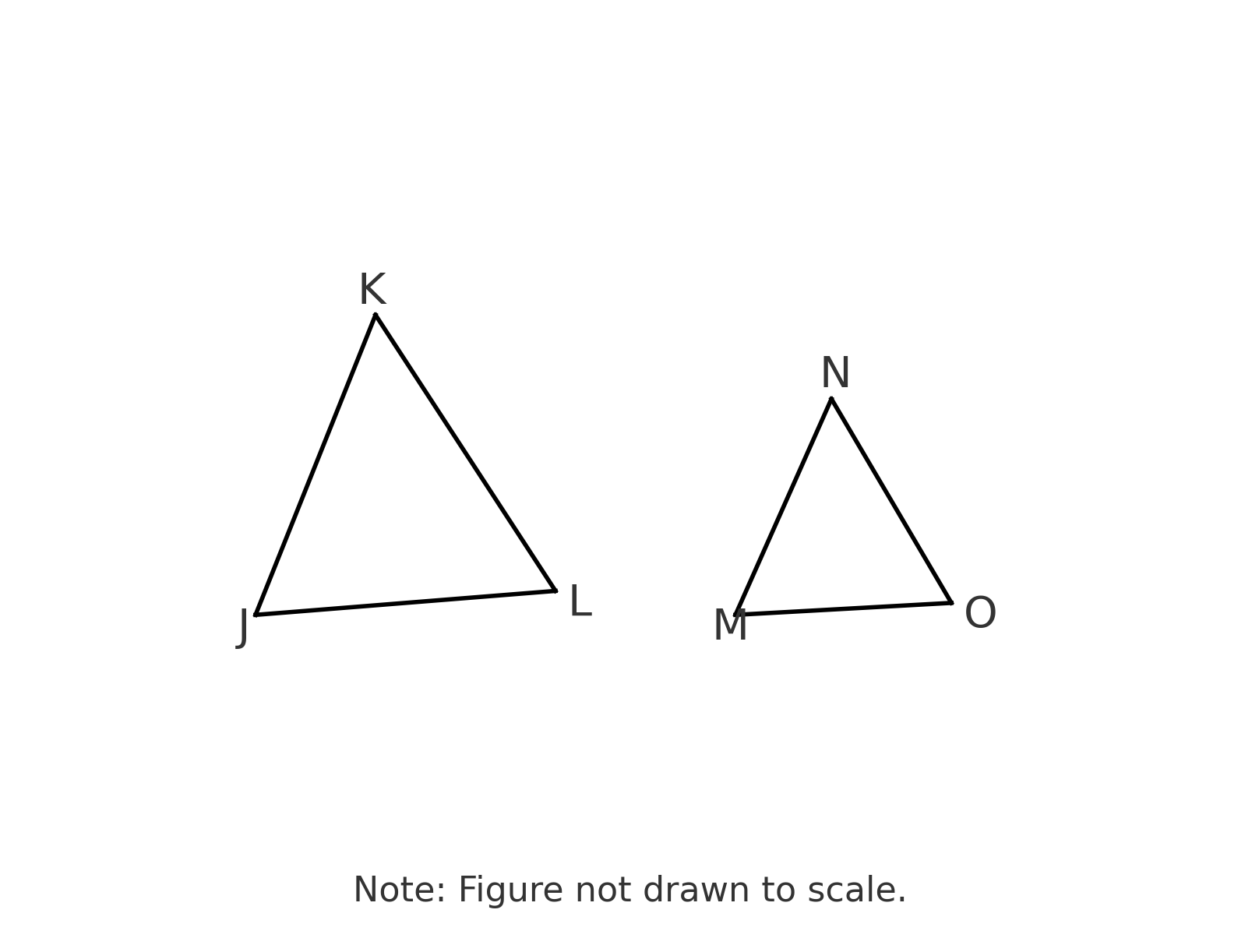
- In the figure, triangles JKL and MNO are shown.
- The side lengths satisfy \(\frac{\mathrm{JK}}{\mathrm{MN}} = \frac{\mathrm{KL}}{\mathrm{NO}} = 4\), and angle \(\angle\mathrm{JKL}\) is congruent to angle \(\angle\mathrm{MNO}\).
- If the measure of angle \(\angle\mathrm{JLK}\) is \(58\), what is the measure, in degrees, of angle \(\angle\mathrm{MON}\)? (Disregard the degree symbol when gridding your answer.)
1. TRANSLATE the problem information
Given:
- Two triangles: JKL and MNO
- Side ratios: \(\mathrm{JK/MN = 4}\) and \(\mathrm{KL/NO = 4}\)
- Angle relationship: \(\angle\mathrm{JKL} \cong \angle\mathrm{MNO}\) (the angles at vertices K and N)
- Measure: \(\angle\mathrm{JLK} = 58°\) (the angle at vertex L)
Find: The measure of \(\angle\mathrm{MON}\) (the angle at vertex O)
2. INFER which similarity criterion applies
Looking at what we have:
- Two pairs of sides with the same ratio (both equal 4)
- A pair of congruent angles
The key question: Is this angle between the two sides?
- In triangle JKL: The angle \(\angle\mathrm{JKL}\) is at vertex K, which is between sides JK and KL ✓
- In triangle MNO: The angle \(\angle\mathrm{MNO}\) is at vertex N, which is between sides MN and NO ✓
This is the SAS similarity criterion: two proportional sides with the included angle congruent.
Therefore: \(\triangle\mathrm{JKL} \sim \triangle\mathrm{MNO}\) (the triangles are similar)
3. INFER the vertex correspondence
From the side ratios given:
- \(\mathrm{JK/MN = 4}\) tells us that side JK in the first triangle corresponds to side MN in the second
- This means: \(\mathrm{J \leftrightarrow M}\) and \(\mathrm{K \leftrightarrow N}\)
- \(\mathrm{KL/NO = 4}\) tells us that side KL in the first triangle corresponds to side NO in the second
- This means: \(\mathrm{K \leftrightarrow N}\) and \(\mathrm{L \leftrightarrow O}\)
Vertex correspondence: \(\mathrm{J \leftrightarrow M}\), \(\mathrm{K \leftrightarrow N}\), \(\mathrm{L \leftrightarrow O}\)
4. INFER which angles correspond
In similar triangles, angles at corresponding vertices are equal.
Since \(\mathrm{L \leftrightarrow O}\) (from our vertex correspondence):
- The angle at vertex L in triangle JKL is \(\angle\mathrm{JLK}\)
- The angle at vertex O in triangle MNO is \(\angle\mathrm{MON}\)
- These angles correspond to each other
5. Apply the corresponding angles property
Because corresponding angles in similar triangles are congruent:
- \(\angle\mathrm{MON} = \angle\mathrm{JLK} = 58°\)
Answer: 58
Why Students Usually Falter on This Problem
Most Common Error Path:
Weak INFER skill: Not recognizing that the given information satisfies the SAS similarity criterion, or not understanding what 'included angle' means.
Students might see the ratios and the congruent angle but fail to connect these to triangle similarity. They might think they need more information (like all three sides or all three angles) to establish any relationship between the triangles. This leads to confusion and guessing among angle measures.
Second Most Common Error:
Weak INFER skill: Incorrectly determining vertex correspondence or misreading angle notation.
Students might establish that the triangles are similar but then confuse which vertices correspond. For example, they might incorrectly assume that because the angle at K is given, they need to find the angle at K in the second triangle, not recognizing that K corresponds to N, not to another angle. Or they might misread \(\angle\mathrm{MON}\) as \(\angle\mathrm{MNO}\), confusing which angle at which vertex is being asked for. This leads to selecting an incorrect angle measure or abandoning the problem.
The Bottom Line:
This problem requires strong spatial reasoning about triangle correspondence. The challenge isn't in the calculation—there is none—but in the logical chain: recognizing SAS similarity → establishing vertex correspondence → identifying corresponding angles. Students who rush or who have weak geometric reasoning skills often break down at one of these inference steps.