
In the figure, two lines intersect at point P, creating four angles labeled A, B, C, and D in clockwise...
GMAT Geometry & Trigonometry : (Geo_Trig) Questions
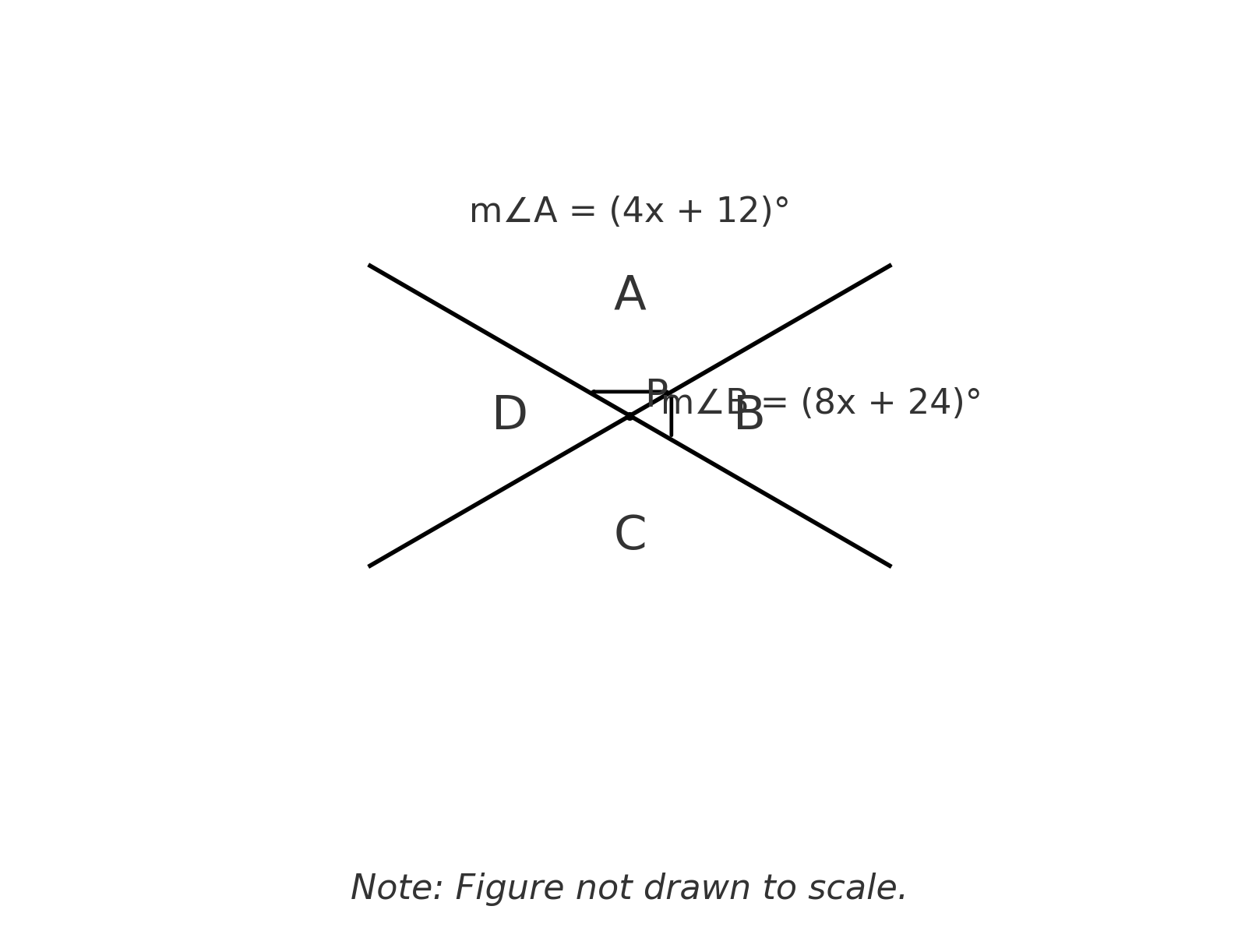
- In the figure, two lines intersect at point P, creating four angles labeled A, B, C, and D in clockwise order starting from the upper-left region.
- Angles A and C are vertical angles.
- The measure of angle A is \((4\mathrm{x} + 12)°\), and the measure of angle B is \((8\mathrm{x} + 24)°\).
- What is the measure of angle C?
1. TRANSLATE the problem information
- Given information:
- Two lines intersect at point P
- Four angles created: A, B, C, D (clockwise from upper-left)
- \(\mathrm{m∠A = (4x + 12)°}\)
- \(\mathrm{m∠B = (8x + 24)°}\)
- Angles A and C are vertical angles
- Find: The measure of angle C
2. INFER the relationship between angles A and B
Look at the diagram carefully. Angles A and B are next to each other, and together they form a straight line along the top. This means they form a linear pair.
- Key insight: Linear pairs are supplementary, so:
- \(\mathrm{m∠A + m∠B = 180°}\)
This gives us an equation we can solve!
3. TRANSLATE the angle relationship into an algebraic equation
Substitute the given expressions:
- \(\mathrm{(4x + 12) + (8x + 24) = 180}\)
4. SIMPLIFY to solve for x
Combine like terms:
- \(\mathrm{4x + 8x + 12 + 24 = 180}\)
- \(\mathrm{12x + 36 = 180}\)
Subtract 36 from both sides:
- \(\mathrm{12x = 144}\)
Divide by 12:
- \(\mathrm{x = 12}\)
5. Calculate m∠A
Substitute \(\mathrm{x = 12}\) into the expression for angle A:
- \(\mathrm{m∠A = 4(12) + 12}\)
- \(\mathrm{m∠A = 48 + 12}\)
- \(\mathrm{m∠A = 60°}\)
6. INFER the relationship to find angle C
Wait—the question asks for angle C, not angle A!
Look at the diagram again. Angles A and C are vertical angles (opposite each other when two lines intersect). Vertical angles are always congruent, so:
- \(\mathrm{m∠C = m∠A = 60°}\)
Answer: A. 60°
Why Students Usually Falter on This Problem
Most Common Error Path:
Weak INFER skill: Students may not recognize that angles A and B form a linear pair. Instead, they might assume angles A and C (the vertical angles) should be set equal to each other immediately without finding x first. However, this doesn't work because both expressions contain x, and setting them equal would give:
- \(\mathrm{4x + 12 = 8x + 24}\) (this is incorrect reasoning)
This leads to confusion and they may randomly guess among the choices.
Second Most Common Error:
Incomplete solution: Students correctly solve for \(\mathrm{x = 12}\) and calculate \(\mathrm{m∠A = 60°}\), but then forget that the question asks for angle C, not angle A. They might incorrectly assume the problem is complete and select Choice A (60°) for the wrong reason—getting the right answer by luck rather than understanding. More problematically, some students might think angle C is different from angle A and look for another value among the choices, potentially selecting Choice C (120°) thinking it's supplementary to angle A.
Third Common Error:
Conceptual confusion: Students might confuse which angles are vertical angles versus which form linear pairs. For example, they might incorrectly think angles A and B are vertical angles and set \(\mathrm{(4x + 12) = (8x + 24)}\), leading to:
- \(\mathrm{4x + 12 = 8x + 24}\)
- \(\mathrm{-4x = 12}\)
- \(\mathrm{x = -3}\)
Substituting back: \(\mathrm{m∠A = 4(-3) + 12 = 0°}\), which makes no sense geometrically. This causes them to get stuck and guess.
The Bottom Line:
This problem requires students to distinguish between two different angle relationships: linear pairs (supplementary) and vertical angles (congruent). Success depends on correctly identifying which relationship to use first (linear pair to find x) and then applying the second relationship (vertical angles) to answer the actual question.