
In the figure, line m is parallel to line n. What is the value of y?
GMAT Geometry & Trigonometry : (Geo_Trig) Questions
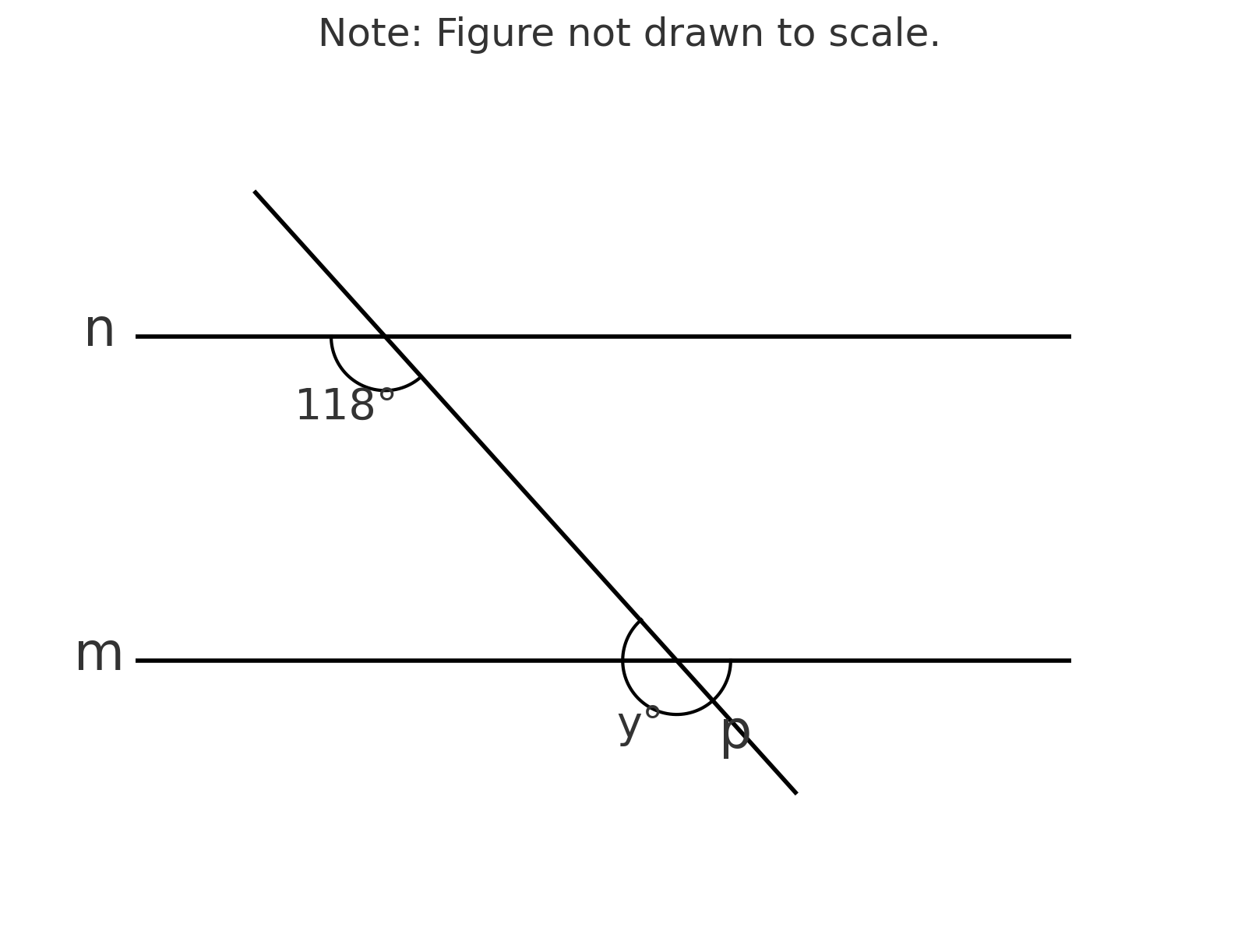
In the figure, line m is parallel to line n. What is the value of y?
1. TRANSLATE the diagram into mathematical information
Looking at the figure, identify what we have:
- Given information:
- Line m and line n are parallel to each other
- A transversal line crosses both parallel lines
- Where the transversal crosses line n: there's an angle of \(118°\)
- Where the transversal crosses line m: there's an angle labeled \(y°\)
- What we need to find: The value of y
2. INFER the angle relationship
This is the critical step. We need to figure out what kind of angle pair \(118°\) and \(y°\) form.
- Examine the positions:
- The \(118°\) angle is on the LEFT side of the transversal at line n
- The \(y°\) angle is on the RIGHT side of the transversal at line m
- Both angles are BETWEEN the two parallel lines (in the interior region)
- The angles are on OPPOSITE sides of the transversal
- Key recognition: When angles are:
- Between the parallel lines (interior), AND
- On opposite sides of the transversal (alternate)
They are called alternate interior angles
3. INFER which theorem applies
Now that we've identified these as alternate interior angles, we need to recall what happens to alternate interior angles when parallel lines are cut by a transversal.
- The Alternate Interior Angles Theorem states: When two parallel lines are cut by a transversal, alternate interior angles are congruent (equal).
- This means: \(y° = 118°\)
4. Conclude
Since alternate interior angles are equal when formed by parallel lines and a transversal:
y = 118
Answer: 118
Why Students Usually Falter on This Problem
Most Common Error Path:
INFER - Misidentifying the angle relationship: Students sometimes confuse alternate interior angles with other angle pairs formed by parallel lines and transversals.
Common confusion #1: Thinking these are co-interior angles (same-side interior angles)
- Co-interior angles are also between the parallel lines BUT on the same side of the transversal
- Co-interior angles are supplementary (sum to 180°), not equal
- If a student incorrectly identifies these as co-interior angles, they would set up: \(y + 118 = 180\), leading to \(y = 62\)
This confusion would cause them to guess or arrive at an incorrect answer.
Common confusion #2: Not recognizing any specific relationship
- Some students see two angles in the diagram but don't connect them through angle relationship theorems
- Without recognizing the alternate interior angle relationship, they have no method to solve for y
- This leads to random guessing
Second Most Common Error:
TRANSLATE - Misreading which angles are marked: Students might incorrectly identify which angle is \(118°\) or which angle is \(y°\) in the diagram, especially if they don't carefully trace the angle arcs shown.
If they confuse the positions, they might think the angles are corresponding angles (which would still give \(y = 118\) by luck) or they might set up a completely incorrect relationship.
The Bottom Line:
This problem tests whether students can visually identify angle pairs formed by parallel lines and a transversal, then apply the correct theorem. The key challenge is the INFER skill of recognizing alternate interior angles from their positions - on opposite sides of the transversal and between the parallel lines. Without this recognition, students cannot access the theorem needed to solve the problem.