
A system of equations consists of a quadratic equation and a linear equation. The equations in this system are graphed...
GMAT Advanced Math : (Adv_Math) Questions
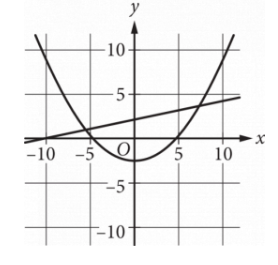
A system of equations consists of a quadratic equation and a linear equation. The equations in this system are graphed in the xy-plane above. How many solutions does this system have?
1. TRANSLATE the problem information
- Given information:
- A system consists of one quadratic equation and one linear equation
- Both equations are graphed in the xy-plane
- Need to find: How many solutions does this system have?
2. INFER what "solutions" means graphically
- Key concept: Solutions to a system of equations are the points \(\mathrm{(x, y)}\) that satisfy BOTH equations simultaneously
- On a graph: These solution points appear where the two curves intersect
- Strategy: Count the intersection points
3. VISUALIZE the graphs to identify the curves
- Looking at the graph, I can identify:
- A parabola (U-shaped curve) opening upward with vertex near \(\mathrm{(0, -2)}\)
- A straight line slanting upward from left to right
- Both curves are clearly visible on the coordinate plane
4. VISUALIZE the intersection points carefully
- Scan the graph systematically to find where the line crosses the parabola
- First intersection: On the left side, around \(\mathrm{x} = -6\), the line crosses the parabola
- Second intersection: On the right side, around \(\mathrm{x} = 5\), the line crosses the parabola again
- Check: Are there any other intersections? No - the line only touches the parabola at these two points
5. INFER the final answer
- Number of intersection points = 2
- Therefore, the system has 2 solutions
Answer: C. 2
Why Students Usually Falter on This Problem
Most Common Error Path:
Weak VISUALIZE skill: Hasty graph reading that miscounts intersection points
Students might rush through reading the graph and:
- Count only one intersection point (perhaps focusing only on the more obvious one on the right)
- Overlook that the line crosses the parabola twice because one intersection might be less prominent
This may lead them to select Choice B (1).
Second Most Common Error:
Conceptual confusion about intersection: Not understanding what "intersection" means in this context
Some students might:
- Count places where the curves are "close" but not actually touching
- Get confused by the grid lines and think there are multiple solution points
- Misunderstand that they need intersection points, not just points on either curve
This leads to confusion and may cause them to select Choice D (3) or guess randomly.
The Bottom Line:
This problem requires careful visual analysis. The key is to slow down and systematically scan the entire graph to count exactly where the two curves cross each other. Remember: each intersection point is one solution, and a line can intersect a parabola at most 2 times (never 3 or more).