
The line segment shown in the xy-plane represents one of the legs of a right triangle. The area of this...
GMAT Geometry & Trigonometry : (Geo_Trig) Questions
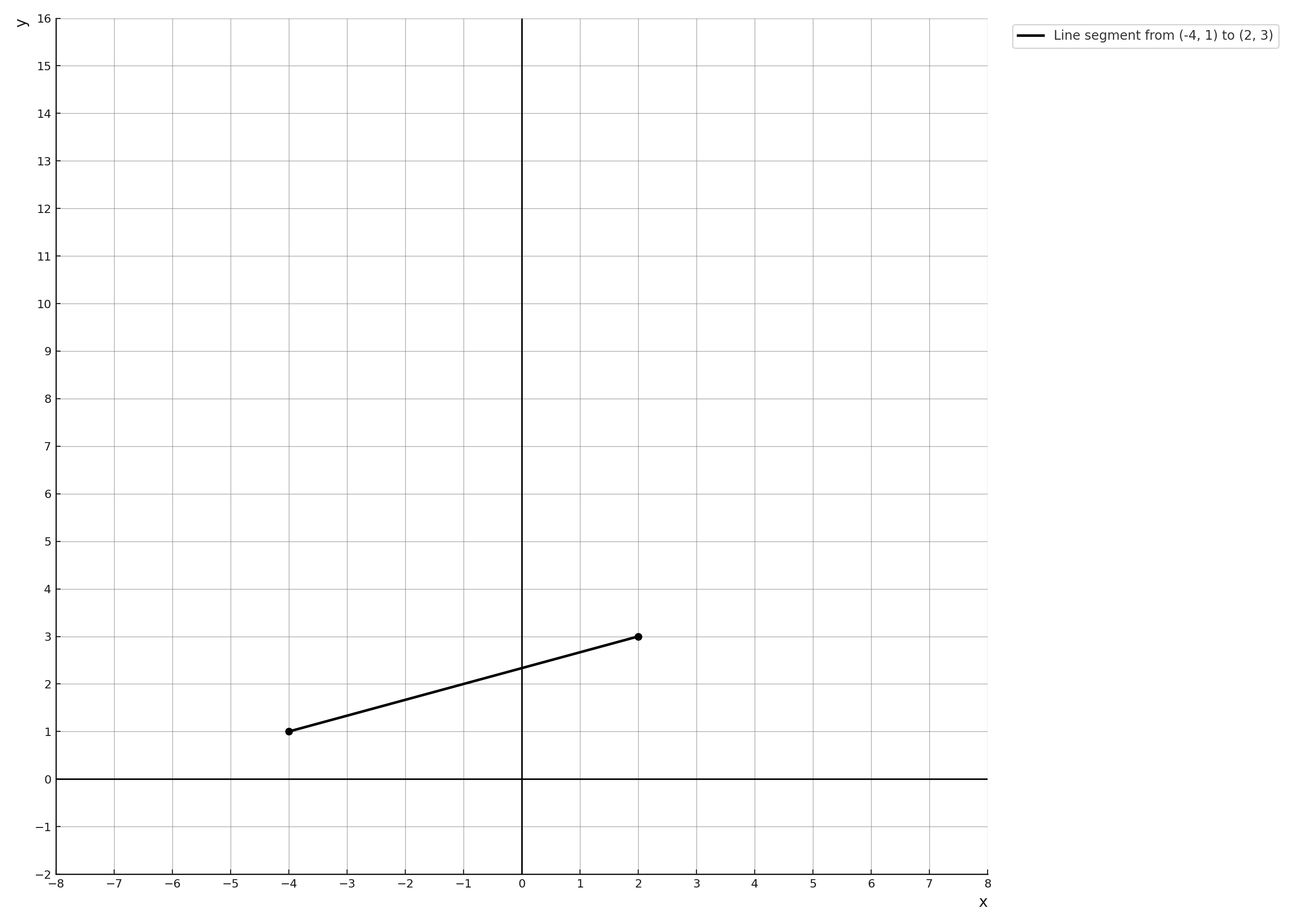
The line segment shown in the xy-plane represents one of the legs of a right triangle. The area of this triangle is \(20\sqrt{10}\) square units. What is the length, in units, of the other leg of this triangle?
1. TRANSLATE the visual information from the graph
- TRANSLATE the coordinates by examining where the line segment endpoints fall on the grid:
- First endpoint: (-4, 1)
- Second endpoint: (2, 3)
- What we need to find: The length of this line segment, which represents one leg of the right triangle.
2. Calculate the length of the shown leg
- Apply the distance formula:
\(\mathrm{d} = \sqrt{(\mathrm{x}_2 - \mathrm{x}_1)^2 + (\mathrm{y}_2 - \mathrm{y}_1)^2}\)
- Substitute the coordinates:
\(\mathrm{d} = \sqrt{(2 - (-4))^2 + (3 - 1)^2}\)
\(\mathrm{d} = \sqrt{(6)^2 + (2)^2}\)
\(\mathrm{d} = \sqrt{36 + 4}\)
\(\mathrm{d} = \sqrt{40}\)
3. SIMPLIFY the radical expression
- Factor out the perfect square:
\(\sqrt{40} = \sqrt{4 \times 10} = \sqrt{4} \times \sqrt{10} = 2\sqrt{10}\) - So the length of the shown leg is \(2\sqrt{10}\) units.
4. TRANSLATE the given area into an equation
- Given information: Area of the triangle = \(20\sqrt{10}\) square units
- Known formula: \(\mathrm{Area} = \frac{1}{2} \times \mathrm{leg}_1 \times \mathrm{leg}_2\)
- TRANSLATE this into an equation:
\(20\sqrt{10} = \frac{1}{2} \times 2\sqrt{10} \times \mathrm{leg}_2\)
5. SIMPLIFY to solve for the unknown leg
- First, simplify the right side:
\(20\sqrt{10} = \frac{1}{2} \times 2\sqrt{10} \times \mathrm{leg}_2\)
\(20\sqrt{10} = \sqrt{10} \times \mathrm{leg}_2\) - Now divide both sides by \(\sqrt{10}\):
\(\mathrm{leg}_2 = \frac{20\sqrt{10}}{\sqrt{10}}\) - Since \(\frac{\sqrt{10}}{\sqrt{10}} = 1\):
\(\mathrm{leg}_2 = 20\)
Answer: 20
Why Students Usually Falter on This Problem
Most Common Error Path:
Weak TRANSLATE skill: Misreading coordinates from the graph
Students may rush through reading the graph and extract incorrect coordinates, such as:
- Reading (-4, 1) as (-3, 1) or (-4, 2)
- Confusing which coordinate is x and which is y
- Reading (2, 3) as (3, 2)
If a student reads the points as (-3, 1) and (2, 3), they would calculate:
\(\sqrt{(2-(-3))^2 + (3-1)^2} = \sqrt{25 + 4} = \sqrt{29}\)
Then using \(20\sqrt{10} = \frac{1}{2} \times \sqrt{29} \times \mathrm{leg}_2\), they would get:
\(\mathrm{leg}_2 = \frac{40\sqrt{10}}{\sqrt{29}} \approx 43.5\) (using calculator)
This leads to confusion because the answer doesn't match any clean value, causing them to abandon the systematic solution and guess.
Second Most Common Error:
Poor SIMPLIFY execution: Errors when working with radicals
Students may correctly find that the shown leg is \(2\sqrt{10}\), but then make algebraic mistakes:
- Forgetting to simplify \(\frac{1}{2} \times 2\sqrt{10}\) to just \(\sqrt{10}\)
- Incorrectly dividing \(20\sqrt{10}\) by \(\sqrt{10}\), perhaps getting 20 instead of properly canceling
- Not recognizing that \(\frac{\sqrt{10}}{\sqrt{10}} = 1\)
One specific error: treating the equation as \(20\sqrt{10} = \frac{1}{2} \times 2\sqrt{10} \times \mathrm{leg}_2\) and incorrectly multiplying through to get \(20\sqrt{10} = \sqrt{10} \times \mathrm{leg}_2\), then dividing incorrectly to get \(\mathrm{leg}_2 = 20\sqrt{10}\) (forgetting to divide by \(\sqrt{10}\)).
This leads to confusion about whether the answer should include a radical or not, causing them to guess or select an incorrect value.
The Bottom Line:
This problem tests the coordination of multiple skills: accurately reading visual information from a graph, applying the distance formula, simplifying radicals, and setting up and solving equations with radical expressions. Students who struggle with any single step—particularly reading coordinates or manipulating radicals—will arrive at incorrect answers or become stuck.