
The graph of the linear function \(\mathrm{y = -2f(x)}\) is shown. If a and b are positive constants, which equation...
GMAT Algebra : (Alg) Questions
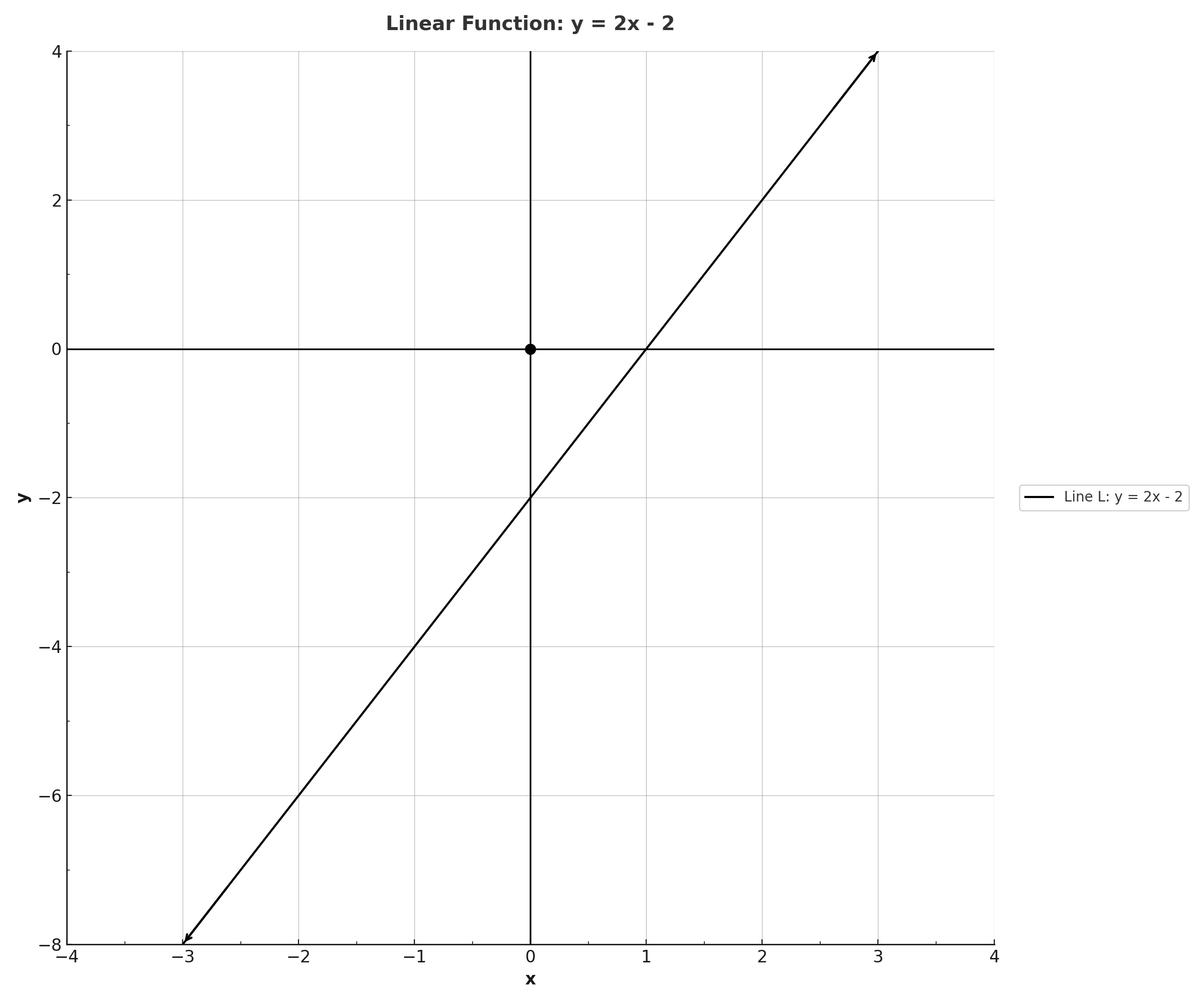
The graph of the linear function \(\mathrm{y = -2f(x)}\) is shown. If a and b are positive constants, which equation could define \(\mathrm{f}\)?
1. TRANSLATE the graph into an equation
The first step is reading the graph carefully. Notice two things:
- The graph shows a straight line
- The title says the graph represents \(\mathrm{y = -2f(x)}\) (not \(\mathrm{f(x)}\) itself!)
Identify clear points on the line:
- At \(\mathrm{x = 0}\), the line crosses at \(\mathrm{y = -2}\) → Point \(\mathrm{(0, -2)}\)
- At \(\mathrm{x = 1}\), the line crosses at \(\mathrm{y = 0}\) → Point \(\mathrm{(1, 0)}\)
- At \(\mathrm{x = 3}\), the line is at \(\mathrm{y = 4}\) → Point \(\mathrm{(3, 4)}\)
2. SIMPLIFY to find the equation of the graphed line
Calculate the slope using any two points:
- Slope = \(\frac{0 - (-2)}{1 - 0} = \frac{2}{1} = 2\)
Identify the y-intercept from the graph:
- The line crosses the y-axis at -2
Write the equation in slope-intercept form:
- \(\mathrm{y = 2x - 2}\)
This is the equation of the line shown in the graph.
3. INFER the relationship between the graph and f(x)
Here's the crucial insight: The problem tells us the graph shows \(\mathrm{y = -2f(x)}\), not \(\mathrm{f(x)}\).
So we have:
\(\mathrm{-2f(x) = 2x - 2}\)
We need to find what \(\mathrm{f(x)}\) equals.
4. SIMPLIFY to solve for f(x)
Starting with: \(\mathrm{-2f(x) = 2x - 2}\)
Divide both sides by -2:
\(\mathrm{f(x) = \frac{2x - 2}{-2}}\)
Simplify the right side:
\(\mathrm{f(x) = \frac{2x}{-2} - \frac{2}{-2}}\)
\(\mathrm{f(x) = -x + 1}\)
5. INFER which answer choice matches this form
Now compare \(\mathrm{f(x) = -x + 1}\) with the answer choices, remembering that a and b are positive constants:
- (A) \(\mathrm{f(x) = -ax - b}\): If a and b are positive, this gives \(\mathrm{-x - (positive\ number) = -x - b}\). Our function has +1, not -1. ✗
- (B) \(\mathrm{f(x) = ax - b}\): If a and b are positive, this gives \(\mathrm{+x - (positive\ number)}\). Our function starts with -x, not +x. ✗
- (C) \(\mathrm{f(x) = -ax + b}\): If a and b are positive, this gives \(\mathrm{-x + (positive\ number)}\). With \(\mathrm{a = 1}\) and \(\mathrm{b = 1}\): \(\mathrm{f(x) = -1 \cdot x + 1 = -x + 1}\) ✓
- (D) \(\mathrm{f(x) = ax + b}\): If a and b are positive, this gives \(\mathrm{+x + (positive\ number)}\). Our function has -x and this has +x. ✗
Answer: C
Why Students Usually Falter on This Problem
Most Common Error Path:
Weak TRANSLATE skill: Students misread what the graph represents and think it shows \(\mathrm{f(x)}\) directly, rather than \(\mathrm{y = -2f(x)}\).
If they believe the graph shows \(\mathrm{f(x)}\), they would conclude:
\(\mathrm{f(x) = 2x - 2}\)
Then looking at the answer choices with positive a and b:
- This would match \(\mathrm{f(x) = ax - b}\) with \(\mathrm{a = 2, b = 2}\)
This leads them to select Choice B (\(\mathrm{f(x) = ax - b}\)).
Second Most Common Error:
Poor INFER reasoning about signs: Students correctly find \(\mathrm{f(x) = -x + 1}\) but then get confused about which answer form this matches.
The confusion often centers on: "Does \(\mathrm{-x + 1}\) match \(\mathrm{-ax + b}\) or \(\mathrm{-ax - b}\)?"
They might think:
- "Well, \(\mathrm{-x + 1}\) could be written as \(\mathrm{-x - (-1)}\), so maybe it's \(\mathrm{-ax - b}\) with \(\mathrm{b = -1}\)"
- But the problem states b is a POSITIVE constant, so b cannot be -1
This confusion might cause them to guess between choices (A) and (C), potentially selecting Choice A (\(\mathrm{-ax - b}\)).
The Bottom Line:
This problem requires careful attention to what the graph actually represents (a transformation of f, not f itself) and precise algebraic manipulation to work backward from \(\mathrm{-2f(x)}\) to \(\mathrm{f(x)}\). The answer choice matching requires understanding how signs work with the constraint that a and b are positive.