
The graph of the function f is shown, where \(\mathrm{y=f(x)}\). What is the y-intercept of the graph?
GMAT Algebra : (Alg) Questions
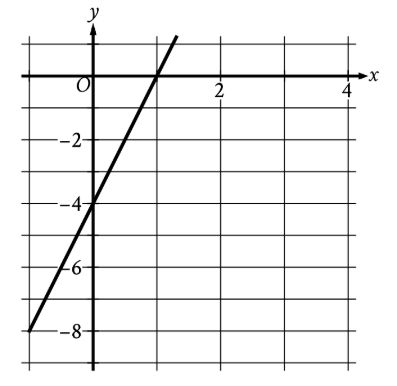
The graph of the function f is shown, where \(\mathrm{y=f(x)}\). What is the y-intercept of the graph?
1. INFER what the question is asking
The question asks for the y-intercept of the function's graph. The key insight is:
- The y-intercept is the point where the graph crosses the y-axis
- This always occurs where \(\mathrm{x = 0}\)
- We need to find the coordinate point in the form \(\mathrm{(0, y)}\)
2. TRANSLATE the visual information from the graph
Look at the graph and locate where the line intersects the y-axis:
- The y-axis is the vertical line in the middle of the graph (where \(\mathrm{x = 0}\))
- Follow the graphed line to see where it crosses this vertical axis
- Reading from the graph, the line crosses the y-axis at \(\mathrm{y = -4}\)
- This gives us the point \(\mathrm{(0, -4)}\)
Answer: B. \(\mathrm{(0, -4)}\)
Why Students Usually Falter on This Problem
Most Common Error Path:
Weak TRANSLATE skill: Students misread the graph by confusing positive and negative values or reading the wrong gridline.
The most common mistake is reading the y-coordinate incorrectly. Some students might:
- Look at the wrong intersection point (perhaps where the line appears to cross near \(\mathrm{y = -1}\))
- Confuse the sign and think the y-intercept is positive instead of negative
- Miscount the gridlines
This may lead them to select Choice A (\(\mathrm{(0, -1)}\)) or Choice C (\(\mathrm{(0, 1)}\)) or Choice D (\(\mathrm{(0, 4)}\)).
Second Most Common Error:
Conceptual confusion about y-intercept: Students confuse y-intercept with x-intercept or misunderstand what "intercept" means.
Some students might look for where the graph crosses the x-axis instead of the y-axis, or they might not understand that an intercept is a point (with both coordinates), not just a single value. This confusion can lead to looking at the wrong location on the graph entirely.
This causes them to get stuck and guess.
The Bottom Line:
This problem tests whether you truly understand what a y-intercept is (the point where \(\mathrm{x = 0}\)) and whether you can accurately read coordinates from a graph. The key is to carefully identify the y-axis and read the y-value where the line crosses it, paying close attention to whether the value is positive or negative.