
What is the y-intercept of the line graphed?
GMAT Algebra : (Alg) Questions
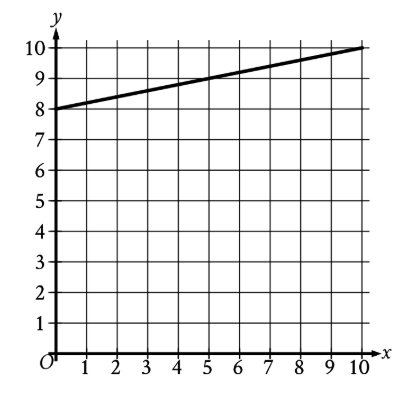
What is the y-intercept of the line graphed?
1. INFER what the question is asking
The question asks for the y-intercept of the line. The y-intercept is the point where the line crosses the y-axis. This happens when \(\mathrm{x = 0}\).
- Key understanding: We need to find where the line meets the y-axis
2. VISUALIZE and locate the y-intercept on the graph
Look at the y-axis (the vertical axis on the left side of the graph). Find where the graphed line intersects this axis.
- Observation: The line crosses the y-axis at a point above the origin
3. TRANSLATE the graph reading into coordinates
Read the y-coordinate value where the line crosses the y-axis:
- The x-coordinate is 0 (because it's on the y-axis)
- The y-coordinate is 8 (reading from the scale on the y-axis)
- Express this as an ordered pair: \(\mathrm{(0, 8)}\)
Answer: D. \(\mathrm{(0, 8)}\)
Why Students Usually Falter on This Problem
Most Common Error Path:
Conceptual Confusion: Confusing y-intercept with slope
Some students might try to calculate the slope of the line instead of identifying where it crosses the y-axis. Looking at the graph, the line rises slowly, and a student might calculate a small slope value (approximately \(\mathrm{1/3}\) or similar). If they then mistakenly think this represents the y-intercept and add a negative sign due to confusion, they might select Choice B. \(\mathrm{(0, -1/3)}\).
Second Most Common Error:
Weak TRANSLATE skill: Misreading the starting point of the line
Students might look at where the line appears to "start" on the left side of the visible graph and assume the line must pass through the origin, especially if they're not carefully reading where it actually crosses the y-axis. This could lead them to select Choice C. \(\mathrm{(0, 0)}\).
The Bottom Line:
This problem tests whether students can apply the definition of y-intercept to a visual representation. The key is understanding that the y-intercept is specifically where x = 0 (on the y-axis), then carefully reading that coordinate value from the graph. Don't confuse y-intercept with other line properties like slope, and don't assume the line passes through the origin without checking.