
What is the y-intercept of the line graphed?
GMAT Algebra : (Alg) Questions
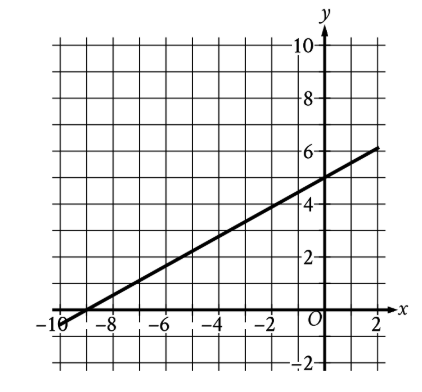
What is the y-intercept of the line graphed?
1. INFER what the question is asking
The question asks for the "y-intercept" of the line. This means:
- We need to find where the line crosses the y-axis
- The y-axis is the vertical axis
- At this point, \(\mathrm{x = 0}\)
2. TRANSLATE the graph information
Looking at the graphed line:
- TRANSLATE by visually tracing the line to where it intersects the y-axis
- The line crosses the y-axis between \(\mathrm{y = 4}\) and \(\mathrm{y = 6}\)
- Reading the grid carefully, the intersection occurs at \(\mathrm{y = 5}\)
- Since this is on the y-axis, the x-coordinate is 0
- Therefore, the point is \(\mathrm{(0, 5)}\)
3. TRANSLATE to match answer format
The answer choices are given as coordinate pairs \(\mathrm{(x, y)}\):
- The y-intercept we found is at \(\mathrm{x = 0, y = 5}\)
- This is written as the ordered pair \(\mathrm{(0, 5)}\)
4. Verify against answer choices
Looking at the options:
- A. \(\mathrm{(-5, 0)}\) - This has the format of an x-intercept \(\mathrm{(y = 0)}\), not a y-intercept
- B. \(\mathrm{(0, 0)}\) - While \(\mathrm{x = 0}\) is correct for a y-intercept, the line doesn't cross at \(\mathrm{y = 0}\)
- C. \(\mathrm{(0, 5)}\) - This matches our finding ✓
- D. \(\mathrm{(0, 9)}\) - While \(\mathrm{x = 0}\) is correct, \(\mathrm{y = 9}\) is too high
Answer: C. \(\mathrm{(0, 5)}\)
Why Students Usually Falter on This Problem
Most Common Error Path:
TRANSLATE error - Confusing x-intercept with y-intercept: Students sometimes confuse which intercept they're looking for. They might look for where the line crosses the x-axis instead of the y-axis. Looking at the graph, the line crosses the x-axis at approximately \(\mathrm{x = -5}\), which would be the point \(\mathrm{(-5, 0)}\).
This may lead them to select Choice A (\(\mathrm{(-5, 0)}\)).
Second Most Common Error:
TRANSLATE error - Misreading the grid scale: Students might miscount the grid lines or misread the scale on the y-axis. They might think the line crosses at a different y-value, such as \(\mathrm{y = 9}\) if they count incorrectly or confuse grid spacing.
This may lead them to select Choice D (\(\mathrm{(0, 9)}\)).
The Bottom Line:
This problem tests your ability to read a graph accurately and connect the definition of y-intercept to its visual representation. Remember: y-intercept = where the line crosses the y-axis, which always has the form \(\mathrm{(0, y)}\). Don't confuse it with the x-intercept, which has the form \(\mathrm{(x, 0)}\).