
A student is conducting an experiment to test the effect of temperature and ethylene treatment on the ripening speed of...
GMAT Information and Ideas : (Ideas) Questions
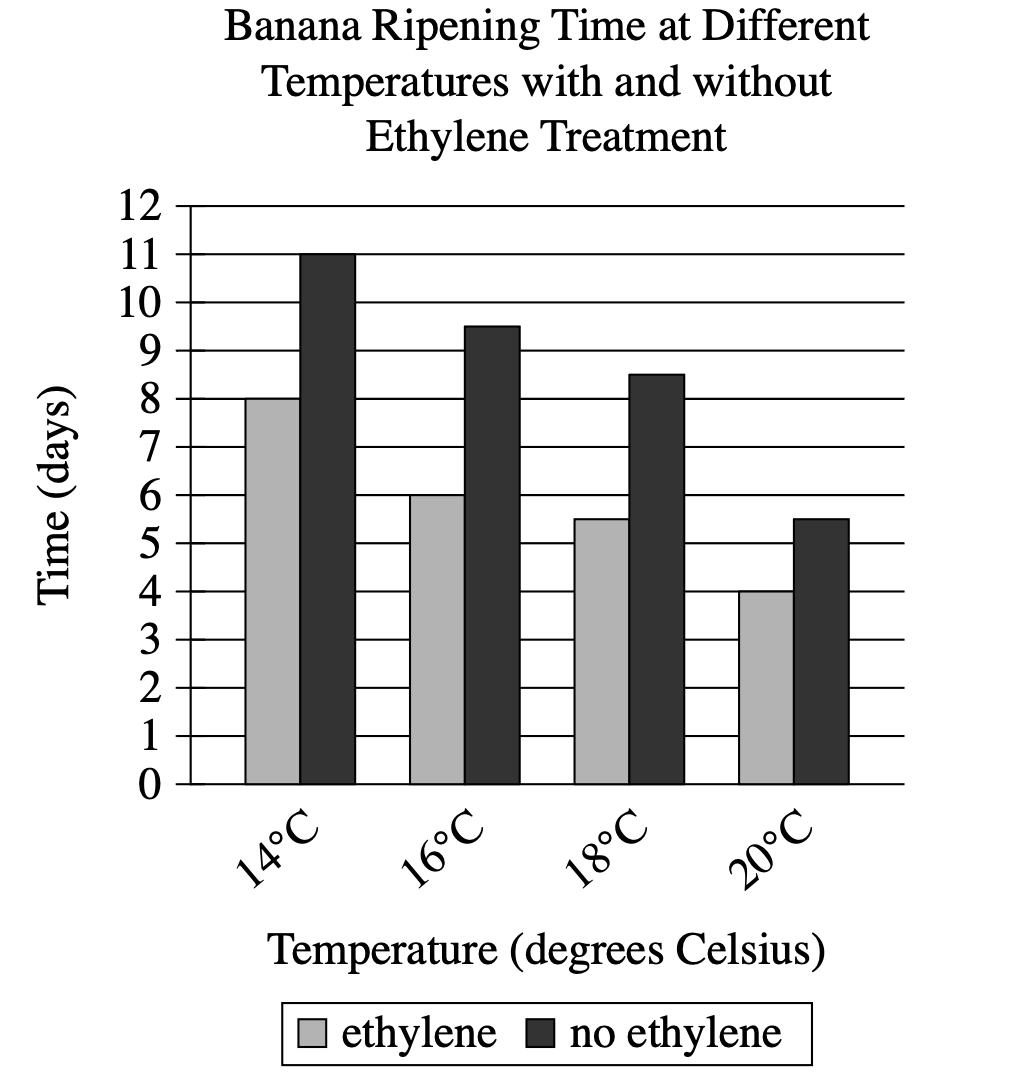
A student is conducting an experiment to test the effect of temperature and ethylene treatment on the ripening speed of bananas. The student treated some bananas with ethylene while leaving others untreated, then allowed both types of bananas to ripen at one of four different temperatures. Comparing the data for bananas with and without ethylene, the student concluded that ________
Which choice most effectively uses data from the graph to complete the student's conclusion?
20°C is the ideal temperature at which to store bananas to slow ripening time.
for those bananas that were not treated with ethylene, differences in temperature were not associated with absolute differences in ripening time.
bananas treated with ethylene ripen faster at 14°C and 16°C than at 18°C and 20°C.
ethylene was associated with a greater absolute change in ripening time at 14°C, 16°C, and 18°C than at 20°C.
Step 1: Decode and Map All Source Material
Part A: Passage Analysis Table
| Text from Passage | Analysis |
|---|---|
| 'A student is conducting an experiment to test the effect of temperature and ethylene treatment on the ripening speed of bananas.' |
|
| 'The student treated some bananas with ethylene while leaving others untreated, then allowed both types of bananas to ripen at one of four different temperatures.' |
|
| 'Comparing the data for bananas with and without ethylene, the student concluded that ______' |
|
Visual Data Analysis:
Visual Type & Title: Bar chart - 'Banana Ripening Time at Different Temperatures with and without Ethylene Treatment'
What It Shows: X-axis: Temperature (\(14°\mathrm{C}\), \(16°\mathrm{C}\), \(18°\mathrm{C}\), \(20°\mathrm{C}\)), Y-axis: Time (days) 0-12, Two bar types: Gray (ethylene), Black (no ethylene), Measures: Ripening time for each temp/treatment combo
Key Observations:
- All temps: ethylene < no ethylene (faster ripening)
- Higher temp = shorter ripening time (both groups)
- Differences (no ethylene - ethylene):
- \(14°\mathrm{C}\): \(\sim 11 - 8 = 3\) days
- \(16°\mathrm{C}\): \(\sim 9.5 - 6 = 3.5\) days
- \(18°\mathrm{C}\): \(\sim 8.5 - 5.5 = 3\) days
- \(20°\mathrm{C}\): \(\sim 5.5 - 4 = 1.5\) days
- Ethylene effect decreases as temp increases
Connection to Text: Graph provides the specific data the student used to reach their conclusion about ethylene and temperature effects.
Part B: Provide Passage Architecture & Core Elements
Main Point: A student conducted a controlled experiment to test how ethylene treatment and temperature affect banana ripening speed.
Argument Flow: The passage establishes an experimental framework with clear variables and methodology, then sets up the need for a data-driven conclusion about the comparative effects observed.
Text-Visual Synthesis: The text provides experimental context while the graph contains the quantitative results that should inform the student's conclusion.
Step 2: Interpret the Question Precisely
This is a fill-in-the-blank question asking us to choose the best logical connector. The answer must create the right relationship between what comes before and after the blank.
Step 3: Prethink the Answer
- Looking at the graph data, ethylene consistently reduces ripening time at all temperatures, but the size of this effect varies by temperature
- At \(14°\mathrm{C}\), \(16°\mathrm{C}\), and \(18°\mathrm{C}\), the difference between treated and untreated is about \(3\)-\(3.5\) days, but at \(20°\mathrm{C}\), it's only \(1.5\) days
- The right answer should recognize that ethylene's effect varies depending on temperature, with greater absolute impact at lower temperatures
20°C is the ideal temperature at which to store bananas to slow ripening time.
✗ Incorrect
- Claims \(20°\mathrm{C}\) is ideal for slowing ripening time
- Graph shows opposite: \(20°\mathrm{C}\) gives fastest ripening (shortest times)
for those bananas that were not treated with ethylene, differences in temperature were not associated with absolute differences in ripening time.
✗ Incorrect
- Claims temperature differences weren't associated with ripening time differences for untreated bananas
- Graph clearly shows temperature effects: untreated bananas ripen in \(\sim 11\) days at \(14°\mathrm{C}\) vs. \(\sim 5.5\) days at \(20°\mathrm{C}\)
bananas treated with ethylene ripen faster at 14°C and 16°C than at 18°C and 20°C.
✗ Incorrect
- Claims ethylene-treated bananas ripen faster at \(14°\mathrm{C}\) and \(16°\mathrm{C}\) than at \(18°\mathrm{C}\) and \(20°\mathrm{C}\)
- Graph shows opposite: \(14°\mathrm{C}\) (8 days) and \(16°\mathrm{C}\) (6 days) are slower than \(18°\mathrm{C}\) (5.5 days) and \(20°\mathrm{C}\) (4 days)
ethylene was associated with a greater absolute change in ripening time at 14°C, 16°C, and 18°C than at 20°C.
✓ Correct
- States ethylene had greater absolute change at \(14°\mathrm{C}\), \(16°\mathrm{C}\), \(18°\mathrm{C}\) than at \(20°\mathrm{C}\)
- Graph data confirms: differences are \(\sim 3\), 3.5, 3 days respectively vs. 1.5 days at \(20°\mathrm{C}\)