
Aerial robots vary considerably in their holding force; the Ultra-Fast Robot Hand, for example, has a holding force of 56...
GMAT Information and Ideas : (Ideas) Questions
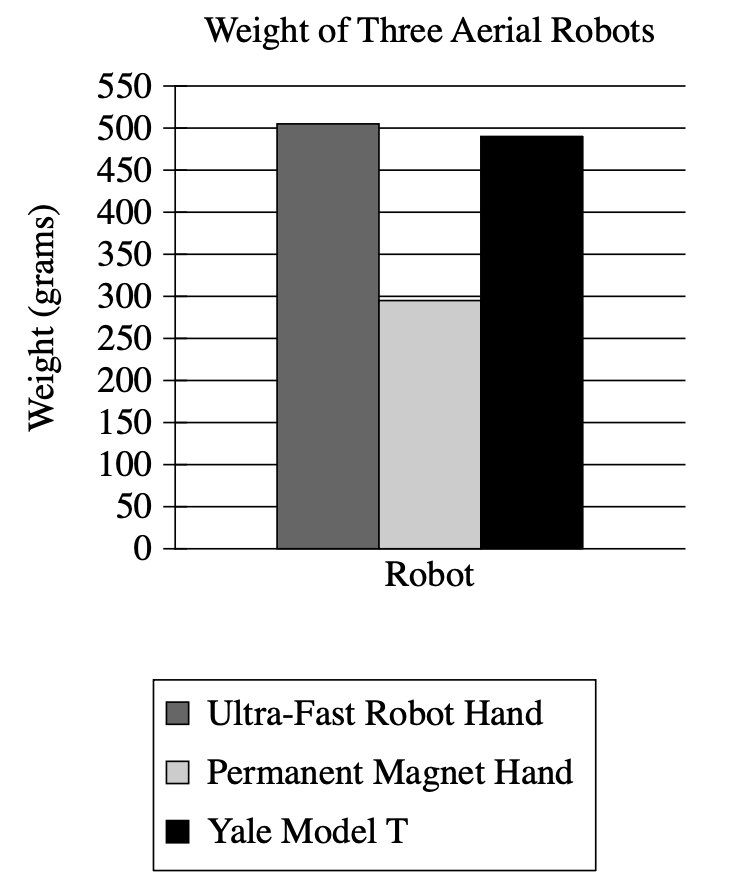
Aerial robots vary considerably in their holding force; the Ultra-Fast Robot Hand, for example, has a holding force of 56 newtons, more than twice that of the Permanent Magnet Hand and more than four times that of the Yale Model T. Since an aerial robot must lift its own weight along with its cargo, engineer Jiawei Meng and colleagues used a ratio of each robot's holding force to the robot's weight to calculate payload capacity, with higher ratios corresponding to greater capacity, concluding that the Ultra-Fast Robot Hand has a higher payload capacity than the Yale Model T.
Which choice best describes data in the graph that support Meng and colleagues' conclusion?
The Ultra-Fast Robot Hand and the Yale Model T each weigh more than 450 grams.
The Ultra-Fast Robot Hand and the Yale Model T each weigh more than the Permanent Magnet Hand does.
The Yale Model T has a lower holding force than the Permanent Magnet Hand despite weighing more.
The Ultra-Fast Robot Hand weighs only slightly more than the Yale Model T does.
Step 1: Decode and Map All Source Material
Part A: Create Passage Analysis Table
| Text from Passage | Analysis |
|---|---|
| 'Aerial robots vary considerably in their holding force' |
|
| 'the Ultra-Fast Robot Hand, for example, has a holding force of 56 newtons' |
|
| 'more than twice that of the Permanent Magnet Hand and more than four times that of the Yale Model T' |
|
| 'Since an aerial robot must lift its own weight along with its cargo' |
|
| 'engineer Jiawei Meng and colleagues used a ratio of each robot's holding force to the robot's weight to calculate payload capacity' |
|
| 'with higher ratios corresponding to greater capacity' |
|
| 'concluding that the Ultra-Fast Robot Hand has a higher payload capacity than the Yale Model T' |
|
Visual Data Analysis:
Visual Type & Title: Bar chart - Weight of Three Aerial Robots
What It Shows: Y-axis shows Weight in grams from 0-550. X-axis shows three robots. Ultra-Fast Robot Hand weighs approximately 510g, Permanent Magnet Hand weighs approximately 300g, Yale Model T weighs approximately 490g.
Key Observations: Ultra-Fast and Yale Model T have very similar weights with only about 20g difference. PMH is much lighter at 300g. Ultra-Fast is heaviest but only slightly more than Yale Model T.
Connection to Text: Visual provides weight data needed for force/weight ratios mentioned in text. Text gives holding forces, graph gives weights - both needed to evaluate conclusion.
Part B: Provide Passage Architecture & Core Elements
Main Point: Engineers determined that the Ultra-Fast Robot Hand has superior payload capacity compared to the Yale Model T by analyzing the ratio of holding force to robot weight.
Argument Flow: The passage establishes that aerial robots vary in holding force, provides specific data showing Ultra-Fast superiority, then explains how engineers used force-to-weight ratios to conclude Ultra-Fast has better payload capacity than Yale Model T.
Step 2: Interpret the Question Precisely
What's being asked? Which data from the graph supports the conclusion that Ultra-Fast has higher payload capacity than Yale Model T.
What type of answer do we need? Specific graph data that would logically support the payload capacity conclusion.
Any limiting keywords? Must focus on graph data, not just text information.
Step 3: Prethink the Answer
- From the text: Ultra-Fast has 56N holding force, more than 4x Yale Model T (so Yale Model T has less than 14N)
- From the graph: Ultra-Fast weighs about 510g, Yale Model T weighs about 490g
- The key insight: If two robots have similar weights but very different holding forces, the one with higher holding force will have better payload capacity
- The graph shows Ultra-Fast and Yale Model T have nearly identical weights, which means the difference in holding force becomes the determining factor
The Ultra-Fast Robot Hand and the Yale Model T each weigh more than 450 grams.
✗ Incorrect
- States both robots weigh more than 450g
- While true, this does not explain why Ultra-Fast has better payload capacity than Yale Model T
- Knowing both are heavy does not support the relative performance conclusion
The Ultra-Fast Robot Hand and the Yale Model T each weigh more than the Permanent Magnet Hand does.
✗ Incorrect
- Claims both weigh more than Permanent Magnet Hand
- True but irrelevant to the conclusion comparing Ultra-Fast to Yale Model T specifically
The Yale Model T has a lower holding force than the Permanent Magnet Hand despite weighing more.
✗ Incorrect
- Discusses Yale Model T versus Permanent Magnet Hand relationship
- Does not address the actual conclusion about Ultra-Fast versus Yale Model T comparison
The Ultra-Fast Robot Hand weighs only slightly more than the Yale Model T does.
✓ Correct
- Shows Ultra-Fast weighs only slightly more than Yale Model T (\(510\mathrm{g}\ \text{vs}\ 490\mathrm{g} = 20\mathrm{g}\ \text{difference}\))
- This similarity in weight is crucial because since weights are nearly equal, the huge difference in holding force determines payload capacity
- This directly supports the conclusion by showing weight is not the differentiating factor