
Gabrielle Adams and colleagues reviewed suggestions for improving a university that had been submitted to the university's president. They coded...
GMAT Information and Ideas : (Ideas) Questions
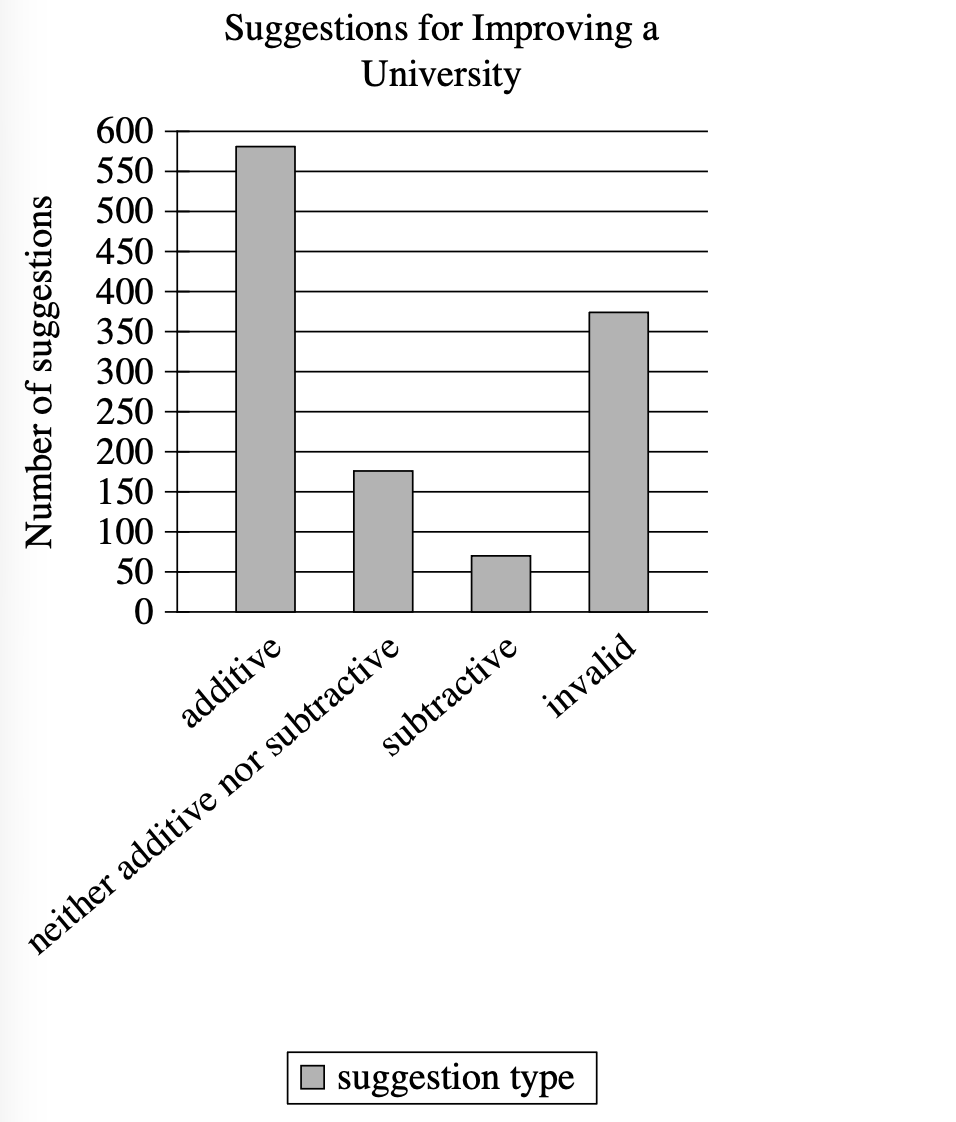
Gabrielle Adams and colleagues reviewed suggestions for improving a university that had been submitted to the university's president. They coded each suggestion as additive (the idea suggested adding something new to the university), subtractive (the idea suggested removing something from the university), neither additive nor subtractive, or invalid (the idea was not comprehensible). The data illustrated people's tendency to overlook the possibility of removing things to achieve improvements: ______
Which choice most effectively uses data in the graph to complete the statement?
around 175 suggestions were coded as neither additive nor subtractive, whereas around 575 suggestions were coded as additive.
more than 350 suggestions were coded as invalid, whereas fewer than 100 suggestions were coded as subtractive.
fewer than 100 suggestions were coded as subtractive, whereas more than 550 suggestions were coded as additive.
around 575 suggestions were coded as additive, whereas around 175 suggestions were coded as subtractive.
Step 1: Decode and Map All Source Material
Part A: Passage Analysis Table
| Text from Passage | Analysis |
|---|---|
| 'Gabrielle Adams and colleagues reviewed suggestions for improving a university that had been submitted to the university's president.' |
|
| 'They coded each suggestion as additive (the idea suggested adding something new to the university), subtractive (the idea suggested removing something from the university), neither additive nor subtractive, or invalid (the idea was not comprehensible).' |
|
| 'The data illustrated people's tendency to overlook the possibility of removing things to achieve improvements: ______' |
|
Visual Data Analysis
Visual Type & Title: Bar chart titled 'Suggestions for Improving a University'
What It Shows: Y-axis: Number of suggestions (0-600), X-axis: 4 categories (additive, neither additive nor subtractive, subtractive, invalid), Data points: Additive ~575, Neither ~175, Subtractive ~70, Invalid ~375
Key Observations: Additive >> all other categories (~575 vs others), Subtractive lowest (~70), Huge gap: Additive (~575) vs Subtractive (~70) = ~8:1 ratio, People suggest adding much more than removing
Connection to Text: Graph provides the missing evidence for the claim about people overlooking subtractive solutions—shows dramatic preference for additive over subtractive approaches.
Part B: Passage Architecture & Core Elements
Main Point: Research shows people heavily favor adding things over removing things when suggesting improvements.
Argument Flow: The passage sets up a study that categorized improvement suggestions, then makes a claim about people's bias toward additive solutions that needs to be supported with specific data from the graph.
Text-Visual Synthesis: The text presents a hypothesis about people's cognitive bias, while the graph provides quantitative evidence with a stark numerical contrast (575 additive vs 70 subtractive suggestions) that proves this bias exists.
Step 2: Interpret the Question Precisely
This is a fill-in-the-blank question asking us to choose the best logical connector. The answer must create the right relationship between what comes before and after the blank.
Step 3: Prethink the Answer
- The passage claims people overlook subtractive solutions in favor of additive ones
- To support this claim, the right answer should: Show the dramatic difference between additive and subtractive suggestions, Use accurate data from the graph (additive ~575, subtractive ~70), Contrast these two categories directly to prove the bias exists
- From the graph, we can see additive suggestions (~575) vastly outnumber subtractive ones (~70) - roughly an 8:1 ratio
- This stark contrast perfectly supports the claim about people's tendency to overlook removing things as a solution
around 175 suggestions were coded as neither additive nor subtractive, whereas around 575 suggestions were coded as additive.
✗ Incorrect
- Compares 'neither additive nor subtractive' (~175) with additive (~575)
- While the numbers are roughly accurate, this doesn't support the main claim
- Trap: Students might think any large difference supports the argument, but the contrast needs to be between additive and subtractive specifically
more than 350 suggestions were coded as invalid, whereas fewer than 100 suggestions were coded as subtractive.
✗ Incorrect
- Compares invalid suggestions (~375) with subtractive (~70)
- The invalid category is irrelevant to the claim about additive vs. subtractive preferences
- Trap: Students might focus on subtractive being low without realizing the comparison category must be additive
fewer than 100 suggestions were coded as subtractive, whereas more than 550 suggestions were coded as additive.
✓ Correct
- States 'fewer than 100 suggestions were coded as subtractive' (matches graph: ~70) and 'more than 550 suggestions were coded as additive' (matches graph: ~575)
- Directly contrasts the two relevant categories mentioned in the claim
- The dramatic difference (575 vs 70) perfectly supports the argument about people overlooking subtractive solutions
around 575 suggestions were coded as additive, whereas around 175 suggestions were coded as subtractive.
✗ Incorrect
- Claims 'around 175 suggestions were coded as subtractive'
- This is inaccurate - the graph shows subtractive at ~70, not 175
- Trap: Students might misread the graph or confuse the 'neither' category (~175) with the subtractive category