
Geographer Adebayo Oluwole Eludoyin and his colleagues surveyed small-scale farmers in three locations in Ondo State, Nigeria—which has mountainous te...
GMAT Information and Ideas : (Ideas) Questions
Geographer Adebayo Oluwole Eludoyin and his colleagues surveyed small-scale farmers in three locations in Ondo State, Nigeria—which has mountainous terrain in the north, an urbanized center, and coastal terrain in the south—to learn more about their practices, like the types of crops they mainly cultivated. In some regions, female farmers were found to be especially prominent in the cultivation of specific types of crops and even constituted the majority of farmers who cultivated those crops; for instance, ______
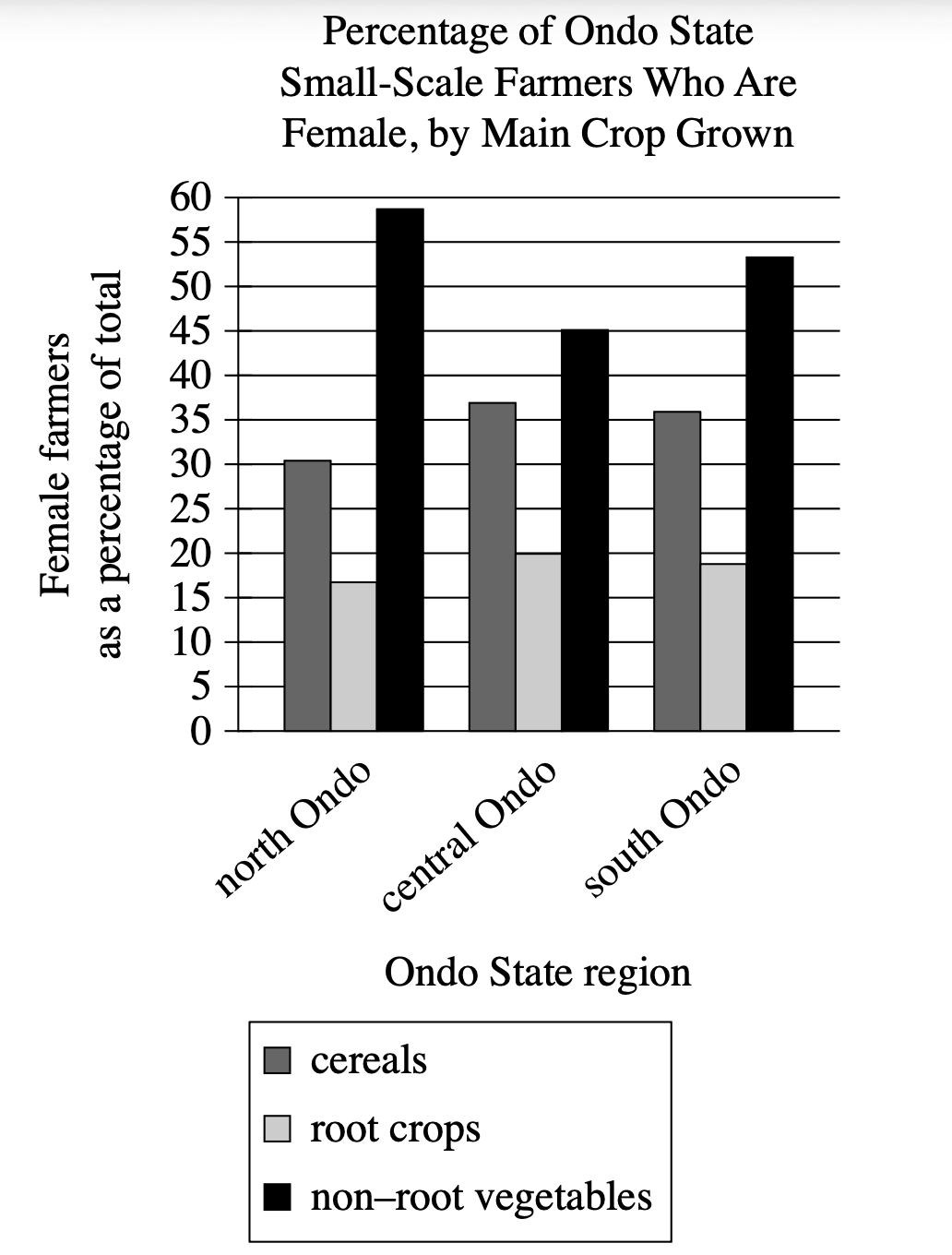
Which choice most effectively uses data from the graph to complete the example?
most of the farmers who mainly cultivated cereals and most of the farmers who mainly cultivated non–root vegetables in south Ondo were women.
more women in central Ondo mainly cultivated root crops than mainly cultivated cereals.
most of the farmers who mainly cultivated non–root vegetables in north and south Ondo were women.
a relatively equal proportion of women across the three regions of Ondo mainly cultivated cereals.
Step 1: Decode and Map All Source Material
Passage Analysis Table
| Text from Passage | Analysis |
|---|---|
| 'Geographer Adebayo Oluwole Eludoyin and his colleagues surveyed small-scale farmers in three locations in Ondo State, Nigeria' |
|
| 'which has mountainous terrain in the north, an urbanized center, and coastal terrain in the south' |
|
| 'to learn more about their practices, like the types of crops they mainly cultivated' |
|
| 'In some regions, female farmers were found to be especially prominent in the cultivation of specific types of crops and even constituted the majority of farmers who cultivated those crops' |
|
| 'for instance, ______' |
|
Visual Data Analysis:
- Visual Type & Title: Bar chart - 'Percentage of Ondo State Small-Scale Farmers Who Are Female, by Main Crop Grown'
- What It Shows: (Note format)
- Variables: 3 regions (north/central/south Ondo) vs. 3 crop types (cereals, root crops, non-root vegetables)
- Units: Percentages of farmers who are female
- Scope: Small-scale farmers in Ondo State
- Key data points:
- North: cereals ~30%, root crops ~17%, non-root veg ~59%
- Central: cereals ~37%, root crops ~20%, non-root veg ~45%
- South: cereals ~36%, root crops ~19%, non-root veg ~54%
- Key Observations: (Note format)
- Non-root veg = highest % female across all regions
- North + South: non-root veg >50% (= majority female)
- Root crops = lowest % female in all regions
- Cereals = middle range (~30-37%)
- Central region = only place where non-root veg <50%
- Connection to Text: Graph provides specific numerical evidence for the text's claim about female farmers being 'especially prominent' in certain crop types.
Part B: Passage Architecture & Core Elements
- Main Point: A survey of Ondo State farmers revealed that in certain regions, women constitute the majority of farmers who grow specific crop types.
- Argument Flow: The passage establishes a research context, describes the study's geographic scope and purpose, presents the key finding about female farmer prominence in specific crop cultivation, and sets up the need for a concrete example to illustrate this pattern.
- Text-Visual Synthesis: The passage describes the qualitative finding that female farmers are 'especially prominent' and even form 'the majority' in certain crop cultivation, while the graph provides the quantitative evidence showing exactly where this occurs—specifically with non-root vegetables in north and south Ondo, where female participation exceeds 50%.
Step 2: Interpret the Question Precisely
This is a fill-in-the-blank question asking us to choose the best logical connector. The answer must create the right relationship between what comes before and after the blank.
Step 3: Prethink the Answer
- Looking at our graph analysis, we need an example where female farmers are 'especially prominent' or form 'the majority' (>50%) in specific crop cultivation
- The graph shows that non-root vegetables have the highest female participation across all regions, and specifically in north and south Ondo, women constitute the majority (59% and 54% respectively)
- This perfectly illustrates the passage's point about female farmers being prominent in specific crops in certain regions
- The right answer should identify where female farmers exceed 50% in particular crop cultivation, specifically highlighting the non-root vegetables category where women clearly dominate in multiple regions
most of the farmers who mainly cultivated cereals and most of the farmers who mainly cultivated non–root vegetables in south Ondo were women.
- Claims most farmers growing cereals in south Ondo were women
- Graph shows \(\sim\mathrm{36\%}\) for cereals in south Ondo (not majority)
- Only accurate about non-root vegetables in south Ondo (\(\sim\mathrm{54\%}\))
- Partially wrong data
more women in central Ondo mainly cultivated root crops than mainly cultivated cereals.
- Claims more women in central Ondo cultivated root crops than cereals
- Graph shows opposite: root crops \(\sim\mathrm{20\%}\), cereals \(\sim\mathrm{37\%}\) in central Ondo
- Backwards relationship
most of the farmers who mainly cultivated non–root vegetables in north and south Ondo were women.
- States most farmers growing non-root vegetables in north and south Ondo were women
- Graph data: north Ondo \(\sim\mathrm{59\%}\), south Ondo \(\sim\mathrm{54\%}\) for non-root vegetables
- Both exceed \(\mathrm{50\%}\) = majority female
- Perfect example of women being 'especially prominent' and constituting 'the majority'
a relatively equal proportion of women across the three regions of Ondo mainly cultivated cereals.
- Claims relatively equal proportions across regions for cereals
- While percentages are similar (\(\mathrm{30\%}\), \(\mathrm{37\%}\), \(\mathrm{36\%}\)), this doesn't show female 'prominence'
- Doesn't illustrate the key finding about majority female participation
- Misses the point about prominence