
It may seem that the optimal strategy for an animal pursuing prey or escaping predators is to move at maximal...
GMAT Information and Ideas : (Ideas) Questions
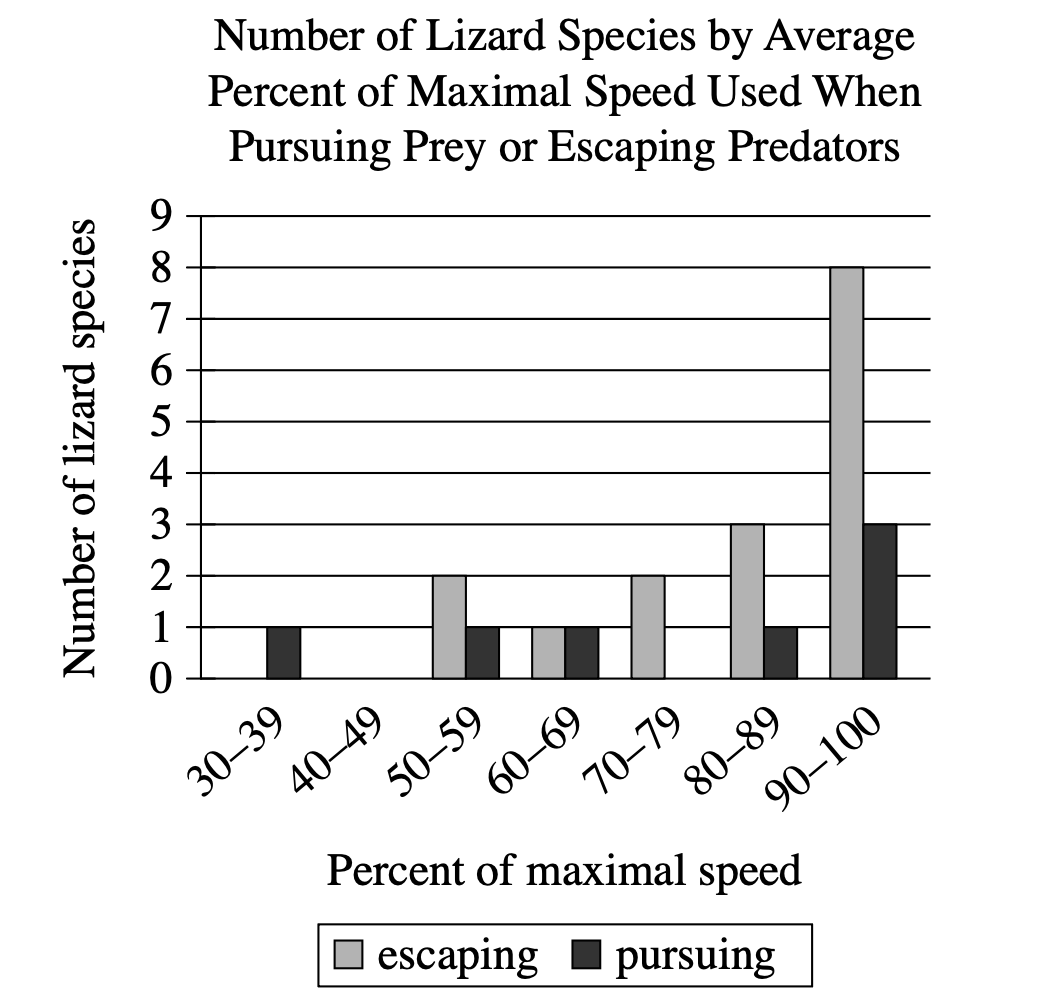
It may seem that the optimal strategy for an animal pursuing prey or escaping predators is to move at maximal speed, but the energy expense of exploiting full speed capacity can disfavor such a strategy even in escape contexts, as evidenced by the fact that ______
Which choice most effectively uses data from the graph to complete the text?
most lizard species use about the same percentage of their maximal speed when escaping predation as they do when pursuing prey.
multiple lizard species move at an average of less than 90% of their maximal speed while escaping predation.
more lizard species use, on average, 90%-100% of their maximal speed while escaping predation than use any other percentage of their maximal speed.
at least 4 lizard species use, on average, less than 100% of their maximal speed while pursuing prey.
Step 1: Decode and Map All Source Material
Part A: Passage Analysis Table
| Text from Passage | Analysis |
|---|---|
| "It may seem that the optimal strategy for an animal pursuing prey or escaping predators is to move at maximal speed" |
|
| "but the energy expense of exploiting full speed capacity can disfavor such a strategy even in escape contexts" |
|
| "as evidenced by the fact that ______" |
|
Visual Data Analysis
Visual Type & Title: Bar chart - "Number of Lizard Species by Average Percent of Maximal Speed Used When Pursuing Prey or Escaping Predators"
What It Shows: X-axis: Speed ranges (30-39%, 40-49%, 50-59%, 60-69%, 70-79%, 80-89%, 90-100%). Y-axis: # lizard species (0-9). Two categories: gray bars = escaping, black bars = pursuing. Data across 7 speed ranges for both behaviors.
Key Observations: Escaping speeds: 30-39%=0, 40-49%=2, 50-59%=1, 60-69%=1, 70-79%=2, 80-89%=3, 90-100%=8. Pursuing speeds: 30-39%=1, 40-49%=0, 50-59%=1, 60-69%=1, 70-79%=0, 80-89%=1, 90-100%=3. Escaping <90%: 9 species total (2+1+1+2+3=9). Escaping 90-100%: 8 species. Most pursuing species also use <90% speeds.
Connection to Text: The graph provides empirical evidence for how lizard species actually use their speed capacity in both escape and pursuit contexts, directly relevant to testing the passage's claim about sub-maximal strategies.
Part B: Passage Architecture & Core Elements
Main Point: Energy costs make sub-maximal speed strategies favorable for animals even in contexts where maximum speed seems most logical (like escaping predators).
Argument Flow: The passage sets up an intuitive assumption that animals should use maximum speed when hunting or escaping, then challenges this by pointing out energy costs, and needs evidence to support this challenge.
Text-Visual Synthesis: The text makes a theoretical claim about energy costs favoring sub-maximal speeds even during escapes, while the graph provides concrete data about actual lizard speed usage that can either support or contradict this claim.
Step 2: Interpret the Question Precisely
This is a fill-in-the-blank question asking us to choose the best logical connector. The answer must create the right relationship between what comes before and after the blank.
Step 3: Prethink the Answer
- The passage argues that energy costs can make sub-maximal speeds favorable "even in escape contexts" - meaning even when you'd most expect animals to use maximum speed
- The evidence from the graph should show that animals don't always use maximum speed when escaping predators
- Looking at our graph data, we found that 9 lizard species escape at less than 90% of maximal speed, while only 8 species escape at 90-100%
- This shows that many species use sub-maximal speeds even when escaping - exactly what would support the passage's claim about energy costs
- The right answer should point out that multiple/many lizard species use less than maximal speed when escaping, demonstrating that the energy cost consideration affects behavior even in escape situations
most lizard species use about the same percentage of their maximal speed when escaping predation as they do when pursuing prey.
- Claims escaping and pursuing speeds are "about the same" across species
- Graph shows different patterns: most pursuing happens at lower speeds, while escaping shows more variety with a peak at \(90-100\%\)
- Doesn't support the passage's specific point about escape contexts
multiple lizard species move at an average of less than 90% of their maximal speed while escaping predation.
- States "multiple lizard species move at an average of less than 90% of their maximal speed while escaping predation"
- Graph data confirms: \(2+1+1+2+3 = 9\) species escape at \(\lt 90\%\) speed ranges
- Perfectly supports passage claim that energy costs make sub-maximal strategies favorable "even in escape contexts"
- Shows that despite escaping being a life-or-death situation, many species still don't use maximum speed
more lizard species use, on average, 90%-100% of their maximal speed while escaping predation than use any other percentage of their maximal speed.
- Claims more species use \(90-100\%\) speed when escaping than any other single range
- While 8 species do escape at \(90-100\%\) (the highest single category), this actually weakens the passage argument
- Suggests most species DO use near-maximal speed when escaping, contradicting the energy cost claim
at least 4 lizard species use, on average, less than 100% of their maximal speed while pursuing prey.
- Focuses on pursuing behavior rather than escaping
- Graph shows about 8+ species pursue at \(\lt 100\%\) speed, so factually supported
- But passage specifically emphasizes escape contexts as the key evidence
- Misses the main point about escaping being where you'd most expect maximum speed