
Participative pricing, in which purchasers choose the prices they pay for products, can enable sellers to capitalize on the heterogeneous...
GMAT Information and Ideas : (Ideas) Questions
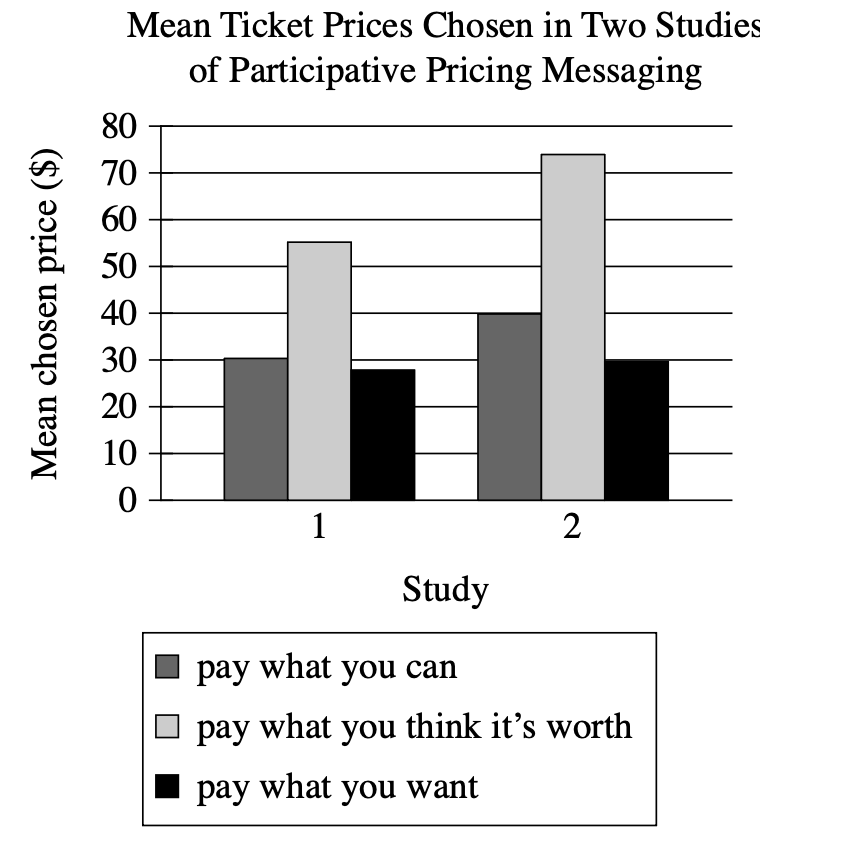
Participative pricing, in which purchasers choose the prices they pay for products, can enable sellers to capitalize on the heterogeneous values consumers assign to the same goods and services, but doing so requires careful messaging. Annie Peng Cui and Jennifer Wiggins recruited 171 participants (ages 18-60) online for an initial study and 83 students (ages 18-31) at a state university for a second study to test the effect of three different messages-'pay what you can,' 'pay what you think it's worth,' and 'pay what you want'-on how much participants would pay for concert tickets. Their results illustrate both the heterogeneity of consumer valuations and how sellers can benefit by prompting consumers to consider their own valuations: ______.
Which choice most effectively uses data from the graph to complete the text?
the students tended to value the concert tickets more highly than did the more age-diverse group recruited online, but when considering what they could afford to pay, the students tended to choose a lower price than did the other group.
in all three messaging conditions, the group of participants recruited online tended to choose lower prices than did the students, but both groups tended to choose prices closest to the actual cost of the tickets when prompted to consider the tickets' value.
the students tended to value the concert tickets more highly than did the more age-diverse group recruited online, but both groups tended to choose a higher price when considering the value of the tickets than when considering what they could afford or wanted to pay.
Step 1: Decode and Map All Source Material
Create Passage Analysis Table
| Text from Passage | Analysis |
|---|---|
| "Participative pricing, in which purchasers choose the prices they pay for products, can enable sellers to capitalize on the heterogeneous values consumers assign to the same goods and services, but doing so requires careful messaging." |
|
| "Annie Peng Cui and Jennifer Wiggins recruited 171 participants (ages 18–60) online for an initial study and 83 students (ages 18–31) at a state university for a second study" |
|
| "to test the effect of three different messages—'pay what you can,' 'pay what you think it's worth,' and 'pay what you want'—on how much participants would pay for concert tickets." |
|
| "Their results illustrate both the heterogeneity of consumer valuations and how sellers can benefit by prompting consumers to consider their own valuations: ______." |
|
Visual Data Analysis:
- Visual Type & Title: Bar chart - "Mean Ticket Prices Chosen in Two Studies of Participative Pricing Messaging"
- What It Shows:
- X-axis: Study 1 and Study 2
- Y-axis: Mean chosen price ($), 0-80 range
- 3 bars per study: "pay what you can" (dark gray), "pay what you think it's worth" (light gray), "pay what you want" (black)
- Key Observations:
- Study 1: can≈$30, worth≈$56, want≈$28
- Study 2: can≈$40, worth≈$75, want≈$30
- Both studies: worth > can > want
- Study 2 > Study 1 in all conditions
- "Worth" messaging = highest prices consistently
- Connection to Text: Graph provides quantitative results of the two studies described in passage.
Provide Passage Architecture & Core Elements
- Visual Structure Map: [CONCEPT DEFINITION] → [RESEARCH SETUP] → [RESULTS INTERPRETATION - needs completion]
- Main Point: Different participative pricing messages affect how much consumers pay, demonstrating both varied consumer valuations and seller opportunities.
- Argument Flow: The passage defines participative pricing, describes two studies testing messaging effects, and begins interpreting results about consumer heterogeneity and seller benefits.
- Text-Visual Synthesis: The text establishes the research framework while the graph provides concrete evidence that "worth" messaging consistently produced highest payments, with students (Study 2) choosing higher prices across all conditions than the online group (Study 1).
Step 2: Interpret the Question Precisely
This is a fill-in-the-blank question asking us to choose the best logical connector. The answer must create the right relationship between what comes before and after the blank.
Step 3: Prethink the Answer
- The correct answer must: Use specific data from the graph to complete the conclusion, Reference the different prices produced by different messaging conditions, Demonstrate how "worth" messaging benefits sellers (higher prices), Address the heterogeneity mentioned by comparing the two study groups.
- From the graph: "Worth" messaging produced highest prices in both studies ($56 vs ~$30 in Study 1; $75 vs ~$40 in Study 2).
- Study 2 participants (students) chose higher prices across all conditions than Study 1 participants (online group).
the students tended to value the concert tickets more highly than did the more age-diverse group recruited online, but when considering what they could afford to pay, the students tended to choose a lower price than did the other group.
✗ Incorrect
- Claims students valued tickets more highly (correct per graph) but then states students chose lower prices when considering affordability.
- Graph contradicts this: Study 2 shows \(\sim\$40\) for "pay what you can" vs Study 1's \(\sim\$30\).
- Students chose higher prices in ALL conditions, not lower.
in all three messaging conditions, the group of participants recruited online tended to choose lower prices than did the students, but both groups tended to choose prices closest to the actual cost of the tickets when prompted to consider the tickets' value.
✗ Incorrect
- Correctly notes online group chose lower prices than students.
- Incorrectly claims both groups chose prices "closest to the actual cost" when prompted about value.
- Graph provides no "actual cost" reference point - we don't know what tickets actually cost.
- Makes unsupported assumption about cost proximity.
the students tended to value the concert tickets more highly than did the more age-diverse group recruited online, but both groups tended to choose a higher price when considering the value of the tickets than when considering what they could afford or wanted to pay.
✓ Correct
- Accurately states students valued tickets more highly (\(\mathrm{Study\ 2} \gt \mathrm{Study\ 1}\) across all conditions per graph).
- Correctly notes both groups chose higher prices when considering value vs. affordability/preference (\(\mathrm{worth} \approx \$56/\$75\) vs \(\mathrm{can} \approx \$30/\$40\) vs \(\mathrm{want} \approx \$28/\$30\)).
- Effectively uses graph data to complete the conclusion about heterogeneous valuations and seller benefits from prompting self-consideration.