
Perovskite solar cells convert light into electricity more efficiently than earlier kinds of solar cells, and manufacturing advances have recently...
GMAT Information and Ideas : (Ideas) Questions
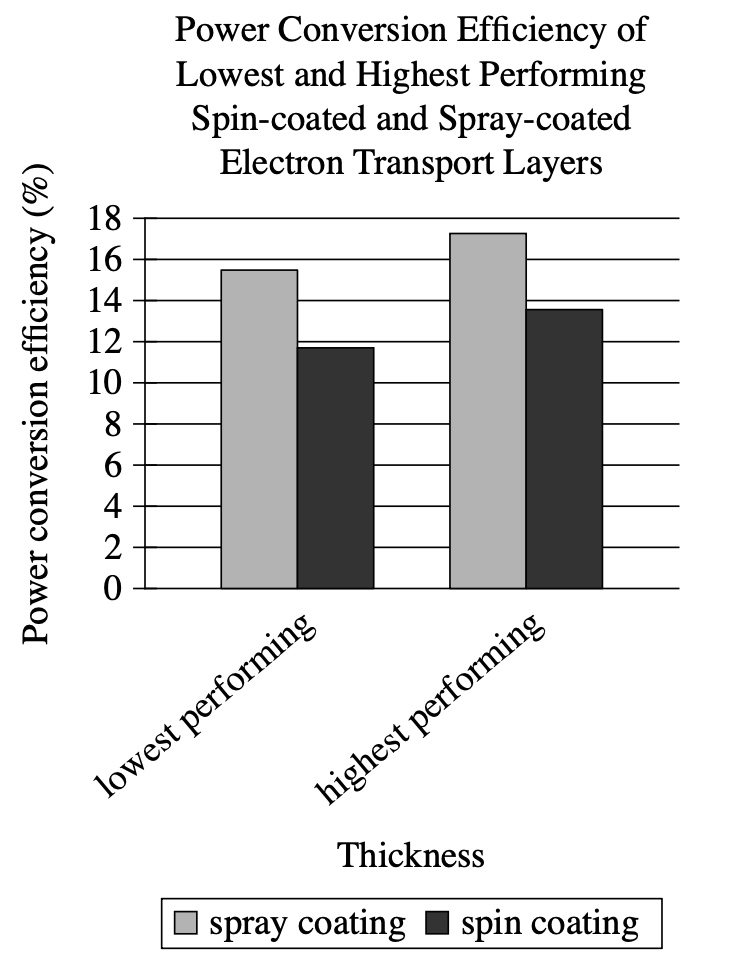
Perovskite solar cells convert light into electricity more efficiently than earlier kinds of solar cells, and manufacturing advances have recently made them commercially attractive. One limitation of the cells, however, has to do with their electron transport layer (ETL), through which absorbed electrons must pass. Often the ETL is applied through a process called spin coating, but such ETLs are fairly inefficient at converting input power to output power. André Taylor and colleagues tested a novel spray coating method for applying the ETL. The team produced ETLs of various thicknesses and concluded that spray coating holds promise for improving the power conversion efficiency of ETLs in perovskite solar cells.
Which choice best describes data from the graph that support Taylor and colleagues' conclusion?
Both the ETL applied through spin coating and the ETL applied through spray coating showed a power conversion efficiency greater than 10% at their lowest performing thickness.
The lowest performing ETL applied through spray coating had a higher power conversion efficiency than the highest performing ETL applied through spin coating.
The highest performing ETL applied through spray coating showed a power conversion efficiency of approximately 13%, while the highest performing ETL applied through spin coating showed a power conversion efficiency of approximately 11%.
There was a substantial difference in power conversion efficiency between the lowest and highest performing ETLs applied through spray coating.
Step 1: Decode and Map All Source Material
Passage Analysis Table
| Text from Passage | Analysis |
|---|---|
| "Perovskite solar cells convert light into electricity more efficiently than earlier kinds of solar cells, and manufacturing advances have recently made them commercially attractive." |
|
| "One limitation of the cells, however, has to do with their electron transport layer (ETL), through which absorbed electrons must pass." |
|
| "Often the ETL is applied through a process called spin coating, but such ETLs are fairly inefficient at converting input power to output power." |
|
| "André Taylor and colleagues tested a novel spray coating method for applying the ETL." |
|
| "The team produced ETLs of various thicknesses and concluded that spray coating holds promise for improving the power conversion efficiency of ETLs in perovskite solar cells." |
|
Visual Data Analysis
Visual Type & Title: Bar chart - "Power Conversion Efficiency of Lowest and Highest Performing Spin-coated and Spray-coated Electron Transport Layers"
What It Shows: Y-axis: Power conversion efficiency (\(\%\)) X-axis: Performance levels (lowest vs. highest performing) Gray bars = spray coating, Black bars = spin coating Compares two coating methods at their best & worst performance levels
Key Observations: Spray coating lowest: \(\sim\mathrm{15.5\%}\) Spin coating lowest: \(\sim\mathrm{11.8\%}\) Spray coating highest: \(\sim\mathrm{17.3\%}\) Spin coating highest: \(\sim\mathrm{13.5\%}\) Spray coating > spin coating in ALL cases Even worst spray coating > best spin coating (\(\mathrm{15.5\%} \gt \mathrm{13.5\%}\))
Connection to Text: Graph provides quantitative evidence for Taylor team's conclusion that spray coating has promise for improving power conversion efficiency compared to current spin coating methods.
Passage Architecture & Core Elements
Main Point: Taylor and colleagues found that spray coating could improve the power conversion efficiency of electron transport layers in perovskite solar cells compared to traditional spin coating methods.
Step 2: Interpret the Question Precisely
What's being asked? Which data from the graph supports Taylor's conclusion about spray coating's promise
What type of answer do we need? Specific evidence from the graph that demonstrates spray coating's superiority over spin coating
Any limiting keywords? "data from the graph" - must reference actual visual evidence, not just text
Step 3: Prethink the Answer
- Taylor's conclusion was that spray coating "holds promise for improving the power conversion efficiency" compared to the current spin coating method
- For graph data to support this conclusion, it should show that spray coating performs better than spin coating in the efficiency measurements
- The most compelling evidence would be that spray coating consistently outperforms spin coating
Both the ETL applied through spin coating and the ETL applied through spray coating showed a power conversion efficiency greater than 10% at their lowest performing thickness.
✗ Incorrect
- Claims both methods exceeded 10% at lowest performance levels
- While factually true (spray \(\sim\mathrm{15.5\%}\), spin \(\sim\mathrm{11.8\%}\)), this doesn't support Taylor's conclusion about spray coating being better
- Shows both methods work, but doesn't demonstrate spray coating's superiority
The lowest performing ETL applied through spray coating had a higher power conversion efficiency than the highest performing ETL applied through spin coating.
✓ Correct
- Identifies that spray coating's worst performance (\(\sim\mathrm{15.5\%}\)) exceeded spin coating's best performance (\(\sim\mathrm{13.5\%}\))
- This directly supports Taylor's conclusion by showing spray coating's clear, consistent superiority
- Demonstrates that even spray coating's weakest result outperforms spin coating's strongest result
The highest performing ETL applied through spray coating showed a power conversion efficiency of approximately 13%, while the highest performing ETL applied through spin coating showed a power conversion efficiency of approximately 11%.
✗ Incorrect
- Cites incorrect data: claims spray coating's highest performance was \(\sim\mathrm{13\%}\)
- Graph shows spray coating's highest performance was actually \(\sim\mathrm{17.3\%}\)
- Inaccurate data cannot support any conclusion
There was a substantial difference in power conversion efficiency between the lowest and highest performing ETLs applied through spray coating.
✗ Incorrect
- Focuses on variation within spray coating method (difference between its lowest and highest performance)
- Doesn't compare spray coating to spin coating, so doesn't support conclusion about spray coating's superiority over current methods