
Research suggests that REM sleep in animals is homeostatically regulated: animals compensate for periods of REM sleep deprivation by increasing...
GMAT Information and Ideas : (Ideas) Questions
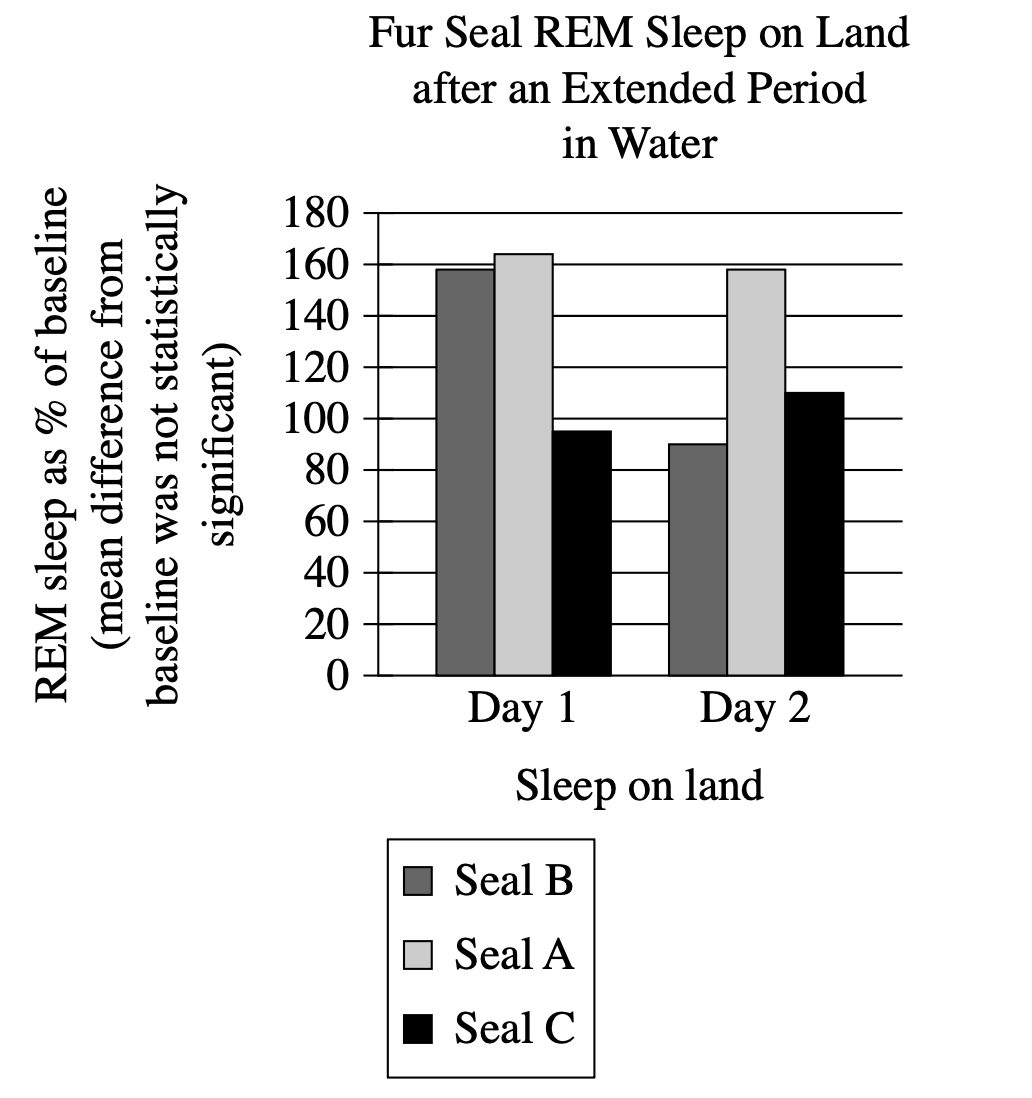
Research suggests that REM sleep in animals is homeostatically regulated: animals compensate for periods of REM sleep deprivation by increasing subsequent REM sleep. When on land, fur seals get enough REM sleep, but during the weeks they're in the water, they get almost none. In a study of fur seals' sleep habits, researchers recorded the REM sleep (as a percentage of baseline) of fur seals once they had returned to land. They concluded that REM sleep may not be homeostatically regulated in fur seals, citing as evidence the fact that the seals in the study ______
Which choice most effectively uses data from the graph to complete the text?
Which choice most effectively uses data from the graph to complete the text?
didn't show significantly less REM sleep during the second day after returning to land than they did during the first day.
showed no significant differences from one another in baseline levels of REM sleep.
didn't consistently demonstrate a significant increase in REM sleep after their period of deprivation in the water.
showed no significant difference between REM sleep after returning to land and REM sleep while in the water.
Step 1: Decode and Map All Source Material
Part A: Passage Analysis Table
| Text from Passage | Analysis |
|---|---|
| 'Research suggests that REM sleep in animals is homeostatically regulated: animals compensate for periods of REM sleep deprivation by increasing subsequent REM sleep.' |
|
| 'When on land, fur seals get enough REM sleep, but during the weeks they're in the water, they get almost none.' |
|
| 'In a study of fur seals' sleep habits, researchers recorded the REM sleep (as a percentage of baseline) of fur seals once they had returned to land.' |
|
| 'They concluded that REM sleep may not be homeostatically regulated in fur seals, citing as evidence the fact that the seals in the study ______' |
|
Visual Data Analysis
Visual Type & Title: Bar graph - 'Fur Seal REM Sleep on Land after an Extended Period in Water'
What It Shows:
- Variables: 3 seals (A, B, C) across 2 days on land
- Units: REM sleep as % of baseline
- Scope: Post-water period recovery data
- Key data points: Day 1: A≈165%, B≈160%, C≈95%; Day 2: A≈160%, B≈90%, C≈110%
Key Observations:
- Inconsistent patterns between seals
- Seal A: 165%→160% (slight decrease)
- Seal B: 160%→90% (major decrease)
- Seal C: 95%→110% (increase)
- No consistent increase trend across all seals
Connection to Text: Graph provides the missing evidence for why researchers concluded REM sleep isn't homeostatically regulated in fur seals—the data shows inconsistent recovery patterns rather than the expected consistent increases.
Part B: Passage Architecture & Core Elements
Main Point: Researchers concluded that fur seals may not follow the typical pattern of homeostatic REM sleep regulation based on their post-water sleep data.
Argument Flow: The passage establishes that REM sleep is normally homeostatically regulated, explains that fur seals experience REM deprivation in water, describes a study measuring their recovery sleep on land, and states that researchers concluded homeostatic regulation doesn't apply to fur seals based on specific evidence from their data.
Text-Visual Synthesis: The text describes the researchers' surprising conclusion that contradicts normal REM sleep regulation, while the graph provides the specific evidence supporting this conclusion—showing inconsistent REM sleep patterns across the three seals rather than the consistent increases that homeostatic regulation would predict.
Step 2: Interpret the Question Precisely
This is a fill-in-the-blank question asking us to choose the best logical connector. The answer must create the right relationship between what comes before and after the blank.
Step 3: Prethink the Answer
- If REM sleep were homeostatically regulated, we'd expect all seals to show increased REM sleep after their period of deprivation in the water
- Looking at our graph data, we see inconsistent patterns: Seal A stayed roughly the same (165%→160%), Seal B actually decreased significantly (160%→90%), and only Seal C increased (95%→110%)
- This inconsistency contradicts what homeostatic regulation would predict
- The right answer should point to this lack of consistent increase across the seals—essentially showing that the seals didn't demonstrate the expected pattern of increased REM sleep after deprivation
didn't show significantly less REM sleep during the second day after returning to land than they did during the first day.
✗ Incorrect
- This focuses on comparing Day 1 vs Day 2, but that's not what challenges homeostatic regulation
- The graph actually shows Day 2 values are generally lower than Day 1 for most seals
- Misses the key point about whether seals showed recovery increases after deprivation
showed no significant differences from one another in baseline levels of REM sleep.
✗ Incorrect
- This is about baseline differences between seals before the study
- The graph doesn't show baseline levels—it shows percentages of baseline
- Doesn't address whether the seals recovered from REM deprivation
didn't consistently demonstrate a significant increase in REM sleep after their period of deprivation in the water.
✓ Correct
- Accurately describes what the graph shows: inconsistent patterns across seals
- Seal A: minimal change, Seal B: decrease, Seal C: increase
- This inconsistency directly contradicts homeostatic regulation, which predicts consistent increases
- Matches our prethinking about lack of consistent recovery response
showed no significant difference between REM sleep after returning to land and REM sleep while in the water.
✗ Incorrect
- The graph doesn't show REM sleep levels while in water
- The graph only shows land data, so this comparison isn't possible from the visual