
The population of the coral Lophelia pertusa declined significantly around 9,000 years ago in the Alboran Sea and around 11,000...
GMAT Information and Ideas : (Ideas) Questions
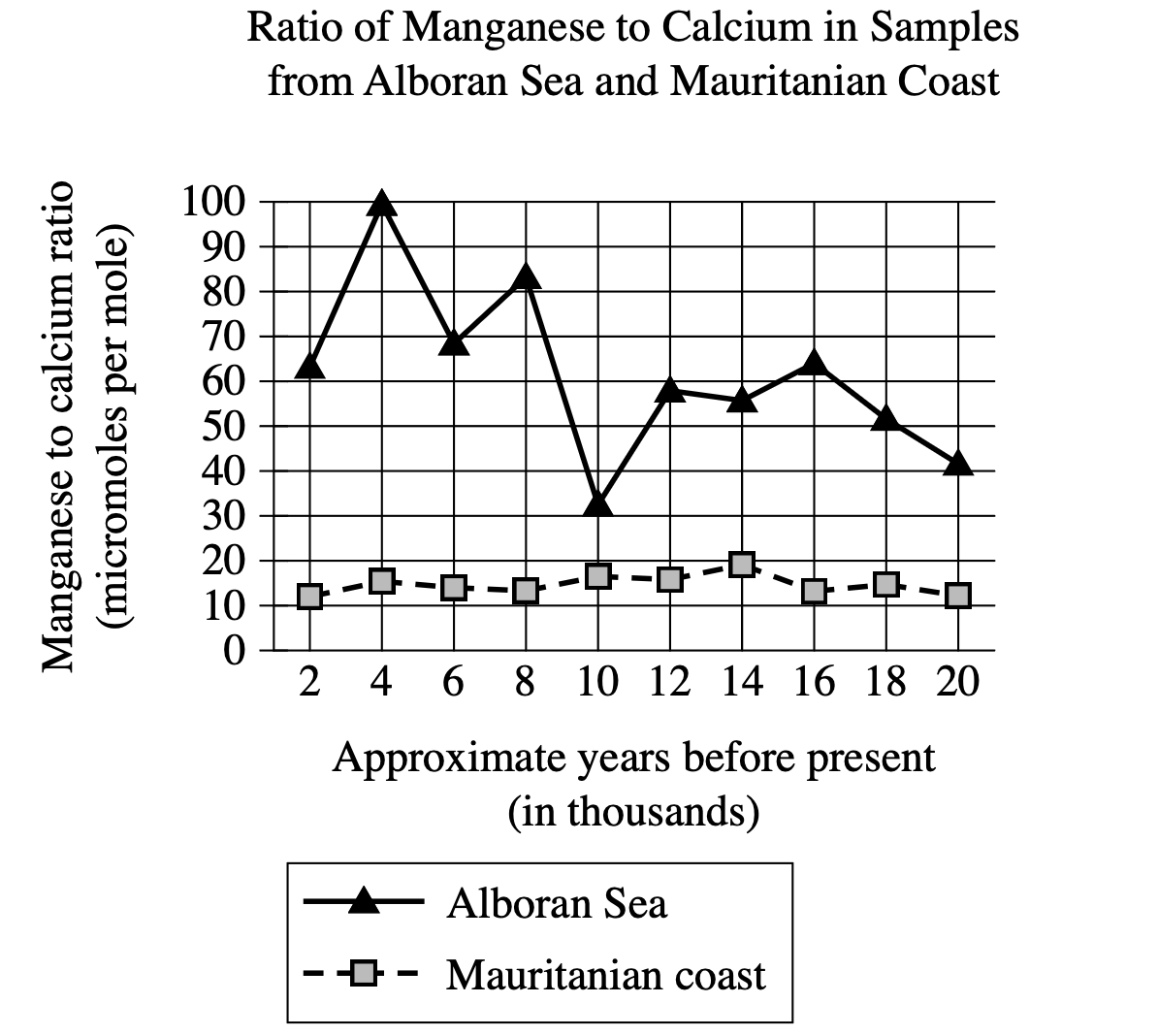
The population of the coral Lophelia pertusa declined significantly around 9,000 years ago in the Alboran Sea and around 11,000 years ago near the Mauritanian coast. Using the ratio of manganese to calcium, which inversely correlates with ocean oxygenation levels, marine scientist Rodrigo da Costa Portilho-Ramos and colleagues evaluated whether oxygenation played a role in the declines of L. pertusa. The researchers concluded that oxygenation may have been important in the Alboran Sea but not near the Mauritanian coast, since ______
Which choice most effectively uses data from the graph to complete the statement?
a substantial increase in oxygenation in the Alboran Sea corresponded with the local decline in L. pertusa, but the opposite relationship between oxygenation and L. pertusa was found near the Mauritanian coast.
L. pertusa declined in the Alboran Sea during a period of substantial local decline in oxygenation, but L. pertusa declined near the Mauritanian coast during a period of little local change in oxygenation.
oxygenation in the Alboran Sea was higher before the decline in L. pertusa than after the decline, whereas oxygenation near the Mauritanian coast was relatively low both before and after the decline in L. pertusa.
oxygenation in the Alboran Sea tended to be substantially higher than oxygenation near the Mauritanian coast during the period studied.
Step 1: Decode and Map All Source Material
Passage Analysis Table
| Text from Passage | Analysis |
|---|---|
| "The population of the coral Lophelia pertusa declined significantly around 9,000 years ago in the Alboran Sea and around 11,000 years ago near the Mauritanian coast." |
|
| "Using the ratio of manganese to calcium, which inversely correlates with ocean oxygenation levels, marine scientist Rodrigo da Costa Portilho-Ramos and colleagues evaluated whether oxygenation played a role in the declines of L. pertusa." |
|
| "The researchers concluded that oxygenation may have been important in the Alboran Sea but not near the Mauritanian coast, since ______" |
|
Visual Data Analysis
Visual Type & Title: Line graph - "Ratio of Manganese to Calcium in Samples from Alboran Sea and Mauritanian Coast"
What It Shows: X-axis: Years before present (1K-20K), Y-axis: \(\mathrm{Mn/Ca}\) ratio (micromoles per mole, 0-100), Two trend lines: Alboran Sea vs Mauritanian coast, Time period: 20,000 years of data
Key Observations:
- Alboran Sea: Highly volatile (30→100→30→85→60→50), major peaks around 4K & 8K yrs ago
- Mauritanian coast: Stable throughout (12-18 range), minimal variation
- Around 9K yrs: Alboran transitioning from low to high values
- Around 11K yrs: Mauritanian stable
Connection to Text: Graph provides the missing evidence for why researchers concluded oxygenation mattered in one location but not the other. High \(\mathrm{Mn/Ca = low\ O_2}\) (inverse relationship).
Passage Architecture & Core Elements
Main Point: Scientists found that oxygenation changes likely contributed to coral decline in the Alboran Sea but not near the Mauritanian coast, based on manganese-to-calcium ratio analysis.
Argument Flow: The passage establishes when and where coral populations declined, explains the research method used to investigate oxygenation's role, then presents a conclusion that requires graph evidence to complete.
Text-Visual Synthesis: The text provides the scientific framework and conclusion, while the graph supplies the crucial evidence pattern that explains why oxygenation mattered in one location but not the other.
Step 2: Interpret the Question Precisely
This is a fill-in-the-blank question asking us to choose the best logical connector. The answer must create the right relationship between what comes before and after the blank.
Step 3: Prethink the Answer
- Since \(\mathrm{Mn/Ca}\) ratios inversely correlate with oxygenation (high \(\mathrm{Mn/Ca = low\ O_2}\)), we need to look at what happened around each decline period
- Alboran Sea (9,000 years ago): The graph shows the ratio transitioning from low values to much higher values, indicating declining oxygenation during the coral decline period
- Mauritanian coast (11,000 years ago): The graph shows the ratio staying consistently around 15-18 throughout this entire timeframe, indicating stable oxygenation during the coral decline period
- The right answer should show that the Alboran Sea experienced substantial oxygenation changes (declining oxygen levels) around its coral decline, while the Mauritanian coast showed little oxygenation change during its coral decline period
a substantial increase in oxygenation in the Alboran Sea corresponded with the local decline in L. pertusa, but the opposite relationship between oxygenation and L. pertusa was found near the Mauritanian coast.
✗ Incorrect
- Claims "substantial increase in oxygenation" in Alboran Sea corresponded with coral decline
- Graph shows the opposite - Mn/Ca ratios were increasing around 9,000 years ago (meaning oxygenation was decreasing, not increasing)
- This represents confusing the inverse relationship between Mn/Ca ratios and oxygenation levels
L. pertusa declined in the Alboran Sea during a period of substantial local decline in oxygenation, but L. pertusa declined near the Mauritanian coast during a period of little local change in oxygenation.
✓ Correct
- States coral declined in Alboran Sea "during a period of substantial local decline in oxygenation" - matches graph data showing Mn/Ca ratios increasing from low toward higher values around 9,000 years ago
- States coral declined near Mauritanian coast "during a period of little local change in oxygenation" - matches graph showing stable Mn/Ca ratios throughout 11,000 years ago period
- Perfectly explains why researchers concluded oxygenation mattered in one location but not the other
oxygenation in the Alboran Sea was higher before the decline in L. pertusa than after the decline, whereas oxygenation near the Mauritanian coast was relatively low both before and after the decline in L. pertusa.
✗ Incorrect
- Makes broad comparisons about "before" and "after" decline periods rather than focusing on what happened during the actual decline periods
- Does not directly address why oxygenation would be important in one location but not the other during the coral declines
oxygenation in the Alboran Sea tended to be substantially higher than oxygenation near the Mauritanian coast during the period studied.
✗ Incorrect
- Compares overall oxygenation levels between the two locations rather than examining changes during decline periods
- Missing the key point about temporal changes in oxygenation that would explain the coral declines
- This represents focusing on general differences between locations rather than changes over time that would cause population declines