
To investigate potential cognitive benefits of taking leave from work, psychologist Jan Packer and colleagues conducted a six-month study of...
GMAT Information and Ideas : (Ideas) Questions
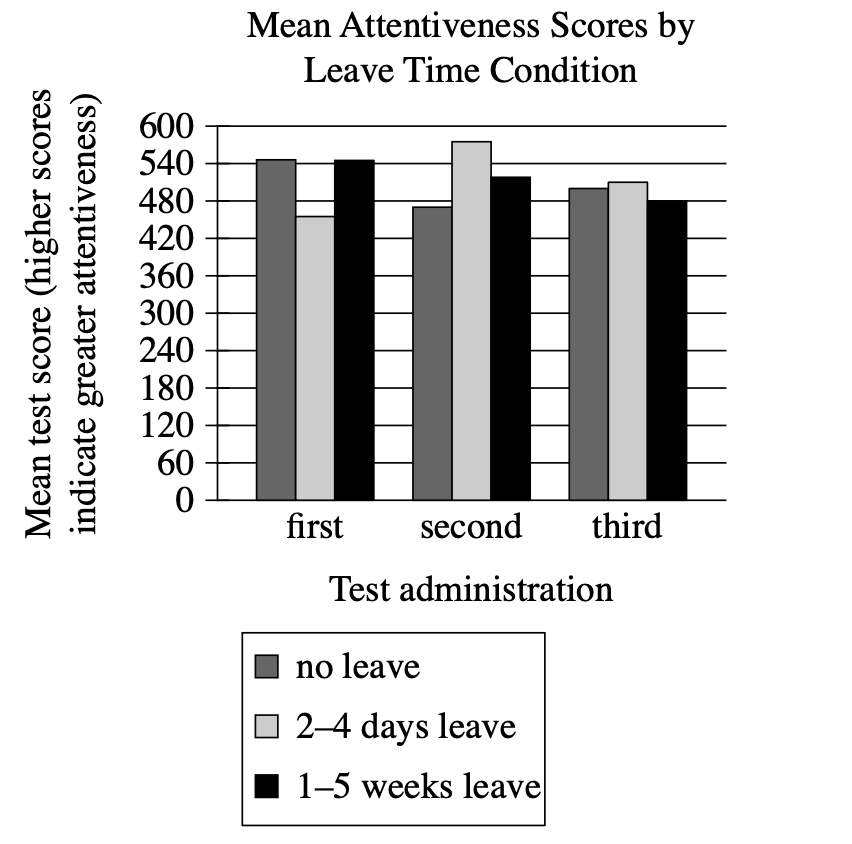
To investigate potential cognitive benefits of taking leave from work, psychologist Jan Packer and colleagues conducted a six-month study of Australian university staff members who took no leave from work during the study, took 2-4 days of leave, or took 1-5 weeks of leave. Tests of attentiveness were administered to participants three times during the study: at random for the no-leave staff, and for the rest, one week before their leave, one week following their return to work, and one week after the second test administration. After analyzing the results, the researchers concluded that longer leave times might not confer a greater cognitive benefit than shorter leave times do.
Which choice best describes data from the graph that support the researchers' conclusion?
In the second test administration, participants who took 2–4 days of leave had higher average attentiveness scores than did those who took no leave, but in the third test administration, those who took no leave had higher average scores than those who took 1–5 weeks of leave.
In the first test administration, participants who took 2–4 days of leave had lower average attentiveness scores than did those who took 1–5 weeks of leave and those who took no leave.
In both the second and third test administrations, participants who took 2–4 days of leave had higher average attentiveness scores than did participants who took 1–5 weeks of leave.
In the second and third test administrations, participants who took 2–4 days of leave had higher average attentiveness scores than did those who took no leave.
Step 1: Decode and Map All Source Material
Passage Analysis Table
| Text from Passage | Analysis |
|---|---|
| "To investigate potential cognitive benefits of taking leave from work, psychologist Jan Packer and colleagues conducted a six-month study" |
|
| "of Australian university staff members who took no leave from work during the study, took 2-4 days of leave, or took 1-5 weeks of leave" |
|
| "Tests of attentiveness were administered to participants three times during the study: at random for the no-leave staff, and for the rest, one week before their leave, one week following their return to work, and one week after the second test administration" |
|
| "After analyzing the results, the researchers concluded that longer leave times might not confer a greater cognitive benefit than shorter leave times do" |
|
Visual Data Analysis
Visual Type & Title: Bar chart - "Mean Attentiveness Scores by Leave Time Condition"
What It Shows:
- X-axis: Test administration (first, second, third)
- Y-axis: Mean test scores (higher = greater attentiveness)
- Three conditions: no leave (dark gray), 2-4 days leave (light gray), 1-5 weeks leave (black)
- Score range: approximately 450-575
Key Observations:
- First test: no leave approximately 540, 2-4 days approximately 450, 1-5 weeks approximately 540
- Second test: 2-4 days approximately 575 > 1-5 weeks approximately 525 > no leave approximately 475
- Third test: 2-4 days approximately 530 > no leave approximately 510 > 1-5 weeks approximately 475
- Pattern: 2-4 days group outperforms 1-5 weeks group in tests 2&3
- 1-5 weeks (longest leave) shows declining performance
Connection to Text: Graph provides concrete data supporting researchers' conclusion that longer leave doesn't necessarily provide greater cognitive benefits.
Passage Architecture & Core Elements
Main Point: A study found that taking longer leave from work doesn't necessarily provide greater cognitive benefits than shorter leave periods.
Argument Flow: Researchers set up a controlled study with three groups taking different amounts of leave, measured their cognitive performance through attentiveness tests, and concluded that longer leave times don't confer superior cognitive benefits.
Text-Visual Synthesis: The text presents the researchers' conclusion about leave length and cognitive benefits, while the graph provides the specific attentiveness score data that supports this conclusion by showing the 2-4 day group consistently outperforming the 1-5 week group in the crucial second and third test administrations.
Step 2: Interpret the Question Precisely
What's being asked? We need to identify which data from the graph supports the researchers' conclusion that longer leave times might not provide greater cognitive benefits.
What type of answer do we need? Specific data patterns or comparisons from the graph that demonstrate the longest leave group (1-5 weeks) doesn't outperform shorter leave groups.
Any limiting keywords? "data from the graph" - we must reference specific graph information, not just text.
Step 3: Prethink the Answer
- The researchers concluded that longer leave times don't necessarily provide greater cognitive benefits
- To support this conclusion, we need graph data showing that the longest leave group (1-5 weeks) doesn't consistently outperform the shorter leave groups, particularly the 2-4 days group
- Looking at our graph analysis:
- The 2-4 days group outperforms the 1-5 weeks group in both the second and third test administrations
- This directly contradicts the expectation that longer leave = better cognitive benefits
- The pattern shows shorter leave performing better than longer leave
In the second test administration, participants who took 2–4 days of leave had higher average attentiveness scores than did those who took no leave, but in the third test administration, those who took no leave had higher average scores than those who took 1–5 weeks of leave.
✗ Incorrect
- Claims 2-4 days > no leave in second test, but no leave > 1-5 weeks in third test
- While parts are accurate, this doesn't directly compare the two leave-taking groups and misses the key comparison between 2-4 days and 1-5 weeks
In the first test administration, participants who took 2–4 days of leave had lower average attentiveness scores than did those who took 1–5 weeks of leave and those who took no leave.
✗ Incorrect
- Focuses only on first test administration where 2-4 days had lowest scores
- First test was baseline before leave effects, so doesn't support conclusion about leave benefits
- Ignores the crucial second and third tests
In both the second and third test administrations, participants who took 2–4 days of leave had higher average attentiveness scores than did participants who took 1–5 weeks of leave.
✓ Correct
- Accurately states that 2-4 days group outperformed 1-5 weeks group in both second and third tests
- This directly supports the conclusion by showing shorter leave consistently provided better cognitive benefits than longer leave
In the second and third test administrations, participants who took 2–4 days of leave had higher average attentiveness scores than did those who took no leave.
✗ Incorrect
- Compares 2-4 days group to no-leave group rather than to the longest leave group
- While this might show leave benefits generally, it doesn't address whether longer leave is better than shorter leave