The Complete Digital SAT Syllabus: Every Topic Tested in 2026
A clear, domain-by-domain breakdown of the Digital SAT syllabus: the eight content areas across Reading, Writing, and Math, how each is weighted, and how scoring works.

The Digital SAT syllabus covers two sections, Reading and Writing and Math, spread across eight content domains. Reading and Writing tests four of them (Information and Ideas, Craft and Structure, Expression of Ideas, and Standard English Conventions), and Math tests four more (Algebra, Advanced Math, Problem-Solving and Data Analysis, and Geometry and Trigonometry). This guide breaks down every topic, how each is weighted, and how the test is scored.
What the Digital SAT syllabus covers
The Digital SAT is a fully computer-based, section-adaptive test scored on the 400 to 1600 scale. Since March 2024 every student in the United States takes this digital version in the College Board's Bluebook app, and the same format applies through the 2025 and 2026 testing years.
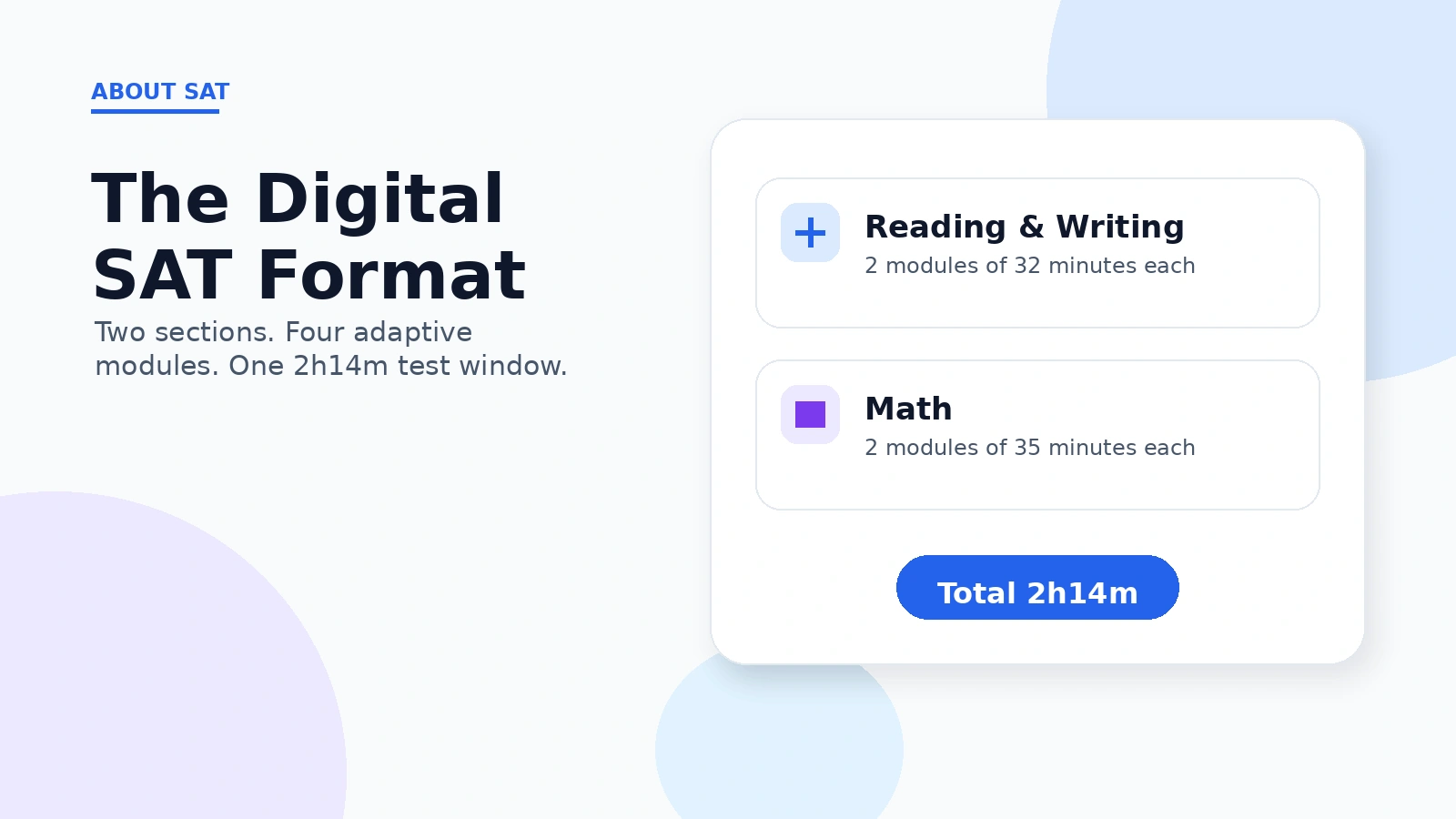
There are two scored sections, each split into two separately timed modules:
| Section | Questions | Time | Format |
|---|---|---|---|
| Reading and Writing | 54 | 64 minutes (two 32-min modules) | All multiple choice, 4 options |
| Math | 44 | 70 minutes (two 35-min modules) | ~75% multiple choice, ~25% type-in answers |
| Total | 98 | 2 hours 14 minutes of testing | Plus a 10-minute break between sections |
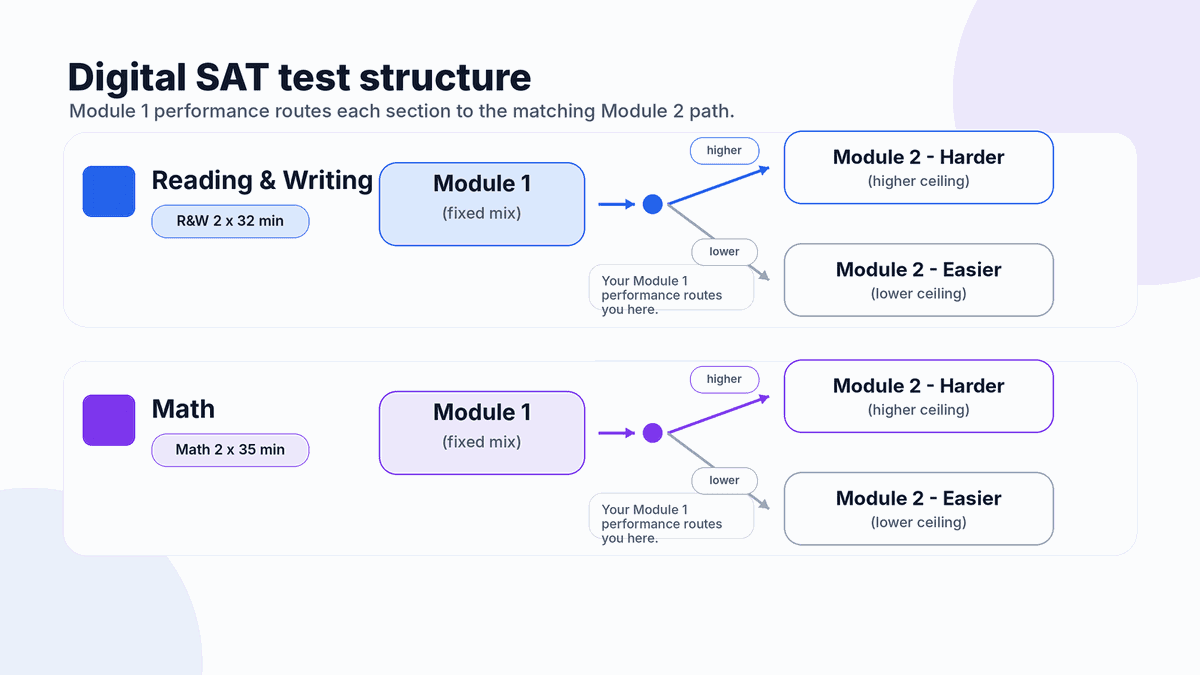
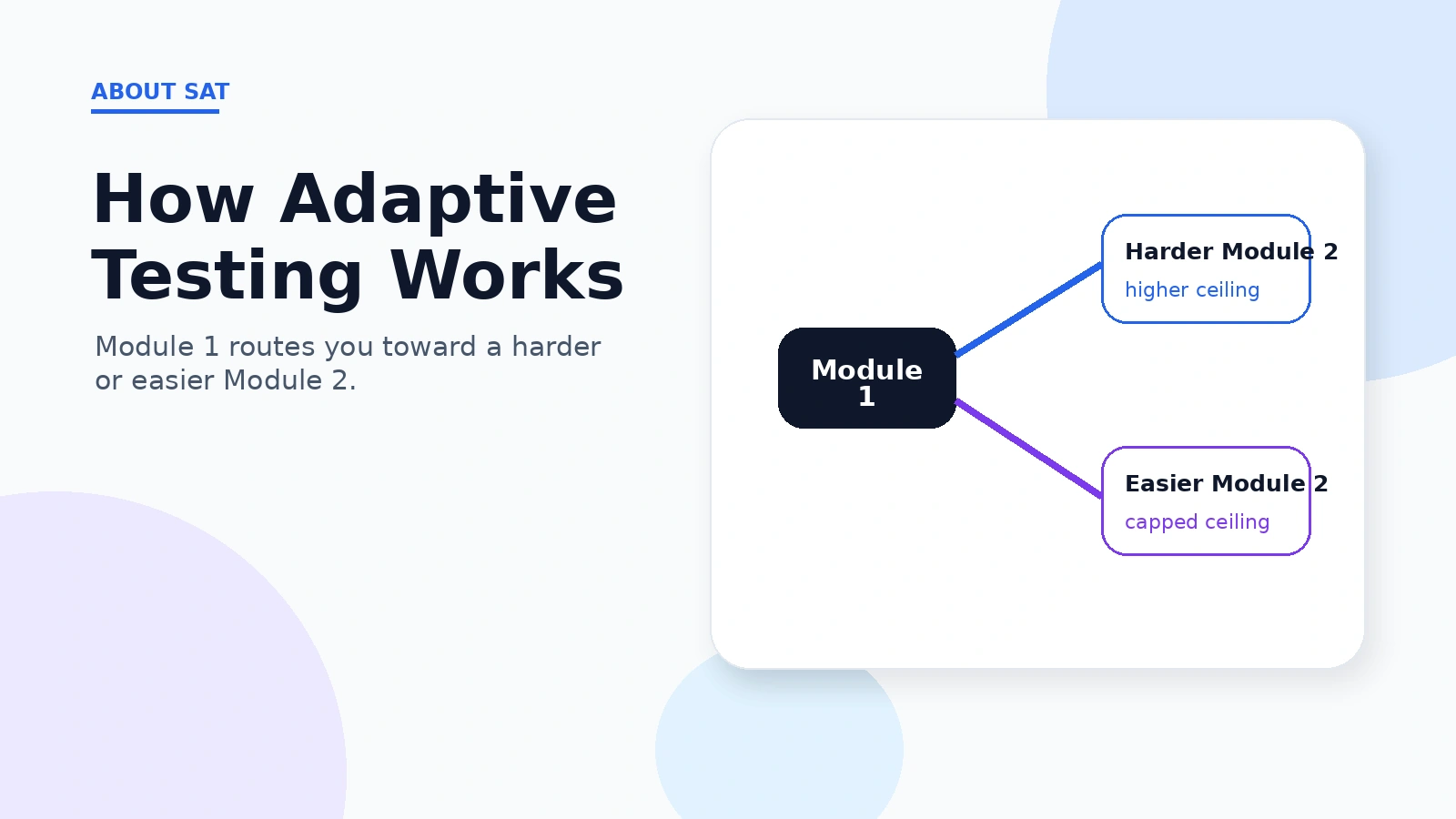
The single most important feature of the syllabus is that it is section-adaptive. Everyone sees the same Module 1 in each section. How you do on Module 1 decides whether your Module 2 is the harder or the easier version, and only the harder version unlocks the top of the scoring range. That makes a strong Module 1 the highest-leverage part of the whole test.
Two rules apply across both sections. There is no penalty for a wrong answer, so you should answer every question. And the built-in Desmos graphing calculator is available for the entire Math section.
A small note for planning: of the 98 questions, 4 are unscored pretest questions (2 per section) that the College Board uses to trial future items. You cannot tell which ones they are, so treat every question as if it counts.
Reading and Writing: the four domains tested
The Reading and Writing section has 54 questions across two 32-minute modules. Each question comes with its own short passage of roughly 25 to 150 words, so you read many short texts rather than a few long ones, and every question is multiple choice with four options. The section is built from four domains.
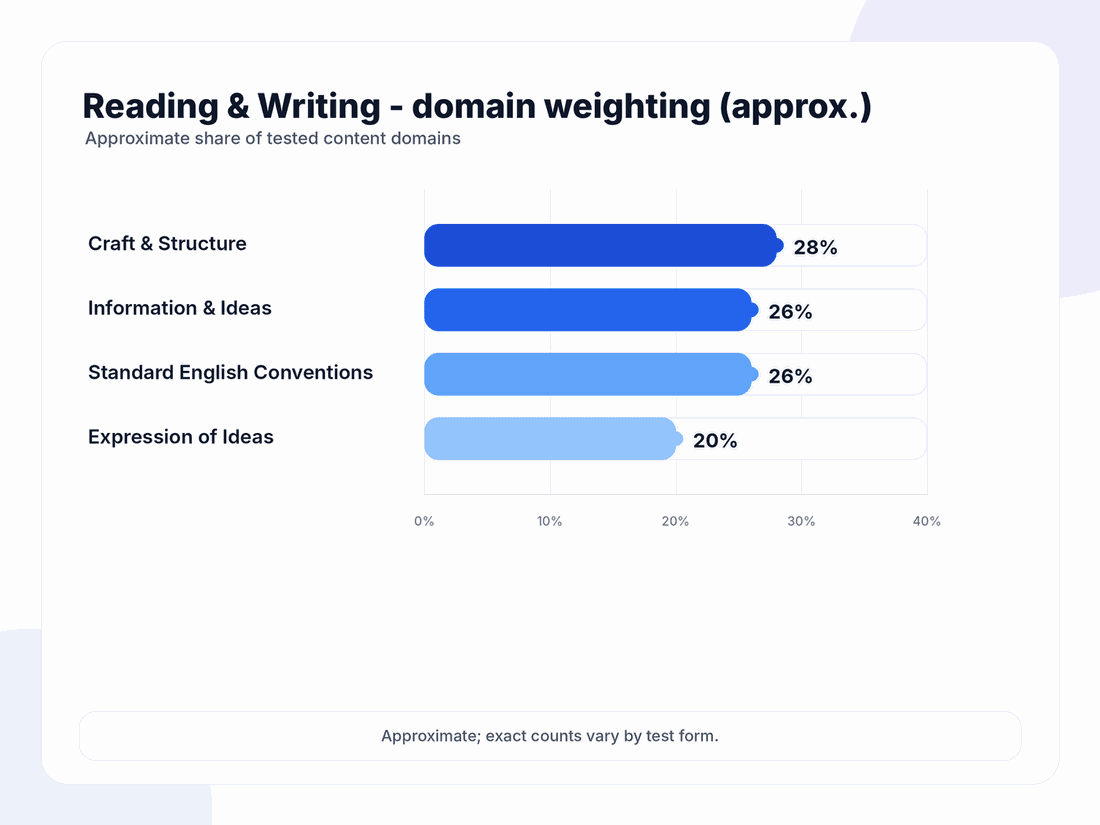
Information and Ideas (about 26% of the section)
This domain is about what a text says and what you can reasonably conclude from it. It tests three skills: identifying central ideas and details, command of evidence, and inferences. Command of evidence appears in two forms, textual (which quotation best supports a claim) and quantitative (reading a value from a graph or table and connecting it to the text). The inference questions ask you to complete a logical conclusion the passage points toward without stating outright.
Craft and Structure (about 28% of the section)
The largest Reading and Writing domain. It covers words in context, where the right meaning depends on the passage rather than the most common dictionary definition; text structure and purpose, which asks how a text is organized and why an author made a choice; and cross-text connections, where you compare how two short related passages treat the same topic. The vocabulary questions here trip up unprepared students most often.
Expression of Ideas (about 20% of the section)
This domain is about effective writing. It tests rhetorical synthesis, where you are given a short list of bulleted notes and must pick the sentence that best accomplishes a stated goal, and transitions, where you choose the word or phrase that correctly links two ideas (contrast, cause and effect, sequence, and so on). It rewards understanding the relationship between ideas, not memorized rules.
Standard English Conventions (about 26% of the section)
This is the grammar and punctuation domain. It covers sentence structure (joining and separating clauses, and avoiding fragments and run-ons), usage (subject-verb agreement, verb tense and form, pronouns, and modifiers), and punctuation (commas, semicolons, colons, dashes, and apostrophes). The rules tested are finite, which makes this the most directly studyable domain in the section.
Math: the four domains tested
The Math section has 44 questions across two 35-minute modules. About 75% are multiple choice and about 25% are student-produced responses, where you type a numerical answer with no options to choose from. A calculator is allowed on every question, and Bluebook includes the Desmos graphing calculator built in. The section covers four domains.
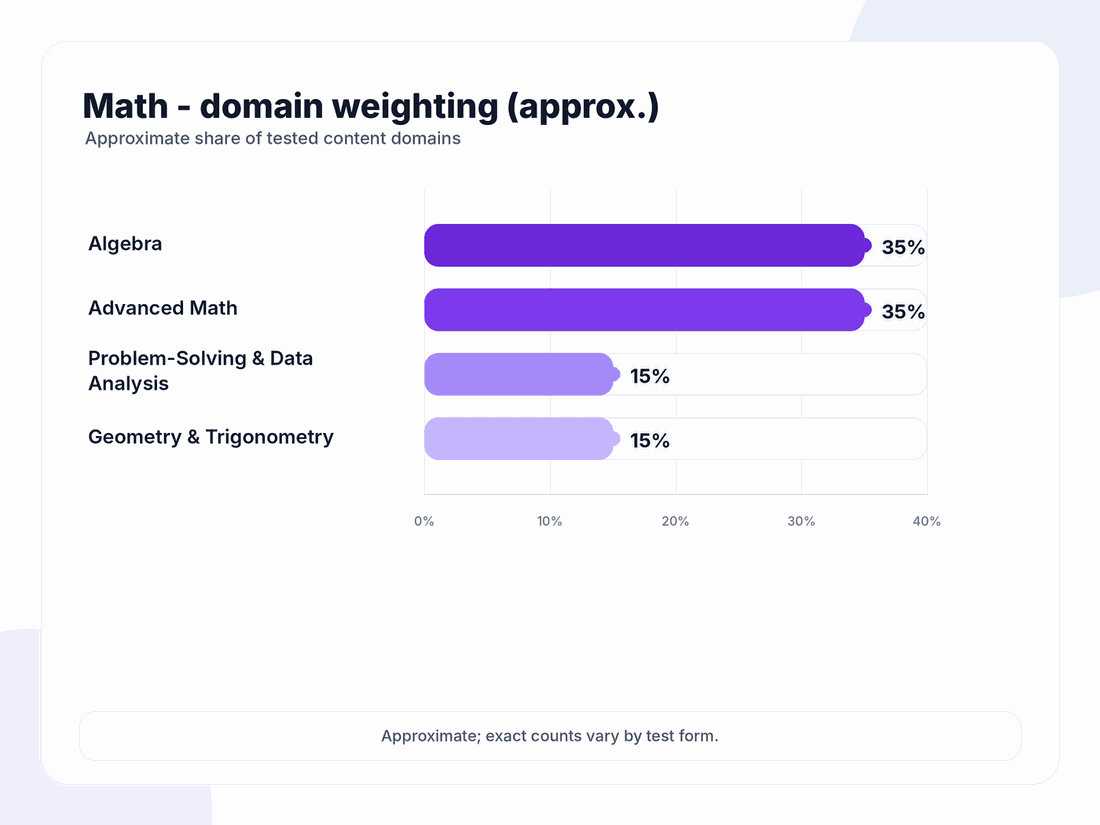
Algebra (about 35% of the section)
The foundation of the Math syllabus. It tests linear equations in one and two variables, linear functions, systems of two linear equations, and linear inequalities. Because it shares the top weighting with Advanced Math, fluency here moves your Math score more than any single Reading and Writing domain moves your verbal score.
Advanced Math (about 35% of the section)
This domain extends algebra into nonlinear territory: creating and recognizing equivalent expressions, working with nonlinear equations and functions (quadratics, exponentials, and polynomials), and solving systems that include a nonlinear equation. Together, Algebra and Advanced Math make up roughly 70% of the Math section.
Problem-Solving and Data Analysis (about 15% of the section)
The applied, real-world domain. It covers ratios, rates, and proportional relationships; percentages; units and unit conversion; probability and the basics of statistics (mean, median, range, and standard deviation as a concept); and interpreting data from tables, graphs, and scatterplots. The math is rarely hard; the challenge is reading the situation correctly.
Geometry and Trigonometry (about 15% of the section)
The smallest domain. It covers area and volume; lines, angles, and triangles; right triangles and basic trigonometry (sine, cosine, tangent, and the Pythagorean theorem); and circles. Many of the formulas you need are provided in the test's reference sheet, so this domain rewards knowing how to apply formulas more than memorizing them.
How the Digital SAT is scored
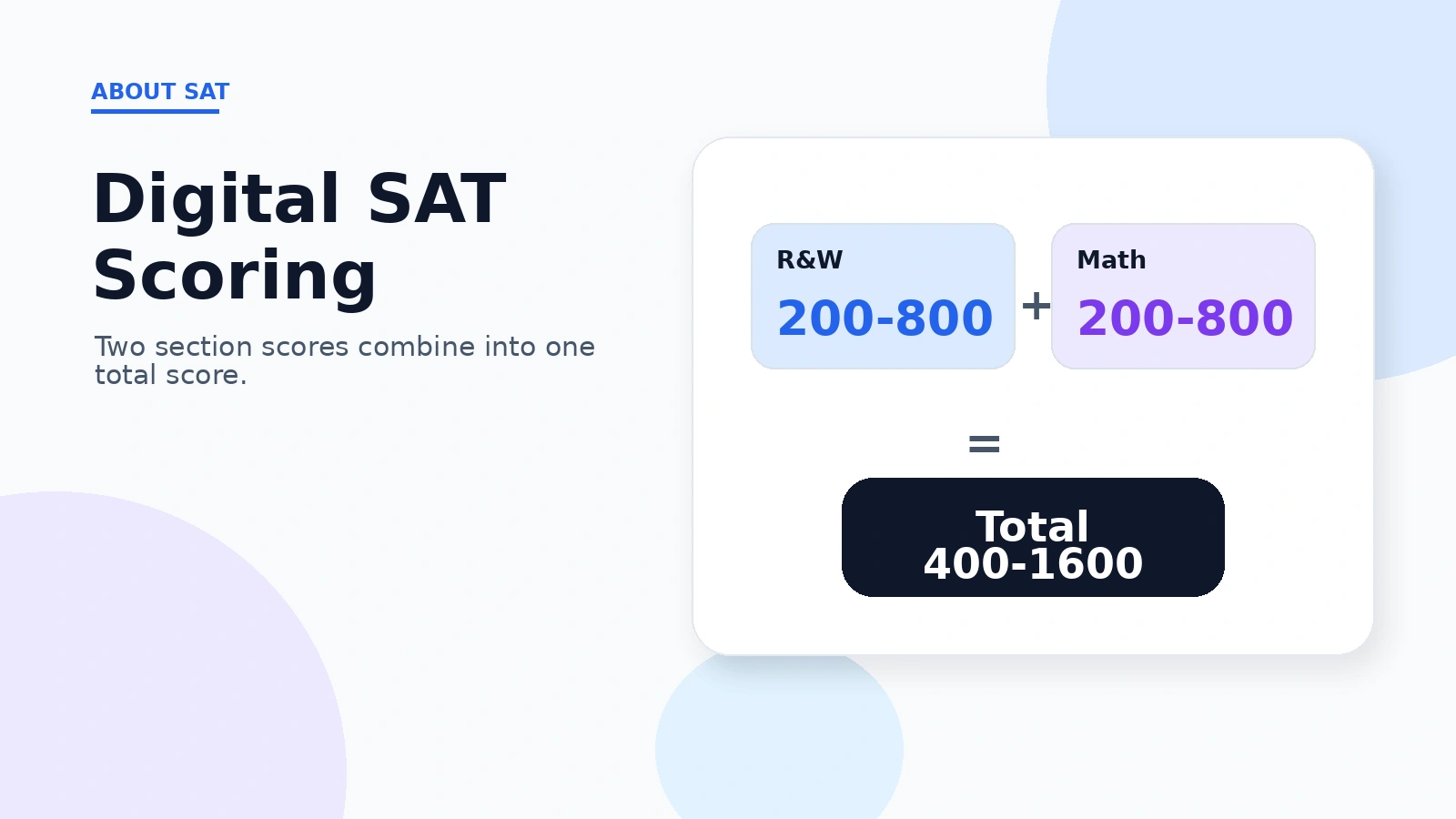
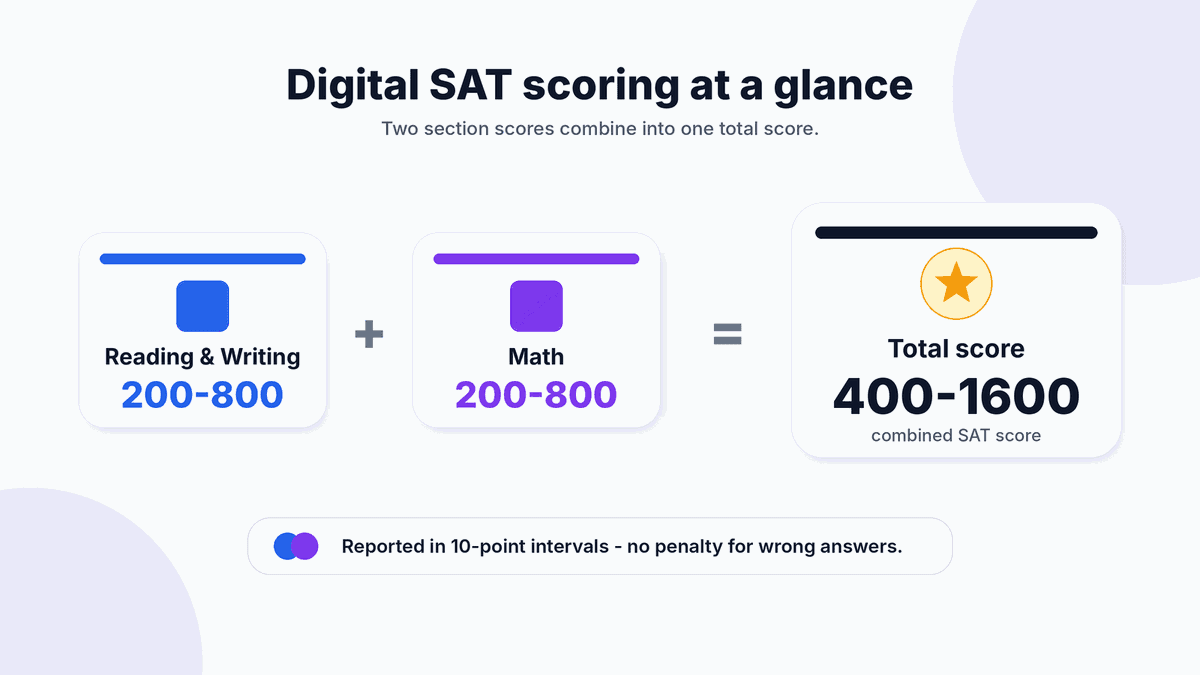
Your total score runs from 400 to 1600 and is the sum of two section scores, Reading and Writing (200 to 800) and Math (200 to 800). Scores are reported in 10-point intervals, so a 690 is possible but a 691 is not.
Raw scores (the number of questions you answered correctly) are converted to scaled scores through a process called equating, which adjusts for small differences in difficulty between test forms so that a given score means the same thing on any date. Because the test is adaptive, the difficulty of the Module 2 you were routed into also factors into your ceiling. Digital scores are typically released within about two weeks, much faster than the old paper test.
How to use this syllabus to build your study plan
Treat this syllabus as a map, not a reading list. The fastest way to raise a score is to find the two or three domains where you lose the most points and concentrate there, rather than reviewing everything evenly.
Start with a full-length diagnostic to see your per-domain performance, then weight your effort by two things at once: where you are weak, and how much each domain counts. A weak spot in Algebra (about 35% of Math) is worth more attention than the same gap in Geometry and Trigonometry (about 15%). For the section-by-section playbook, see our guide on building an SAT study plan, and for the mechanic that makes Module 1 so important, read how Digital SAT adaptive testing works. When you are ready to register, our walkthrough of the SAT test dates and deadlines covers the full schedule.
At Prism Learning, every practice test maps your results straight back to these eight domains and turns them into a targeted plan, so the hours you put in land on the topics that actually move your score.
Frequently asked questions about the Digital SAT syllabus
Q: How many topics are on the Digital SAT? A: The syllabus is organized into eight content domains, four in Reading and Writing and four in Math. Each domain contains several specific skills, so there are more individual question types, but the eight domains are the structure everything else hangs on.
Q: Is the Digital SAT syllabus the same in 2026 as in 2025? A: Yes. The fully digital, adaptive, 1600-point format has applied to all US test-takers since March 2024 and is unchanged for the 2025 and 2026 testing years. Always confirm current details on the College Board site before your test date.
Q: What is the hardest part of the SAT syllabus? A: It varies by student, but two areas catch people out most: vocabulary in context within Craft and Structure, because the answer depends on the passage rather than the dictionary, and Advanced Math, because it moves beyond linear equations into quadratics, exponentials, and functions.
Q: Do I need to memorize math formulas for the SAT? A: Some, but not all. The Math section provides a reference sheet of common geometry formulas, so Geometry and Trigonometry rewards application over memorization. You should still know core algebra relationships and how to use the built-in Desmos calculator efficiently.
Q: How is the SAT syllabus weighted? A: In Math, Algebra and Advanced Math dominate at roughly 35% each, with Problem-Solving and Data Analysis and Geometry and Trigonometry at about 15% each. In Reading and Writing, the four domains are more even, ranging from about 20% to 28%. Exact question counts vary slightly between test forms.
Put this into practice with PRiSM Learning: the SAT Math practice set and the Reading & Writing practice set.