When to Start SAT Prep: Timing, Test Dates, and a Sample Plan
A practical guide to when to start SAT prep: the three-to-four-month rule, an ideal timeline by grade, how many months you need, and how to line it up with test dates.

The simplest rule for when to start SAT prep is to begin about three to four months before your first test date, which usually means starting in the fall or winter of junior year for a spring SAT. That window is long enough to cover every content area and take full-length practice tests without burning out. Here is how to time your prep by grade, how many months you really need, and how to line it up with test dates.
When to start SAT prep
The right start date works backward from your first test. Plan for roughly three to four months of steady preparation, a few hours a week, leading into the test. For a March or May SAT in junior year, that means starting around November to January.
Starting earlier than four months out is fine if you spread the work thinly, but very long timelines often lose momentum. Starting much later than three months out tends to compress practice tests and leave content gaps. The sweet spot for most students is a focused three-to-four-month block built around a specific test date.
The ideal SAT prep timeline by grade
| Grade | What to do |
|---|---|
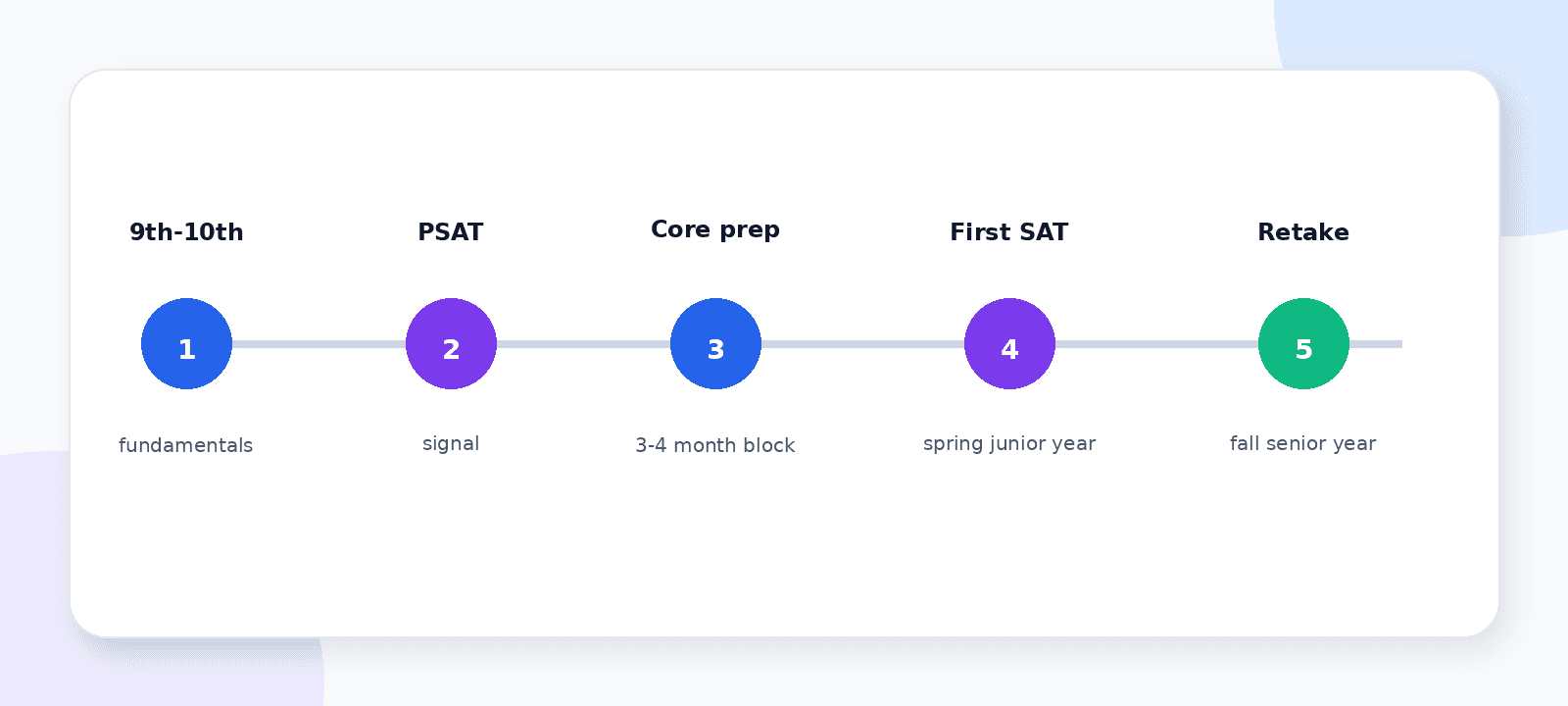
| 9th-10th grade | Build strong reading and math fundamentals; take the PSAT for a baseline. No formal SAT prep needed yet. |
| Fall of 11th grade | Take the PSAT; begin light, structured prep with a diagnostic test. |
| Winter-spring of 11th grade | Core prep block; take your first SAT in March, May, or June. |
| Summer before 12th grade | Review weak areas from your first score; prep for a retake. |
| Fall of 12th grade | Retake in August, September, or October if needed, before application deadlines. |
Taking your first SAT in junior year is the single most useful timing decision, because it leaves room for a retake while keeping scores ready before senior-fall deadlines.
How many months of SAT prep do you need?
The honest answer depends on the gap between your diagnostic score and your target. A good rule of thumb is that a focused student can target a meaningful score gain over about three to four months of consistent work, but a larger jump naturally takes longer.
Start with a full-length diagnostic to find your baseline and your weakest content domains. Then weight your study time toward those domains and toward the highest-value areas of the test. Our Digital SAT syllabus shows how the eight content domains are weighted so you can prioritize, and our guide to building an SAT study plan turns that into a week-by-week schedule.
Lining up prep with your test date
Choose your test date first, then count backward three to four months to set your start date. Make sure your chosen date leaves room for a retake before any application deadlines, and confirm the schedule on our SAT test dates guide.
If you are applying Early Decision or Early Action, plan so that you finish testing by the early-fall date whose scores will arrive before your deadline, often the October SAT. Registering early also protects your choice of test center, which matters most during the busy fall season.
Frequently asked questions about SAT prep timing
Q: When should I start studying for the SAT? A: About three to four months before your first test date, which for a spring SAT in junior year usually means starting in the fall or winter of 11th grade. That gives you time to cover content and take full practice tests.
Q: What grade should I take the SAT in? A: Most students take it for the first time in the spring of junior year, then retake it in the early fall of senior year if needed. This leaves room to improve while keeping scores ready before deadlines.
Q: How many months of SAT prep do I need? A: Three to four months of consistent work suits most students aiming for a solid improvement. A larger score jump usually takes longer, so start with a diagnostic to gauge the gap.
Q: Is it too early to prep in 9th or 10th grade? A: Formal SAT prep is usually unnecessary that early. Focus on strong reading and math fundamentals and take the PSAT; targeted SAT prep is most effective starting in junior year.
Q: Can I prepare for the SAT in one month? A: It is possible to review and sharpen test strategy in a month, but one month rarely allows enough full-length practice to close large content gaps. If your timeline is short, prioritize your weakest high-value domains.
Put this into practice with PRiSM Learning: PRiSM's SAT plans and pricing and the full PRiSM SAT prep program.