SAT vs ACT in 2026: Key Differences and How to Choose
A current, side-by-side comparison of the Digital SAT and the Enhanced ACT: format, length, scoring, the optional Science section, and how to pick the right test.

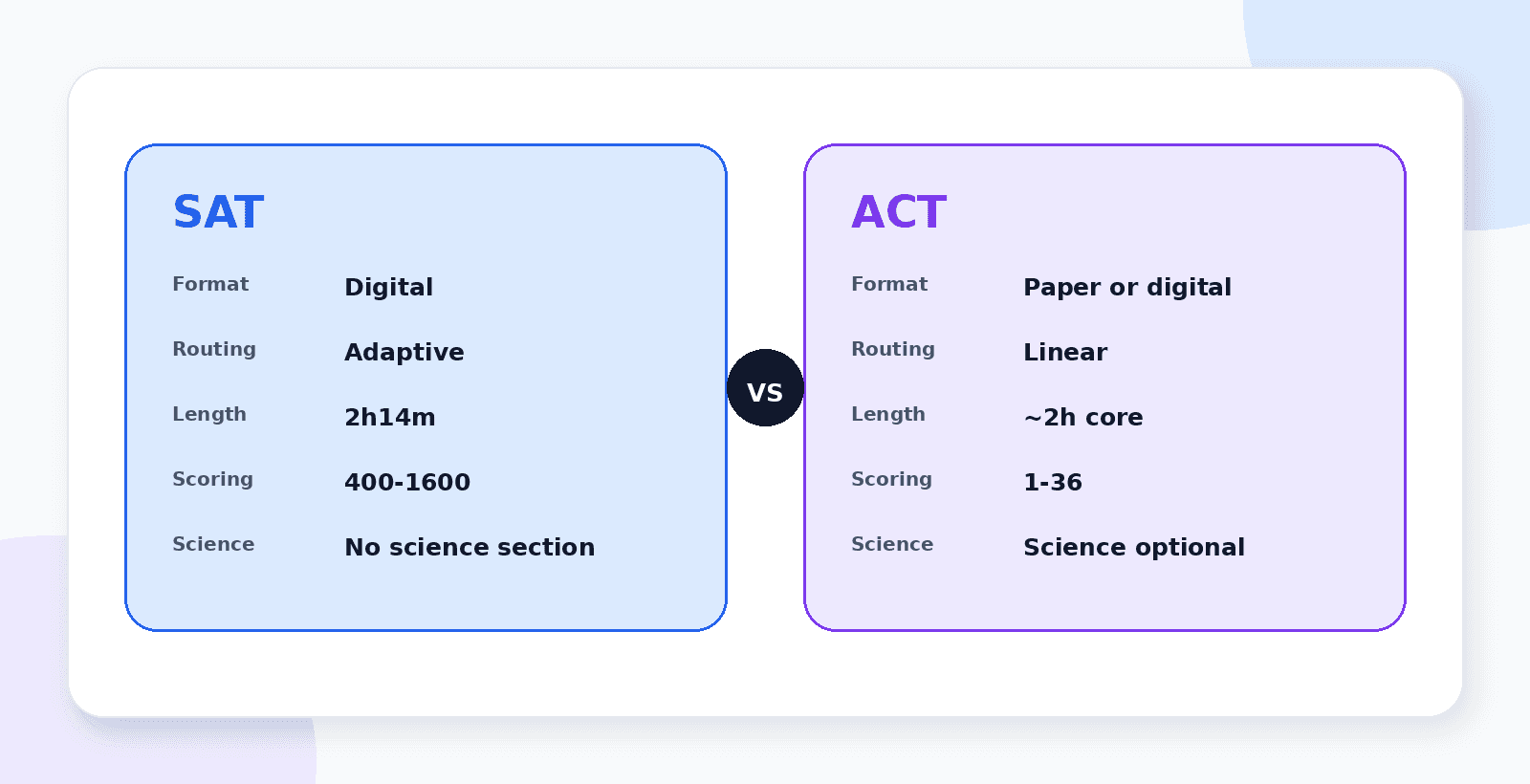
In the SAT vs ACT decision, the biggest 2026 differences are format and structure. The Digital SAT is a fully digital, section-adaptive test of 2 hours 14 minutes scored from 400 to 1600. The Enhanced ACT is a shorter, linear test (paper or digital) with a now-optional Science section, scored from 1 to 36. Most colleges accept either equally, so the right choice usually comes down to which format fits how you think. Here is the full comparison.
SAT vs ACT: the key differences
Both tests changed dramatically in the last two years, so older advice is often out of date. The table below reflects the current 2026 formats.
| Feature | Digital SAT | Enhanced ACT |
|---|---|---|
| Format | Fully digital, section-adaptive | Paper or digital, linear (not adaptive) |
| Length | 2 hours 14 minutes | About 2 hours core; about 2h40m with Science |
| Sections | Reading and Writing, Math | English, Math, Reading; Science and Writing optional |
| Total score | 400 to 1600 | 1 to 36 composite |
| Science | No separate section | Optional separate section (not in composite) |
| Calculator | Allowed on all Math (Desmos built in) | Allowed on Math |
| Scores released | About two weeks | About two to eight weeks |
How the Digital SAT works now
The SAT went fully digital in March 2024, and the paper version is gone. It has two sections, Reading and Writing and Math, each split into two modules, for 98 questions in 2 hours and 14 minutes. There is no essay; the optional essay was retired in 2021.
Its defining feature is that it is section-adaptive: your performance on the first module of each section routes you into a harder or easier second module, and the harder path unlocks the top scores. For a full breakdown, see our Digital SAT format guide and the Digital SAT syllabus.
How the Enhanced ACT works now
The ACT rolled out its "Enhanced" format starting in April 2025 for national online tests, September 2025 for all national weekend tests, and spring 2026 for school-day administrations. The core test is now English, Math, and Reading, taking about two hours, down from roughly three hours on the old version.
The headline change is that Science is now optional. The 1 to 36 composite is built only from English, Math, and Reading; if you take Science, it is reported separately and feeds a STEM score, but it does not affect your composite. Writing remains optional too. Unlike the SAT, the ACT is linear, not adaptive, and you can choose paper or digital.
Which test should you take?
Because colleges treat the two tests equally, choose the one you score better on and feel more comfortable taking. A few patterns can guide you:
- Consider the SAT if you prefer a fully digital, adaptive test, want a built-in graphing calculator on every math question, and like more time per question.
- Consider the ACT if you prefer a linear test you can take on paper, are strong in science reasoning (and want that separate score for STEM programs), or simply pace better on its style of questions.
The most reliable way to decide is to take a timed, full-length practice test of each current format and compare both your scores and how each one felt. At Prism Learning, a diagnostic on each test shows you where you stand and which one gives you the higher ceiling, so you can commit your prep time to a single test with confidence.
Do colleges prefer the SAT or the ACT?
No. Colleges that require or accept testing accept the SAT and the ACT equally and do not favor one. Yale's "test-flexible" policy even lets applicants meet the requirement with AP or IB scores instead. Whether scores are required at all depends on the school; for that, see our guide on who should take the SAT.
Frequently asked questions about SAT vs ACT
Q: Is the SAT or ACT easier? A: Neither is universally easier. They reward slightly different strengths, the SAT with its adaptive digital format and more time per question, the ACT with its linear structure and optional Science. The best test is the one you score higher on, which a practice test of each will reveal.
Q: Do colleges prefer the SAT or the ACT? A: No. Schools that consider testing accept both equally. Choose the test that suits you, not the one you think colleges want.
Q: Is the ACT Science section still required? A: No. As of the Enhanced ACT, Science is optional and is not included in the 1 to 36 composite. If you take it, the score is reported separately and contributes to a STEM score.
Q: Is the ACT adaptive like the digital SAT? A: No. The Enhanced ACT is linear in both its paper and digital forms. Only the SAT adapts, adjusting the difficulty of your second module based on the first.
Q: Should I take both the SAT and the ACT? A: Usually not. It is more efficient to take a practice version of each, pick the one you do better on, and focus your preparation there rather than splitting effort across two tests.
Put this into practice with PRiSM Learning: PRiSM Learning and the PRiSM SAT prep program.