Who Should Take the SAT? Test-Optional Rules and Who Still Needs Scores
A clear answer to who should take the SAT in 2026-2027: which selective colleges require scores again, why scores still help at test-optional schools, and who can skip it.

The short answer to who should take the SAT is that most college-bound students still should. As of the 2026-2027 cycle, many of the most selective universities have brought back testing requirements, and even at schools that remain test-optional, roughly 80 to 85 percent of applicants submit scores. The main exceptions are students applying only to test-free schools like the University of California. Here is who needs the SAT, who can skip it, and why scores still matter even when they are optional.
Who should take the SAT in 2026-2027
You should plan to take the SAT if any school on your list requires or recommends testing, if you might pursue merit scholarships, or if a strong score would strengthen an application where your GPA alone might not stand out. For most students building a college list with a mix of selective schools, that covers nearly everyone.
You can reasonably skip the SAT only if every school you are applying to is test-free (meaning it will not consider scores at all) and you are not seeking scholarships that require them. Because policies change and college lists grow, taking the test once keeps your options open.
The test-optional landscape has shifted
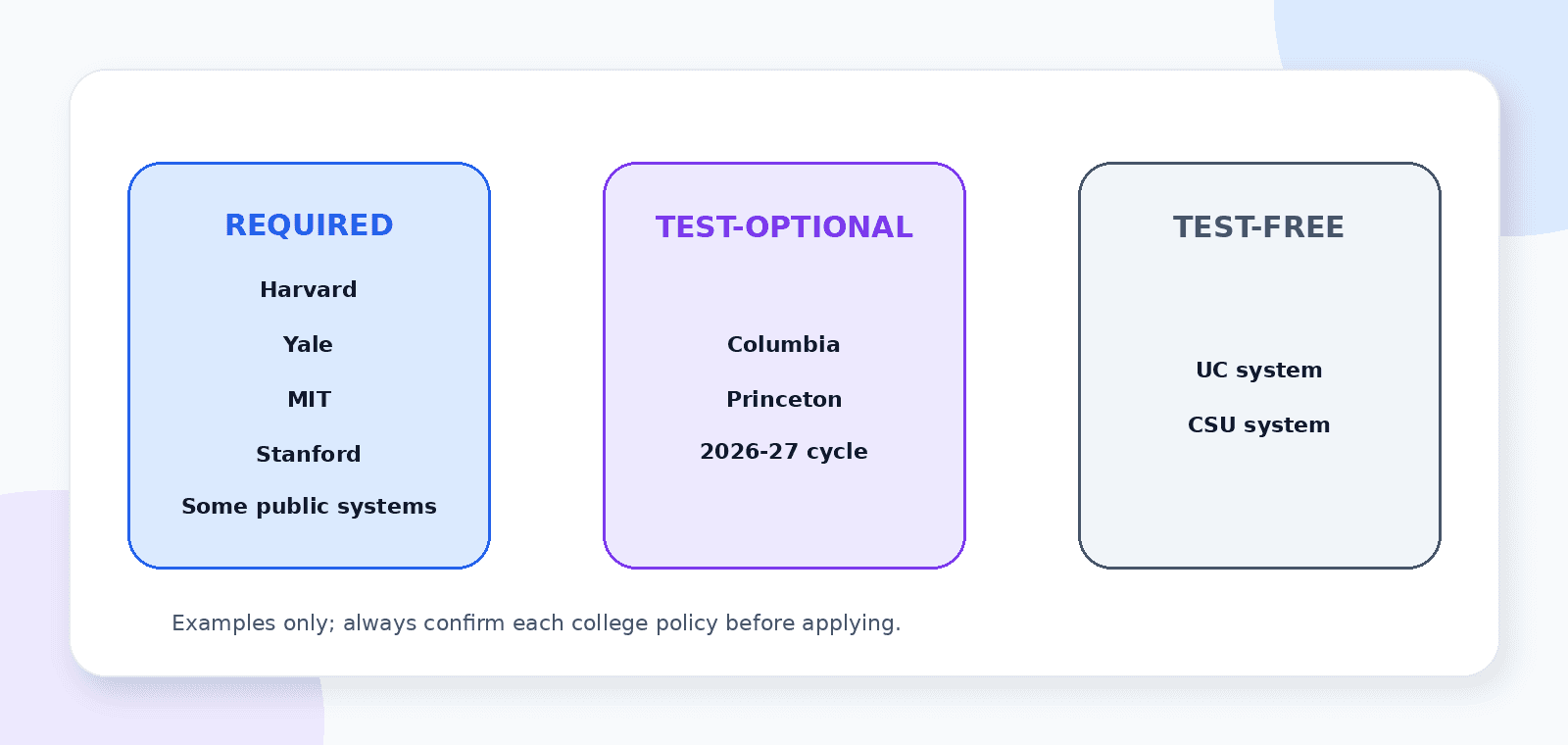
The pandemic-era test-optional wave is receding at the most selective universities. For the 2026-2027 application cycle, six of the eight Ivy League schools require scores: Harvard, Yale (under a test-flexible policy that also accepts AP or IB results), Brown, Dartmouth, Cornell, and the University of Pennsylvania.
Columbia remains the only Ivy with a permanent test-optional policy, and Princeton is test-optional for 2026-2027 before requiring scores starting with the 2027-2028 cycle. Beyond the Ivies, schools such as MIT, Caltech, Stanford, Georgetown, and Johns Hopkins require scores, as do large public systems including Florida, Georgia, the University of Texas at Austin, and Ohio State's Columbus campus. Several of these reinstated testing after internal research found scores were a strong predictor of college success, particularly for lower-income and first-generation students.
Policies still vary widely and continue to change, so verify the current requirement for every school on your list directly with its admissions office before you decide.
Why scores still help even at test-optional schools
Test-optional does not mean test-blind. At schools that let you choose, a strong score is one more piece of evidence in your favor, and the share of applicants submitting scores has climbed from roughly 55 to 60 percent a few years ago to about 80 to 85 percent today.
Scores can also unlock money. Many colleges, including some that are test-optional for admission, use SAT or ACT scores to award merit-based scholarships and to qualify students for honors programs. A good score can be worth real financial aid even where it is not required to apply.
The practical rule at a test-optional school: submit your score if it is at or above the school's published middle-50% range, and consider withholding it only if it falls well below. To find your starting point, take a diagnostic and compare it to your target schools' ranges.
Who can skip the SAT
A small set of schools are test-free (sometimes called test-blind), meaning they will not consider scores even if you send them. The University of California system has been test-free since 2021, and the California State University system followed in 2022, both by policy that is not expected to change.
If your entire list is test-free and no scholarship you want requires a score, you do not need the SAT. Even then, taking it once is low-risk insurance in case you add a school or a scholarship later. To decide between tests, see our comparison of the SAT vs ACT, and to plan your timing, read when to start SAT prep.
Frequently asked questions about who should take the SAT
Q: Do I still need to take the SAT in 2026? A: Most likely yes. Many selective colleges require scores again for the 2026-2027 cycle, and most applicants to test-optional schools submit scores anyway. You can skip it only if every school on your list is test-free and you are not chasing scholarships that need a score.
Q: Which Ivy League schools require the SAT? A: For 2026-2027, Harvard, Yale, Brown, Dartmouth, Cornell, and the University of Pennsylvania require scores. Columbia is permanently test-optional, and Princeton is test-optional for this cycle before requiring scores in 2027-2028. Always confirm with each school.
Q: Should I submit my score to a test-optional school? A: Generally submit it if it is at or above the school's middle-50% range, and consider withholding it if it falls well below. A score in range can only help, and may also qualify you for merit aid.
Q: Are there schools that will not look at my SAT score at all? A: Yes. Test-free schools such as the University of California and California State University systems do not consider scores in admissions, though some may use them for course placement after you enroll.
Q: Does a good SAT score help with scholarships? A: Often, yes. Many colleges use SAT or ACT scores to award merit scholarships and honors-program eligibility, sometimes even when scores are optional for admission.
Put this into practice with PRiSM Learning: PRiSM Learning and the PRiSM SAT prep program.