What Is This Question Actually Testing? #1 — The System With No Solution
“No solution” means parallel lines — that one inference is the whole question. The 90-second coefficient method, why Desmos struggles here, and the drill.

The short answer: Not algebra speed, and not Desmos. This question tests one inference — no solution means parallel lines, so the coefficient ratios must match — and one choice of method. Students who know both finish in under 90 seconds. Students who don't quit at 96. Accuracy: 36% (Prism platform analysis, 2026).
The question
A student sent me this question with a one-line message: "How do I solve this using Desmos?" Before I answer that, try it yourself — the way you would on test day.
$$
$$
In the given system of equations, p is a constant. If the system has no solution, what is the value of p?
— Official College Board digital SAT question. There are no answer choices — you type in the answer yourself.
Why the popular method feels right
Desmos has been paying you all year. Graph it, drag it, read it — on plenty of questions that genuinely works. So the plan writes itself: type both equations, put a slider on p, drag until the lines look parallel.
This is where strong students lose the question. The plan has three breaks in it, and each one is built into the question:
- The typing is the riskiest step. Four fractions in the first equation alone. One wrong denominator and the graph lies to you with full confidence.
- Your eye can't certify "parallel." At p = 5.9, 6.0, and 6.1 the lines all look parallel. Looking parallel is not being parallel.
- There are no answer choices. You can't test options against the graph. You have to produce the exact value yourself — so the algebra is still waiting for you after all the dragging.
And to even start the plan, you needed the idea that no solution means parallel. The tool never spares you the concept. It adds slow, risky work on top of it.
What the question rewards
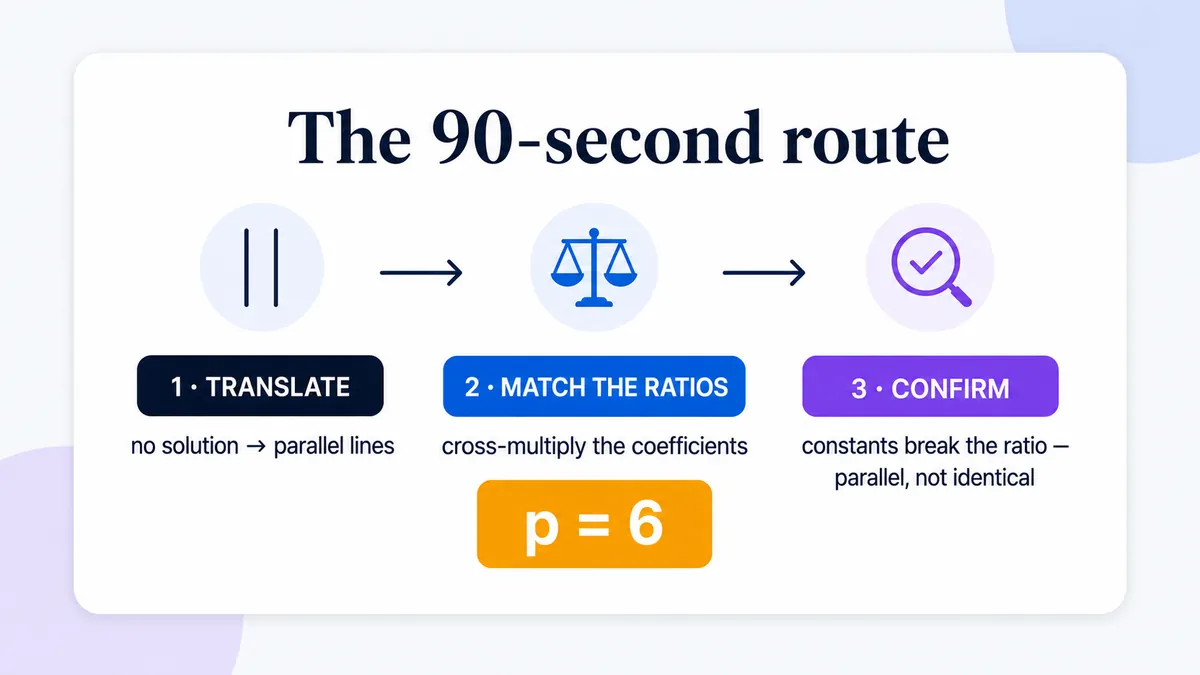
One inference, one clean method. No solution means the lines never meet. Lines that never meet are parallel — so the x- and y-coefficients sit in the same proportion, while the constants break it.
Tidy both equations into : and . Match the ratios and cross-multiply: , so — p = 6. One glance to confirm the constants don't follow the same ratio (, not ): the lines are genuinely parallel, not the same line.
Two tidy-ups, one cross-multiplication, one glance. The only fractions you touched are the ones College Board printed. (Comparing slopes also works — it just manufactures four new fractions on the way, including a p in a denominator. Correct, but costlier.)
What the data says
- 36% accuracy. Two-thirds of students never get there.
- Wrong answers stop at a median of 96 seconds. That is not the timestamp of a calculation error. It's the timestamp of a student who never found the inference and watched the familiar moves connect to nothing.
- Right answers take 2:48 at the median. Most solvers found a way — the slow way. The skilled solve is under 90 seconds, so the typical correct answer paid roughly double.
The chain behind those numbers is short: students miss this question because they can't start, and they can't start because "no solution" never became "matching ratios." That's the root cause. And once you have the root cause, the fix is a slam dunk — one sentence of translation, not fifty more drills.
The skill, named
This question tests two abilities, one after the other.
The first is translation. The question hands you a condition in words — no solution — and expects you to turn it into structure: two parallel lines, matching coefficient ratios. Most students who miss this question fall right here, at the first step. Not because the math is hard — because they never paused to ask what the condition actually means.
The second is choosing your method. Three roads lead to p = 6, and the question quietly tells you which one to take. The unknown is a letter, not a number — so a slider has nothing definite to land on. The fractions are messy — so every extra manipulation is a chance to slip. And you have to type the exact answer yourself — so "close enough" doesn't exist. Every one of those features points to the coefficient route, and away from the calculator.
Neither ability is a trick. Both are exactly what your first college math course assumes you already have.
And there's a bonus. The same picture answers the SAT's cousin question — infinitely many solutions. Same setup, one difference: now the constants must match the proportion too, because the two equations have to be the same line. Understand one idea, and you can solve the whole family of questions built on it. That's what understanding buys that memorization never will.
Run this every time
- 1.Translate before you touch anything. Say the condition as a structure sentence: "no solution = ratios match, constants don't." If you can't say it, no method can start.
- 2.Pick your method from the question's features. A letter for the unknown, messy fractions, no answer choices — that's the question telling you: coefficients, not the calculator. Ten seconds of judgment.
- 3.Confirm the constants. Parallel, not identical. One glance.
Tonight, take your last three hard algebra misses and write, for each one, the structure sentence you never wrote on test day. Three sentences. If you can name what a question was testing, you own it — and that's the ability this question was built to find.
A note on sources and figures
- Question text: official College Board digital SAT item, reproduced for educational commentary and analysis, attributed to College Board.
- Prism Learning platform analysis (2026): accuracy 36.2% (80 attempts); median 168s correct / 96s incorrect — from our 2,845-question analysis of official digital SAT questions with real student performance. The under-90-second skilled solve is our editorial estimate, consistent with the observed timing gap. Prism's findings, not College Board figures.
Put this into practice with PRiSM Learning: the PRiSM SAT prep program and PRiSM's full-length SAT mocks.