The Most Popular Answer Is Wrong: Inside a Hard SAT Transition Question
On this hard SAT transition question, 53% pick “However” — and it’s wrong. See why careful students miss it, and the 3-step drill that fixes it.
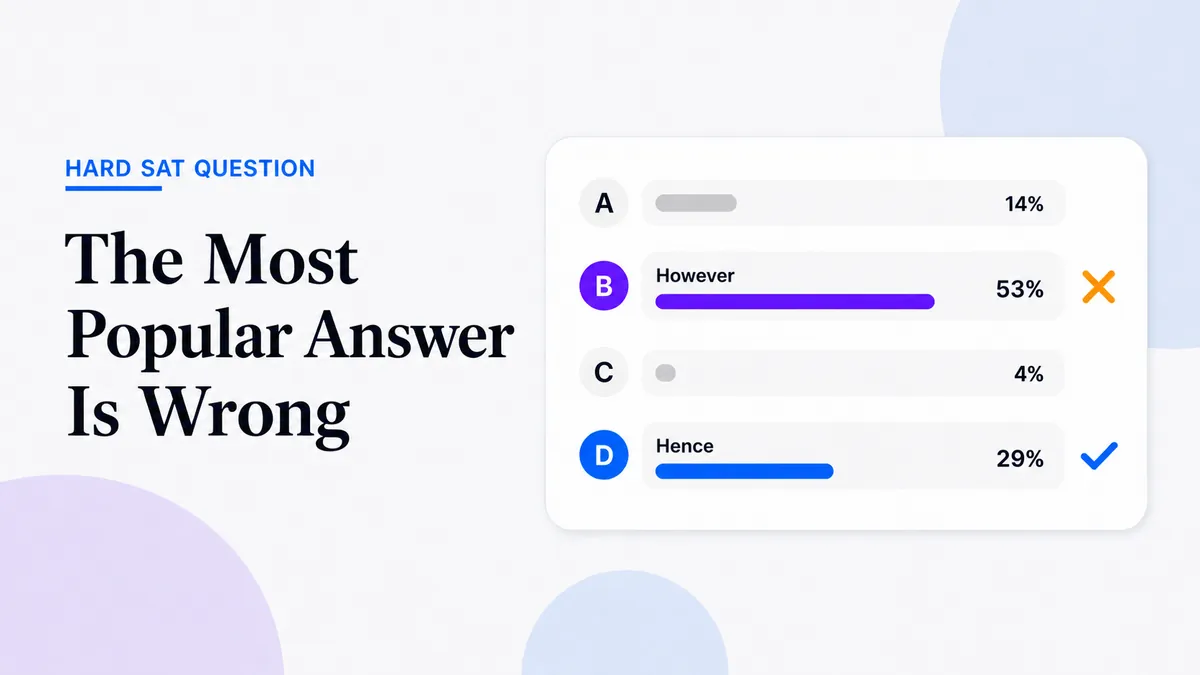
The short answer: On this official hard question, the trap answer is more popular than the correct one — 53% pick "However," only 29% find "Hence." And the times match (28 vs 29 seconds), so it isn't carelessness. It's pattern-matching, carefully executed. That's the 750 test's signature move (Prism platform analysis, 2026).
The question
I want to show you the single most revealing thing in our dataset — a question where the most popular answer in the room is wrong. Try it first, the way you would on test day:
A turtle shell appears external to the animal, protecting its body like armor. ______ the shell is often incorrectly assumed to be an exoskeleton, a rigid outer casing like that of a crustacean or an insect, when in fact it is an endoskeleton, a part of the turtle's internal bone structure, more akin to a spine or a pair of ribs.
A) That being said, B) However, C) For instance, D) Hence,
— Official College Board digital SAT question.
Why the popular method feels right
Run the instinct you've been rewarded for a hundred times: scan the sentence's shape. "Shell appears external… but in fact it's internal bone." Appearance versus reality — that's a contrast. Grab the contrast word — However — and move on, feeling sharp.
Here's how students on our platform split: B 53% · D 29% · A 14% · C 4%. The trap doesn't just catch a careless few — it's the most popular answer in the room. And this is where strong students should pay attention: right answers took a median of 28 seconds, wrong ones 29. Same care, same effort, same reading of every word. What failed wasn't attention. It was the method — answering the sentence's shape instead of its logic.
What the question rewards
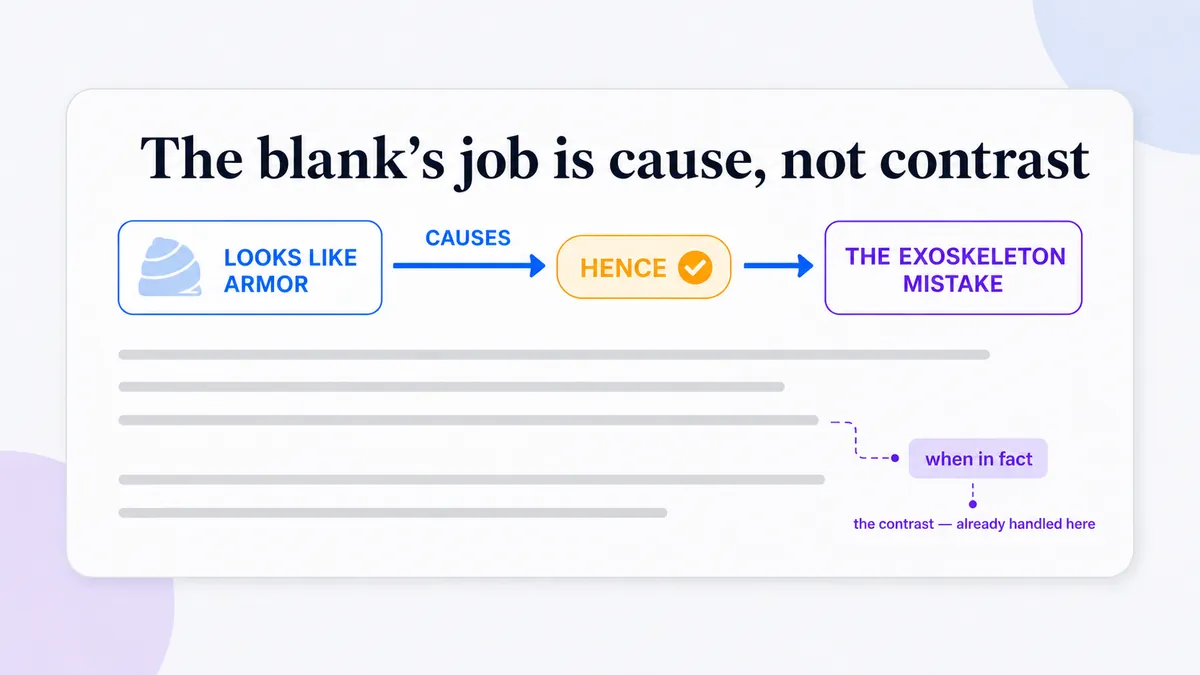
Figure out the blank's job before you shop for words. The blank connects two ideas: the shell looks external, and people incorrectly assume it's an exoskeleton. The real relationship between those two isn't a clash — the look is the reason for the mistake. Because it looks like armor, people file it wrong. Cause and effect. Hence.
But there is a contrast in the sentence — and the sentence already handles it, with "when in fact," one clause later, where it belongs. The test writers planted a real contrast right after the blank, knowing you'd feel it and reach early. Add choice A — the softer version of the same trap — and 67% of students answered a job the blank was never given.
What the data says
- 53% pick the wrong answer the question was built around; 29% find the right one. The trap is nearly twice as popular as the right answer.
- 28 vs 29 seconds. Wrong answers are not rushed answers. The instinct executes perfectly — on the wrong task.
- About 7 in 10 hard Reading & Writing questions can't be answered without real understanding (the parent article's finding). This question shows how that's enforced: three plain lines, no big words — and the only way through is the logic.
This is why a score can park at 650 while the student is being careful. The miss doesn't feel like a trap. It feels like "I was sure of that one." The most dangerous misses on hard questions are the confident ones.
The skill, named
This question tests one ability: name the blank's job before you evaluate a single choice.
Every transition blank has a job — connect two specific ideas in one specific way. Cause, contrast, example, addition. The students who get this question right aren't better at vocabulary, and they aren't slower or more careful. They simply decide what the relationship is before the answer choices get a vote.
That's reading for logic instead of shape. No pattern drill builds it, because patterns are exactly what it replaces. And it's the skill your college reading will assume from day one — a lecture, a textbook, a source you have to evaluate. The SAT is just the first place it gets measured.
Run this every time
- 1.Name the two ideas the blank sits between — in your own words.
- 2.Commit to the relationship before you look at the choices. Cause? Contrast? Example? Decide first, so the choices can't decide for you.
- 3.Check that a nearby signal isn't already doing the job. "When in fact" had the contrast covered. A relationship that's already expressed is never the blank's job.
Tonight, pull three hard transition questions from your practice set. Cover the choices, write the relationship in your own words, then uncover and answer. Anywhere your written relationship and your final answer disagree, you've caught the shortcut habit in the act. That catch is the breakthrough.
A note on sources and figures
- Question text: official College Board digital SAT item, reproduced for educational commentary and analysis, attributed to College Board.
- Prism Learning platform analysis (2026): accuracy 34% (50 attempts); choice distribution A 14% / B 53% / C 4% / D 29%; median 28s correct / 29s incorrect; the 7-in-10 must-understand rate for hard R&W — from our 2,845-question analysis of official digital SAT questions with real student performance. Prism's findings, not College Board figures.
Put this into practice with PRiSM Learning: the PRiSM SAT prep program and PRiSM's full-length SAT mocks.