The SAT Is a Test of Ability — Not a Test of Tricks (And I Can Prove It)
Analysis of 2,845 real SAT questions shows tricks work on easy questions and fail on hard ones by design. What the SAT actually measures — and how to train it.

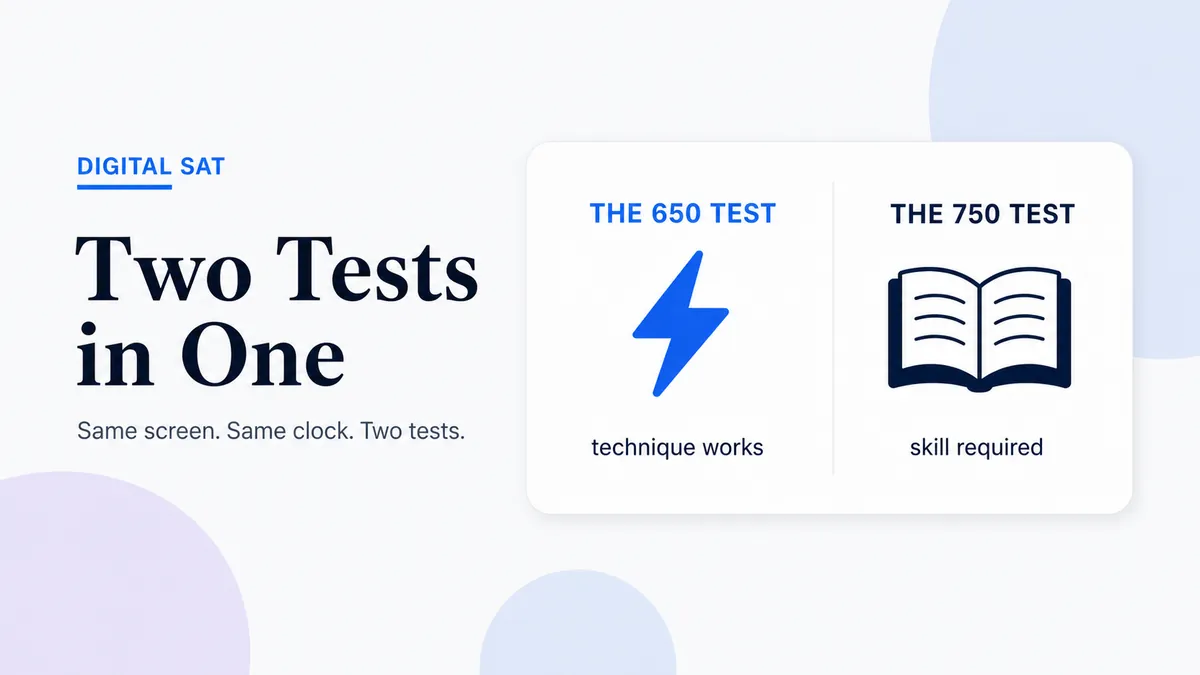
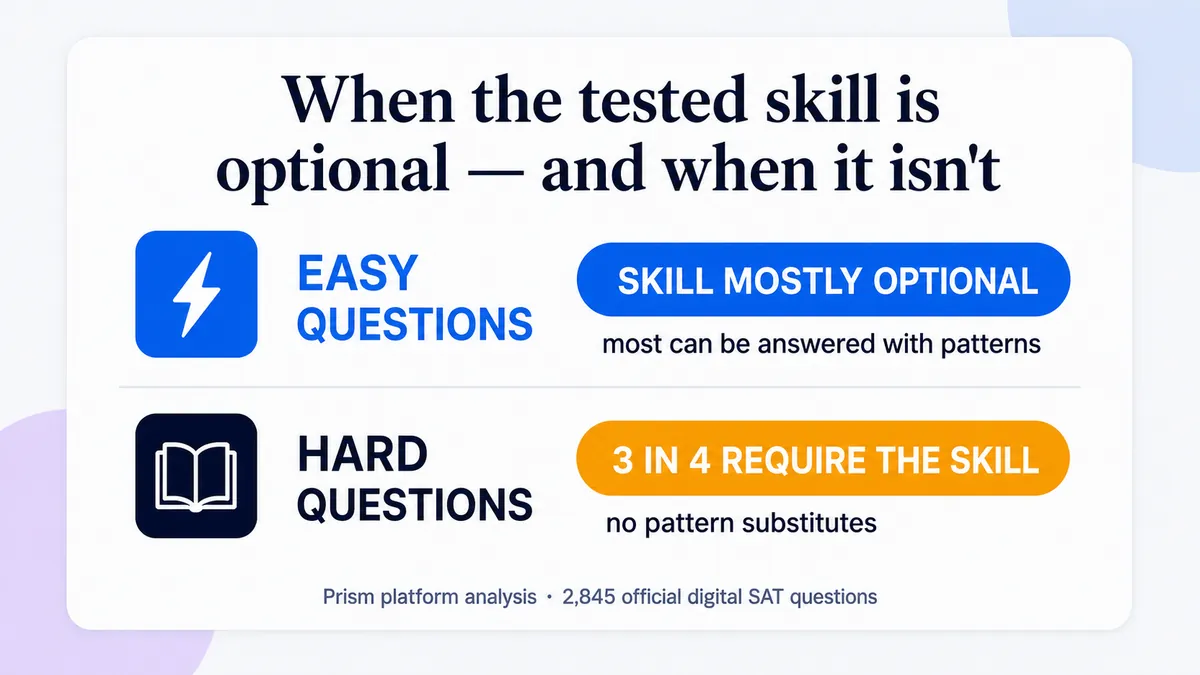
The short answer: The SAT is not a test of how many tricks you've memorized. It's a test of ability — can you understand what you read, reason about what you know, and pick the right method for the problem in front of you. We analyzed 2,845 real digital SAT questions, and the pattern is unmistakable: on easy questions, the tested skill is optional — about 3 in 4 Math questions and nearly all Reading & Writing questions can be answered without it. On hard questions — the ones that decide whether you score 650 or 750 — that flips. Roughly 3 in 4 hard questions in both sections cannot be answered without the real skill. The test is built to let tricks carry you partway, and then check whether there's ability underneath. The good news: that ability can be trained — and unlike a trick, you keep it for life.
Every week I get some version of the same question from a student. They've hit a hard Math problem, and they ask: "How do I solve this one with Desmos?" Or it's Reading & Writing, and they want the elimination rule, the keyword pattern, the thing that gets them to the answer without the work.
I understand why. The internet is full of SAT "hacks," and some of them genuinely work. But I want to show you what's actually going on inside this test — because once you see it, you'll stop asking "what's the trick for this question?" and start asking a much better question: "what is this question testing?"
Those are two different mindsets. And the SAT — deliberately, by design — rewards one and punishes the other.
What do I mean by "a test of ability"?
I don't mean it as a motivational line. I mean it in terms of how the test is actually built.
Every SAT question sits somewhere on a scale: at one end, questions you can answer with a memorized pattern — a grammar rule, a keyword match, a calculator routine. At the other end, questions where no pattern rescues you. You have to understand the passage, or understand the concept, or judge which of your methods actually fits — and that's ability. Not "smartness." Ability: a trained skill, applied under time pressure.
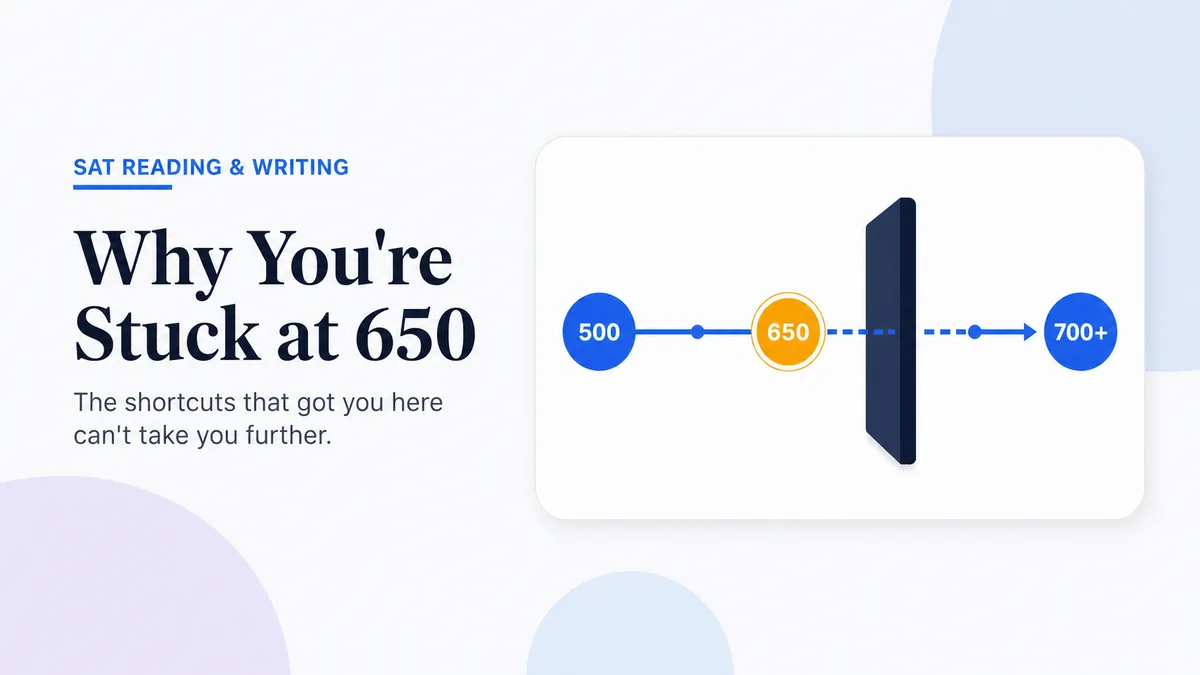
Here's the part most students never realize: the SAT uses that scale as its difficulty dial. Easy questions live at the pattern end. Hard questions live at the ability end. So when your score climbs into the high 600s and stalls, the test isn't asking you for more patterns. It's asking you for something patterns can't fake.
Let me prove it with one question. A real one — a hard one — and I'll bet it's exactly the kind you'd want to Desmos your way through.
What is this hard question actually testing?
Try it. It's an official College Board question, and there are no answer choices — you type in the answer yourself:
$$
$$
In the given system of equations, p is a constant. If the system has no solution, what is the value of p?
— Official College Board digital SAT question.
Now watch me work it — and notice that the first move isn't algebra at all. It's an inference. No solution. What does that actually mean? It means these two lines never meet. Two lines that never meet are parallel — same direction, different position. That one connection — no solution → parallel — is the entire question. Everything after it is bookkeeping.
But here's what most prep never tells you: from that one insight, there's more than one way to get to the answer. And which way you pick is itself part of the test. Let me show you the two concept methods side by side.
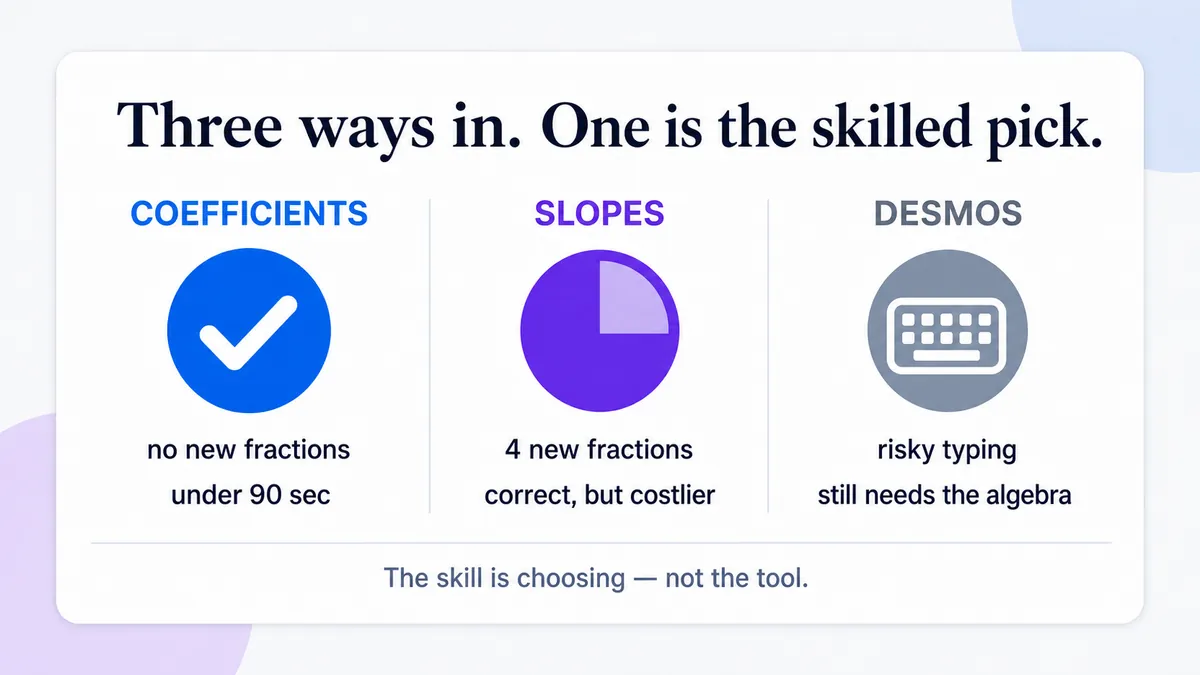
Way 1 — compare the coefficients. Parallel lines, written as equations, have matching proportions: the x- and y-coefficients of one equation are the same multiple of the other's, while the constants break the pattern. So I don't solve for anything. I just tidy both equations into shape. First equation — add to both sides: . Second — move things across: . Now line up the ratios — — and cross-multiply: , so , and p = 6. One glance to confirm the constants don't follow the same ratio — against is not — so the lines are truly parallel, not the same line. Done. Two tidy-ups and one cross-multiplication. Well under ninety seconds.
Way 2 — compare the slopes. Also completely valid: put each equation into form and set the slopes equal. You'll get and the same p = 6. But look at what it costs. To get there you have to divide one equation through by 3 and the other by p, and in the process you create four brand-new fractions — , , , — that the question never gave you. Every new fraction is a new chance to slip.
Both ways run on the same inference. Both should land inside a minute and a half — which is about what this question deserves from a student whose concepts are in order. But a skilled student doesn't flip a coin between them. They pick the coefficient method, and they pick it for reasons: fewest moves, nothing gets divided, no new fractions get created — the only numbers you touch are the ones printed on the screen, and p stays out in the open where you can see it. That choice takes ten seconds to make and pays for itself immediately.
On our platform, this question runs at 36% accuracy. And the timing data tells the story in two layers. Students who get it wrong give up at a median of 96 seconds — they bail early because they never make the inference, quitting at almost exactly the moment a skilled student is typing 6 into the answer box. And the students who get it right? They take nearly three minutes — 2:48 at the median. They found a way to solve it — but most of them found a slow one. Two layers, one lesson: this question isn't grading your arithmetic. It's grading whether you can find the condition — and how well you choose your method once you have it.
"But can't I just Desmos it?"
Now, the third way — the Desmos plan. And I want to be fair to it, because the student asking isn't being lazy — they're being strategic with the tools they have. Here's what the Desmos route actually looks like: type in both equations, put a slider on p, and drag until the two lines look parallel.
Notice something, though. To know you're looking for parallel lines, you already had to make the inference — no solution means parallel. The Desmos student isn't skipping the concept. They can't. Nobody can; that's what makes this question hard.
So if the concept is needed either way, what's wrong with Desmos here? Three things, and none of them is "it's cheating":
- Entering these equations is where errors live. Four fractions in the first equation alone. One mistyped denominator and your whole screen is lying to you — confidently.
- Your eye can't certify "parallel." A slider shows you lines that look parallel at p = 5.9 and at 6.1. Looking parallel is not being parallel.
- There are no answer choices. You need the exact value. So after all the typing and dragging, you still have to do the algebra to confirm — the calculator saved you nothing.
So Desmos isn't wrong because it's a shortcut. Desmos is wrong for this question — slower, and easier to fumble, than the ninety-second coefficient method. On other questions, Desmos genuinely is the best move; our analysis flags plenty where it wins. That's exactly the point. The real skill was never "algebra versus calculator." The real skill is judgment: knowing all three ways, reading the question, and choosing the one this question rewards.
And here's the finding that convinced me the SAT is grading judgment on purpose. In our analysis of the hard Math pool, on 205 of the 457 hard questions, the student data shows a faster, safer route that most students never took. You just watched it happen: on the question above, even the successful solvers averaged nearly three minutes — which tells you most of them took the long way, dividing through and juggling new fractions, when the coefficient move finishes in half the time. Think about what that means. The hard part of hard questions usually isn't the computation. It's the decision about how to attack them. That decision is ability. And you can't memorize a decision.
The same test is hiding inside Reading & Writing
You might think this is a Math story. It isn't. Here's a hard official transition question:
A turtle shell appears external to the animal, protecting its body like armor. ______ the shell is often incorrectly assumed to be an exoskeleton, a rigid outer casing like that of a crustacean or an insect, when in fact it is an endoskeleton, a part of the turtle's internal bone structure, more akin to a spine or a pair of ribs.
A) That being said, B) However, C) For instance, D) Hence,
— Official College Board digital SAT question.
The pattern-matcher sees it instantly: "looks like armor... but it's actually internal bone" — appearance versus reality, that's a contrast, grab However. On our platform, 53% of students pick B. It's the most popular answer in the room. And it's wrong.
Read the logic — the actual logic, not the shape. The shell looks external. That's precisely why people wrongly assume it's an exoskeleton. The appearance doesn't clash with the mistake; the appearance causes the mistake. Cause and effect. Hence. Only 29% get there. And this isn't carelessness. Right and wrong answers took the same 28 to 29 seconds. Students read carefully and still missed, because they ran a pattern where the question demanded reasoning.
Same test, different section. In Math it checks whether you can draw the inference and pick your method. In Reading & Writing it checks whether you follow what the sentence actually says instead of what it resembles. Both times, one thing is being measured: is there ability under the technique?
Two questions. What about the other 2,843?
Fair. We ran this analysis on 2,845 real digital SAT questions — 1,465 Math, 1,380 Reading & Writing — asking, for every single one: can a student get this right without the skill it claims to test?
- Easy questions: mostly yes. About 77% of easy Math questions can be answered without the tested idea. In Reading & Writing it's more extreme: fewer than 1 in 25 easy questions truly require you to understand the passage.
- Hard questions: mostly no. About 3 in 4 hard Math questions cannot be answered without the concept. About 7 in 10 hard Reading & Writing questions cannot be answered without genuinely understanding the passage — and most of the exceptions are grammar items where a mechanical comma rule happens to suffice.
It's not your intelligence being filtered at the top of the test. It's not your effort. It's not your luck. It's whether there is skill underneath your technique — because the test is built so that technique alone runs out exactly where the scores start to matter.
And once you see that, the whole "hacks" conversation changes. The tricks aren't evil. The test simply knows about them. It lets them work on the questions that don't separate anyone, and it quietly turns them off on the questions that do.
Here's the part I absolutely love
If the SAT were really a test of tricks, then every hour you spent preparing would evaporate the day you closed Bluebook. It isn't. The abilities this test checks on its hard questions — read something dense and follow its actual logic, connect a condition to what it implies, look at a problem and choose your method like a professional instead of reaching for the same tool every time — those are the abilities your first year of college assumes you have. They're the ones that make you the student who handles rigor instead of drowning in it.
So when a hard question refuses to be hacked, it isn't the test being unfair to you. It's the test asking you, quietly, the only question colleges actually care about: can you think? Preparing for that question is never wasted. It's the rare kind of test prep you keep for the rest of your life.
Here's what I want you to do tonight. Take one hard question — Math or Reading & Writing, doesn't matter. Before you touch it, say out loud: "What is this question testing?" Then pick your method on purpose, and say why — "Desmos, because the answer choices are graphable points," or "coefficients, because no-solution is a proportion condition," or "read the whole thing, because the logic lives in the passage." One question, solved with judgment, teaches you more than twenty solved on autopilot. That habit — noticing what's being tested and choosing your method on purpose — is the ability. Start building it tonight.
A note on sources and figures
- Question text: both questions shown are official College Board digital SAT items, reproduced for educational commentary and analysis, and attributed to College Board.
- Prism Learning platform analysis (2026): the 2,845-question dataset (1,465 Math + 1,380 Reading & Writing — every official question with real student performance data available to us); the without-the-skill rates by difficulty (Math: ~77% easy / ~25% hard; R&W: ~96% easy / ~32% hard, of which most are grammar-rule items); the 205-of-457 unused-faster-route finding; and the per-question statistics (no-solution system: 36.2% accuracy, median 168s correct / 96s incorrect; turtle transition: 34% accuracy, 53% choosing "However," 28–29s median times). These are Prism's own findings, not College Board figures, and per-question stats reflect our platform's population.
- Difficulty labels (easy/medium/hard) are College Board's own designations on the source questions.
Put this into practice with PRiSM Learning: the PRiSM SAT prep program and PRiSM's full-length SAT mocks.