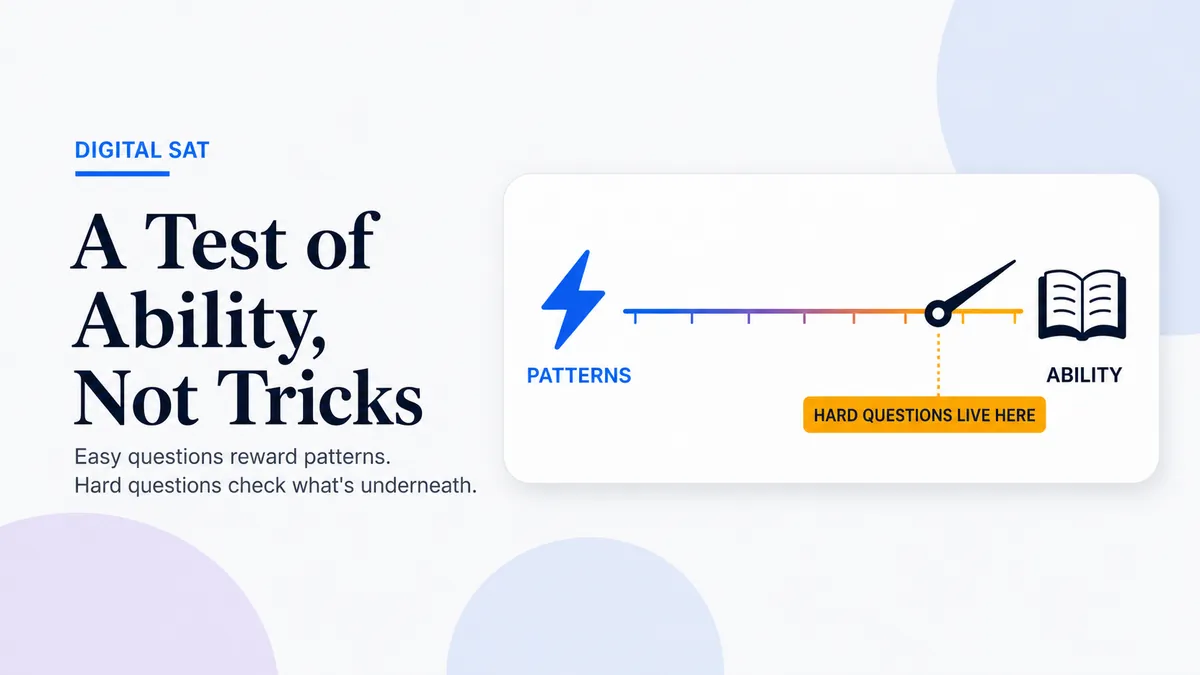
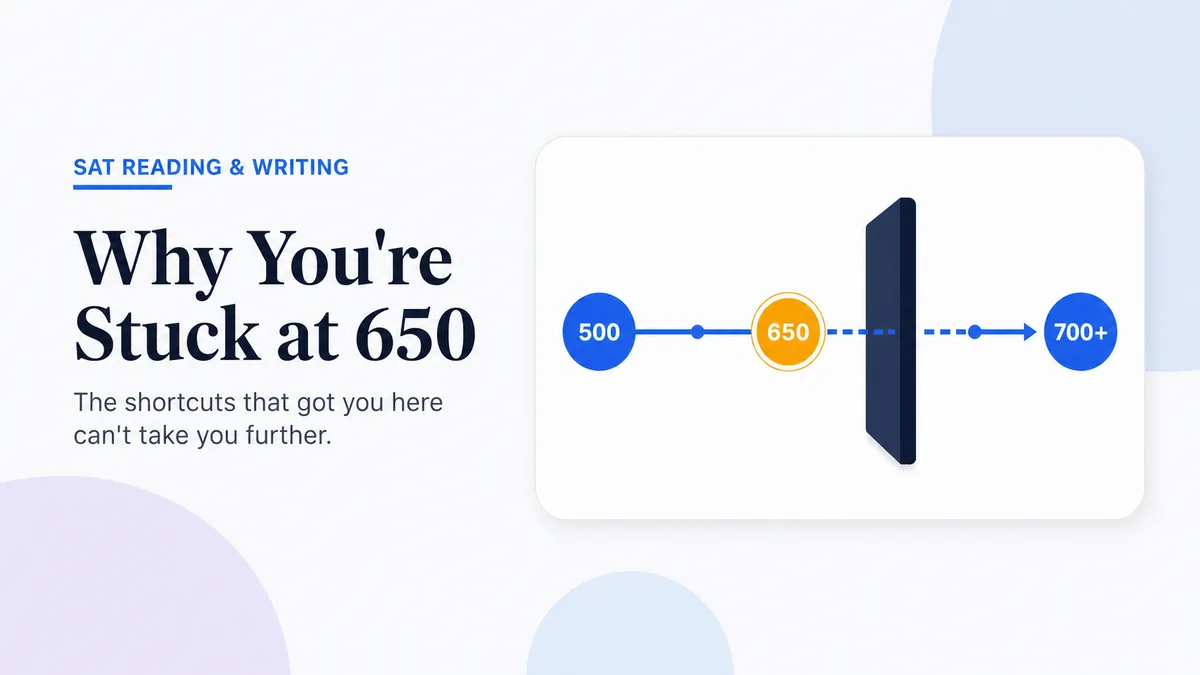
The SAT Is Two Tests in One: The One That Gets You to 650, and the One That Takes You to 750
The SAT that takes you to 650 isn’t the SAT that takes you to 750. Analysis of 2,845 real questions shows where the switch happens — and how to prep.
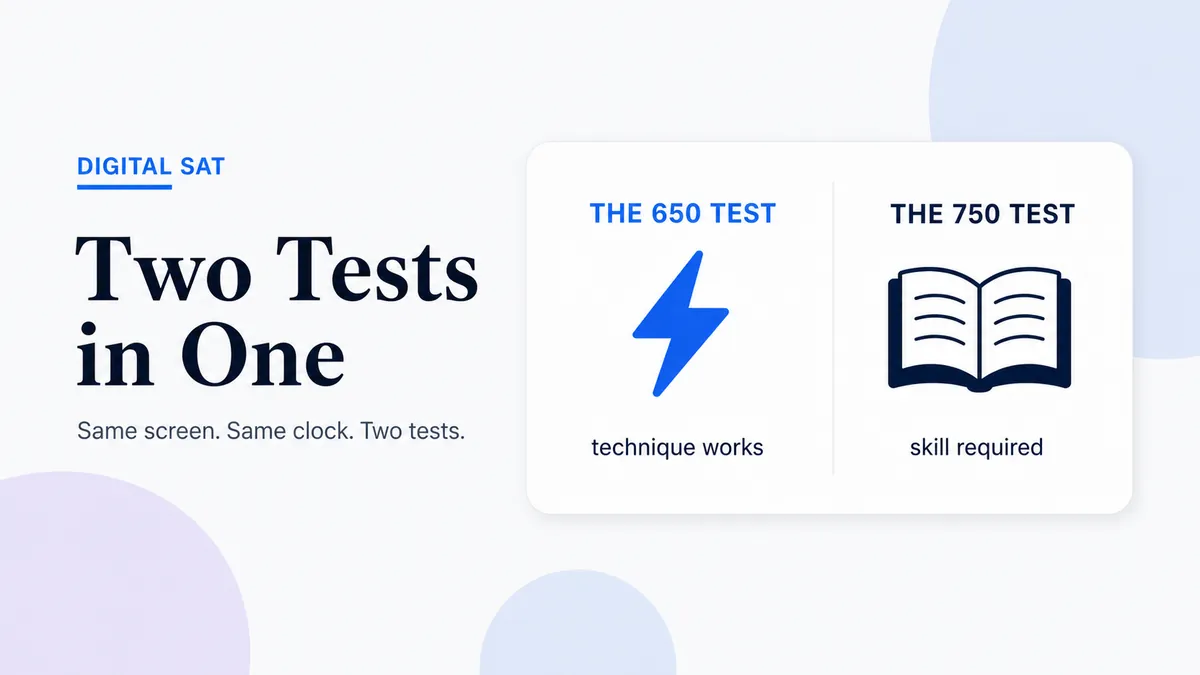
The short answer: The SAT is really two tests in one. The first test is made of easy and medium questions, and it can be beaten with technique — patterns, elimination, plugging in answer choices, calculator routines. Our analysis of 2,845 real digital SAT questions shows that nearly all easy Reading & Writing questions and about 3 in 4 easy Math questions can be answered without the skill they claim to test. The second test is made of hard questions, and it's built the opposite way: roughly 3 in 4 hard questions in both sections cannot be answered without genuine skill — and many of them are designed so that technique picks a specific wrong answer. Because of the SAT's adaptive module structure, the first test ends and the second test begins right around 650. If your score is stuck there, you haven't hit your ceiling. You've passed the first test — and you're taking the second test with the first test's methods.
I want to share the single most useful thing our research has ever shown me about the SAT. It's not a strategy. It's not a question type. It is this: the test you take on your way to 650 and the test you take after 650 are not the same test. They look identical — same screen, same sections, same clock. But they check two completely different things. And they respond to two completely different kinds of preparation.
I know that might be hard to absorb. So you don't have to take my word for it. I'm going to show you both tests — two real SAT questions, and the data from all 2,845.
The 650 test: watch a shortcut do all the work
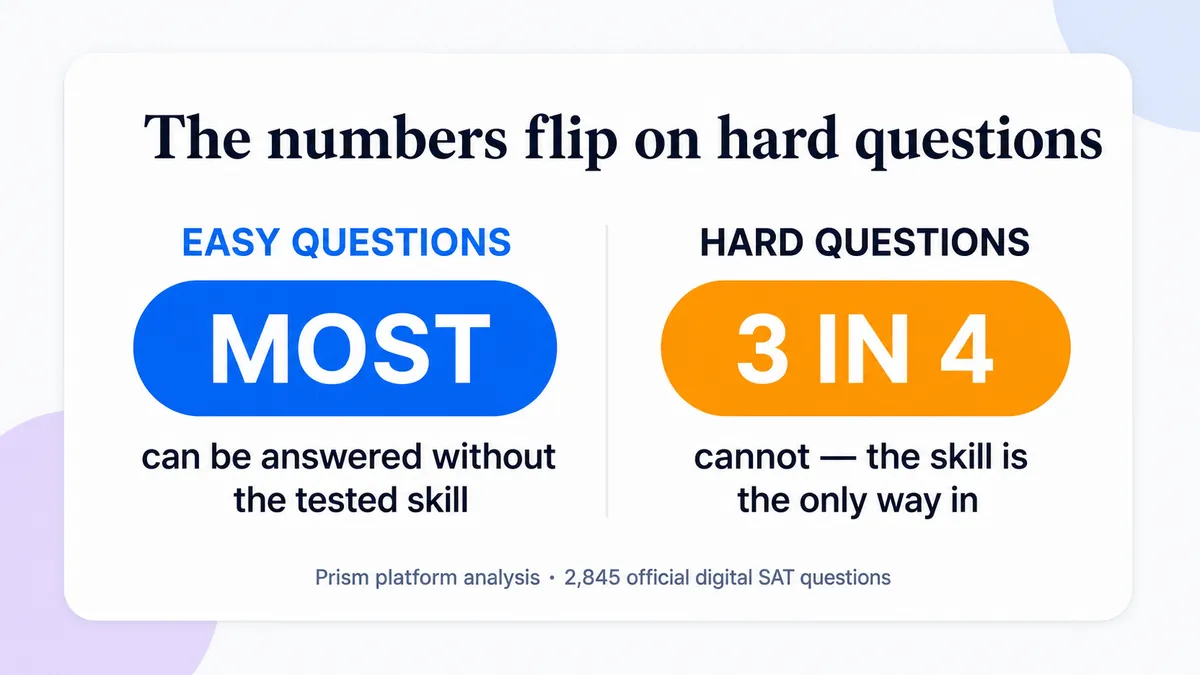
Here's what we did. We took 2,845 real digital SAT questions — 1,465 Math and 1,380 Reading & Writing — and on every single one, we asked one simple thing: can a student get this right without the skill it claims to test?
On easy questions, the answer is overwhelmingly yes:
- Reading & Writing: fewer than 1 in 25 easy questions truly require you to understand the passage. Everything else can be answered with something cheaper — a grammar rule, reading just around the blank, elimination.
- Math: about 77% of easy questions can be answered without the idea being tested.
Let me make that concrete. Here's a real easy Math question:
Which of the following is a solution to the equation ?
A) 1 B) 2 C) 3 D) 4
— Official College Board digital SAT question.
Watch me solve it without using any algebra idea at all. I'll just test the choices. Try 1: two times 1 is 2, minus 4 is −2. Is −2 equal to 1? No. Try 2: two times 4 is 8, minus 4 is 4. Is 4 equal to 2 squared? Yes. Done. Answer: B.
Notice what I never did. I never rearranged the equation. I never thought about what x² = 4 means. I didn't need the concept — I just needed the answer choices and thirty seconds. And the data agrees: on our platform, students take about 22 seconds on this question, and essentially nobody misses it.
This is the test that every "hack" video on the internet is about. And I want to be honest with you here, because this is important: on this test, the shortcuts genuinely work. They're supposed to. Easy questions are built that way. So let me say something you have probably never heard before: nobody who went from 500 to 650 got lucky. You got good. You got good at the 650 test. That is a real accomplishment.
It's just not the accomplishment the 700s are asking about.
The 750 test: the questions that check what you actually know
Now run the exact same analysis on hard questions, and the numbers flip:
- Reading & Writing: about 7 in 10 hard questions cannot be answered without genuinely understanding the passage. Most of the exceptions are grammar questions, where a punctuation rule happens to be enough.
- Math: about 3 in 4 hard questions cannot be answered without the tested concept. No plug-in. No backsolving. No graphing routine. Nothing substitutes.
And here's the part that should genuinely worry you: the 750 test doesn't just resist your technique. Many of its questions are built so that the technique picks one specific, confident, wrong answer. On the ant question from the 650 article, reading only around the blank leads you straight to choice A — and A is the most popular answer at 40%, while only 21% of students find the right one. On a hard turtle-shell transition question, the sentence looks like a contrast, and 53% of students pick "However" — the trap — while only 29% pick the correct answer, "Hence."
On the 750 test, the wrong answer built for shortcut-users gets more votes than the right answer.
Math does the same thing, in its own way. Remember the easy question above — the one you could beat by plugging in the choices? Here's its hard cousin:
$$
In the given system of equations, p is a constant. If the system has no solution, what is the value of p?
— Official College Board digital SAT question.
Same subject — equations. But look at what changed. There are no answer choices — you type in the answer yourself. Nothing to plug in. Nothing to eliminate. And the calculator doesn't save you either — you can't reliably see "no solution" on a graph, and you'd still need the exact value of p. The student who backsolved the easy question in 22 seconds now has no move at all. The only way in is to actually know what "no solution" means: the two lines never meet, so they must be parallel. That's not an accident. That is the second test doing its job — checking whether the knowledge is there once the shortcuts are taken away.
The data on this question: 36% accuracy, and the students who miss it give up at a median of 96 seconds — half the time of the students who solve it. They aren't making calculation errors. They never find the way in.
So here's the picture. One test rewards technique. The other is built to expose it. Same screen. Same clock. Two tests.
Why the switch happens exactly at 650
Now, if the SAT is two tests, here's the question that makes everything click: why does everyone hit the wall at the same score? Why 650?
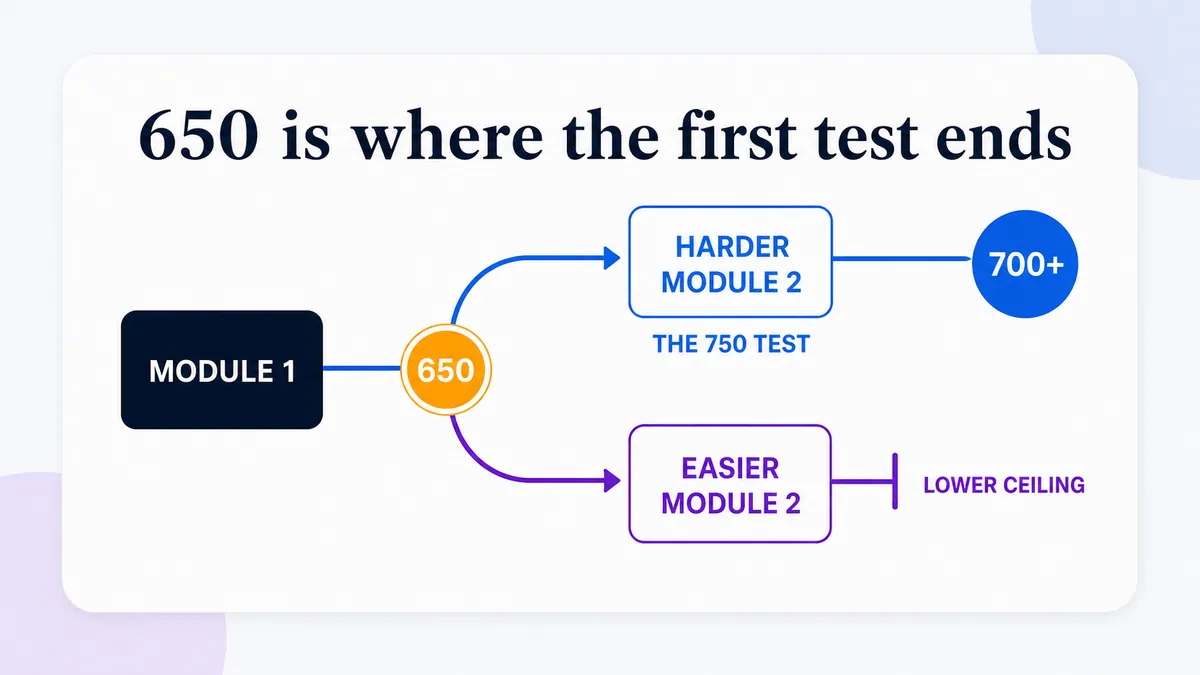
Because the switch isn't gradual — it's built into the structure. Each section of the digital SAT runs in two modules. Everyone gets a mixed first module, and how you do on it decides which second module you receive: an easier one, or a harder one. (College Board's test specifications describe this adaptive design.) The easier second module has a ceiling: by our numbers, you can answer every single question on it correctly and your section score still tops out in the high 500s to low 600s. The 700s exist in one place only — inside the harder second module. And that module is filled with exactly the hard questions you just saw.
Now follow a student through this. A good one. Their technique is sharp, so they do well on Module 1. So the test gives them the harder Module 2 — the 750 test. And there, their technique meets question after question built to expose it. They're good enough to reach the 750 test. They're not prepared to pass it. So the score lands at 650. Next attempt, 650 again. And again.
That's the plateau. It's not a coincidence, and it's not your ceiling. 650 is simply the score where the first test ends and the second one begins. That's the whole secret.
Why you never noticed you were taking two tests
Three reasons. None of them your fault.
First — the 650 test is most of what you see. Roughly two out of three questions in the official pool are easy or medium. Most of your drills, most of your practice, most of the confidence you've built came from there.
Second — the 650 test kept rewarding you. From 500 to 650, your methods worked and your score climbed. And what's more convincing than a rising score? The first test spent a year teaching you to trust exactly the methods that the second test is built to expose.
Third — the SAT never announces the switch. Hard questions don't come labeled. The two modules look identical on screen. The only signal you get is the one you've been misreading this whole time: a score that stopped moving. A plateau at 650 is the announcement. It's the second test telling you it has started, and it wants something different from you.
And this explains the most expensive mistake in SAT prep: preparing for the second test with more first-test training. More drills. More practice tests. More hours with the same methods. Practice reinforces whatever method you bring to it — so all those hours make you faster and more automatic at the wrong test.
The plateau math
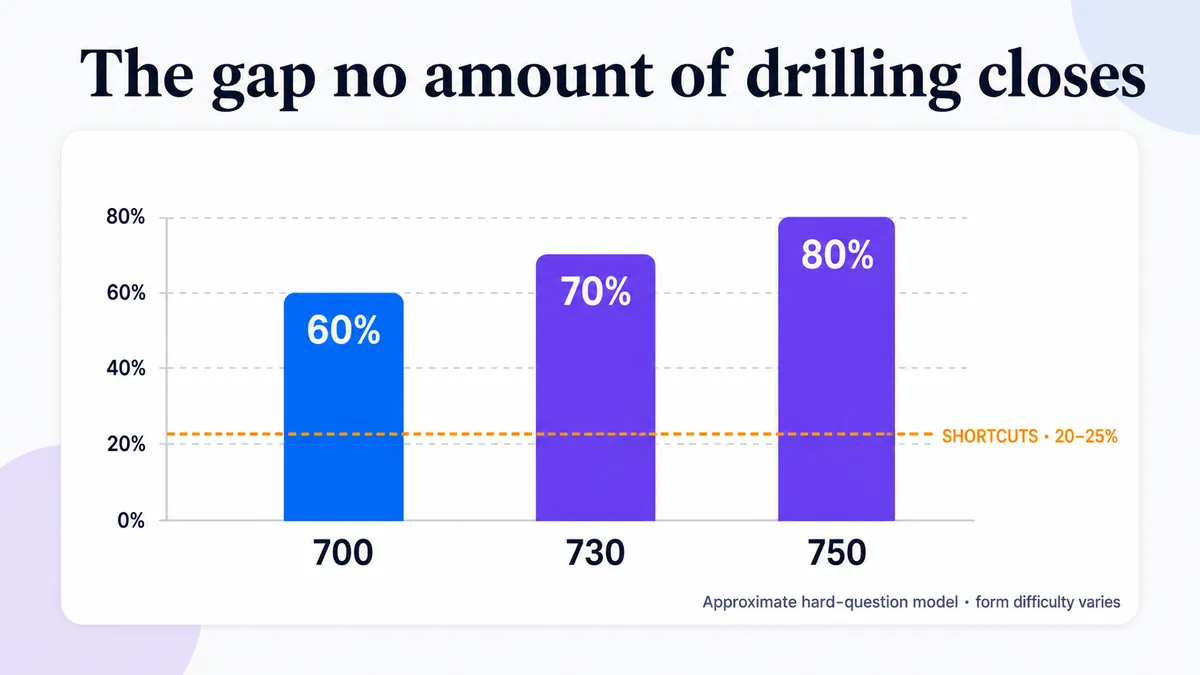
Let me put real numbers on this — they are worth reading slowly. (These are our numbers — exact scaled scores shift from form to form, so treat this as the direction, not a promise.) Inside the harder second module, your score comes down almost entirely to one thing: hard-question accuracy.
- To score 700, you need roughly 60% accuracy on hard questions.
- To score 750, you need roughly 80%.
- And shortcuts — the entire toolkit of the 650 test — work on only about 20–25% of hard questions. The rest are shortcut-proof by design.
Look at that gap. You need 60, 70, 80 percent. Your method delivers 20-something. That gap is your plateau — not as a feeling, as arithmetic. And no amount of extra practice with the same methods changes that equation. The only thing that closes the gap is the thing the 750 test actually measures.
What the 750 test measures — and how to prepare for it
Three skills. Just three — and every one of them can be trained:
- 1.Read something dense and follow its actual logic — not its surface pattern. That's the skill that picks "Hence" while 53% of the room picks "However."
- 2.Connect a condition to what it implies. That's the skill that turns "no solution" into "the lines are parallel" before any algebra starts.
- 3.Choose your method deliberately — instead of reaching for the same favorite tool every time.
Notice what's not on that list: speed tricks, elimination rules, memorized templates. The 750 test was built precisely so those don't carry over.
Preparing for it looks different, and it should feel different — slower at first. On every hard practice question: read the whole thing. Say what it's actually testing before you solve. Pick your method on purpose. And when you miss, figure out which of the three skills failed — not which trick you forgot. I walk through exactly this, question by question, in the companion articles in this series.
And here's the part I absolutely love. The 650 test's skills expire the day you're done with the SAT. The 750 test's skills are the exact ones college demands in your first semester — reading dense material for real meaning, reasoning from conditions, judging your approach. So the second test isn't an obstacle between you and your score. It's a preview of the student you're about to become. Prepare for that, and the score comes along with you.
So — tonight. Pull up your last practice test and sort your misses into two piles. Pile one: 650-test misses — easy and medium questions, slips, rushing, careless errors. Pile two: 750-test misses — hard questions where your method never had a way to reach the answer. Count both piles. If pile two is bigger — and at 650, it almost always is — you now know exactly what your next month of prep should look like. Not more of the test you've already passed. The other one.
A note on sources and figures
- College Board / digital SAT structure (two adaptive modules per section; Module 1 performance routing; harder Module 2 required for top scores; easy/medium/hard difficulty labels) is drawn from College Board's published digital SAT specifications and scoring documentation.
- Prism Learning platform analysis (2026): the 2,845-question dataset (1,465 Math + 1,380 Reading & Writing — every official question with real student performance data available to us); the without-the-skill rates by difficulty (R&W: ~96% easy vs ~32% hard; Math: ~77% easy vs ~25% hard); the easy/medium share of the pool (~2 in 3); the easier-Module-2 score ceiling (high 500s–low 600s); the score→accuracy model (60% for 700, 80% for 750 — directional, not a guarantee); and per-question statistics (backsolving question: 100% accuracy across 23 attempts, median 22s; ant question 40% trap vs 21% correct; turtle transition 34% accuracy, 53% "However" vs 29% "Hence"; no-solution system 36.2% accuracy, median 96s incorrect / 168s correct). These are Prism's own findings, not College Board figures, and reflect our platform's population.
- Question text: both questions shown are official College Board digital SAT items, reproduced for educational commentary and analysis, and attributed to College Board. The ant, turtle, and no-solution questions are worked in full in the companion articles.
Put this into practice with PRiSM Learning: the PRiSM SAT prep program and PRiSM's full-length SAT mocks.