Why You’re Stuck at 650 on SAT Reading & Writing (It’s Not Intelligence, Effort, or Vocabulary)
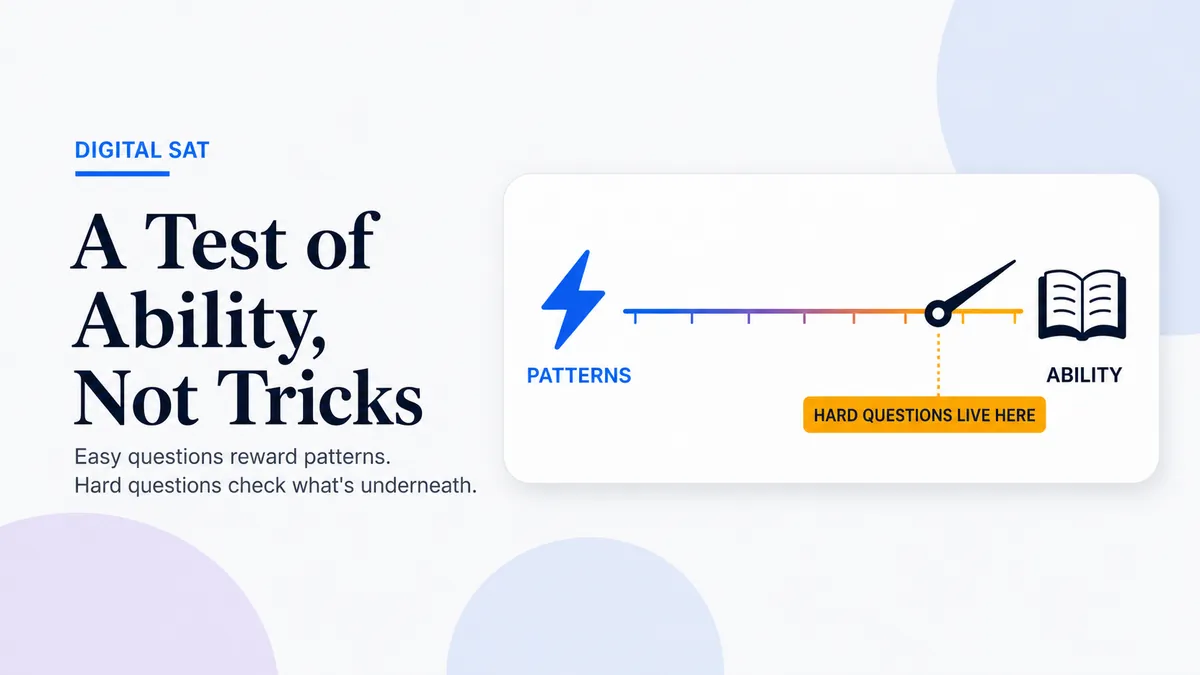
Stuck at 650 on SAT Reading & Writing? Our analysis of 2,845 real SAT questions shows why shortcuts stall there — and the one skill that breaks 700.
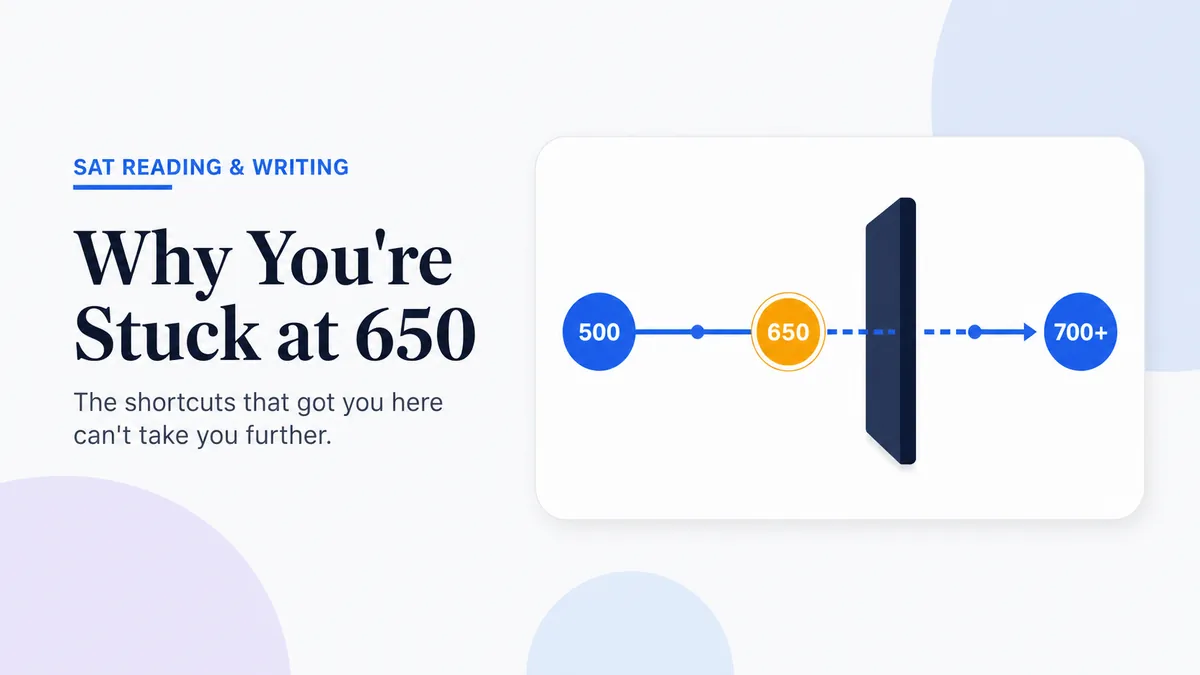
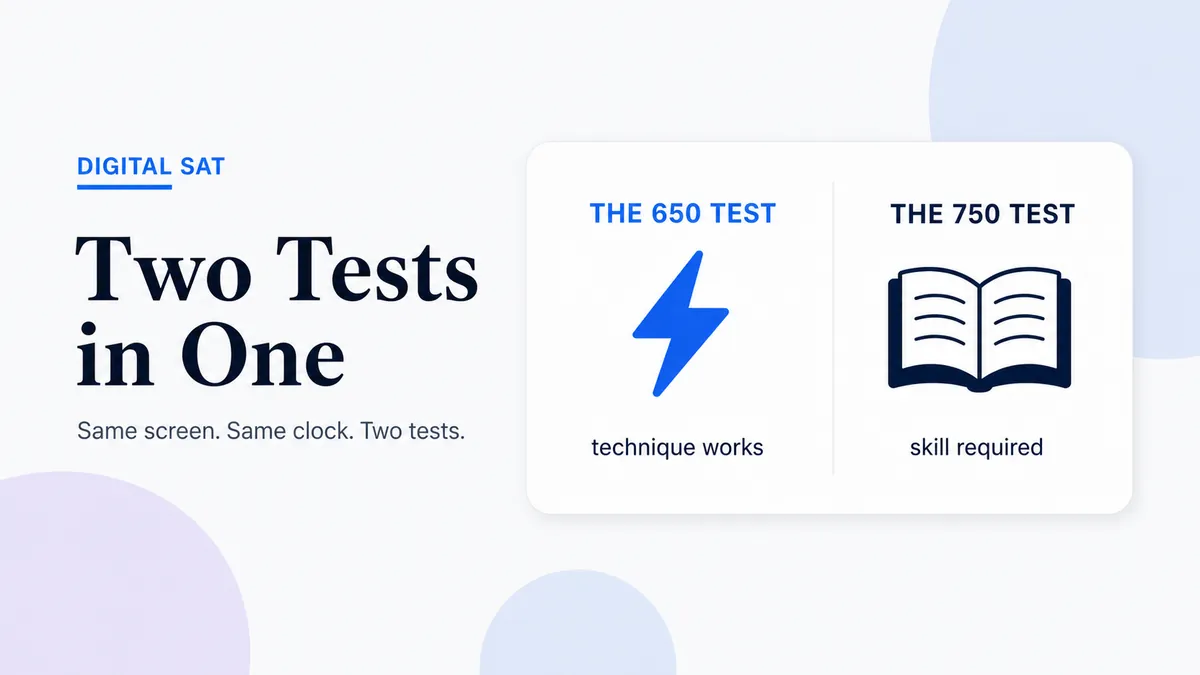
The short answer: You're not stuck at 650 because of your intelligence, your effort, or your vocabulary. You're stuck because the very techniques that took you from 500 to 650 stop working on hard questions. We analyzed 2,845 real digital SAT questions, and only about 1 in 5 hard questions can be solved with a shortcut. To break 700, you need 60–80% accuracy on hard questions — and no shortcut strategy gets you there, no matter how much you practice. The fix isn't a better hack. It's a different skill: reading for meaning.
If you've gone from the 500s up to the mid-600s and then just stopped moving, this one's for you. You've probably taken more practice tests, done more drills, put in more hours — and watched your score sit right there at 640, 650, 660. It's frustrating. And it makes you start to wonder: maybe this is just my ceiling.
It's not. And that's the whole point of what I want to show you. Your plateau isn't about your ability. It's a signal that one specific method has hit its limit. And you don't have to take my word for it — I'm going to take two real SAT questions and prove it to you, and then I'll show you the data underneath it.
Why 650, and not some other number?
The 650 wall isn't random. It sits exactly where the digital SAT changes the game on you.
The Reading & Writing section is adaptive. Two modules, 27 questions each — 54 questions, 64 minutes — delivered through College Board's Bluebook app. Module 1 is a mix of easy, medium, and hard questions. And here's the thing: how you do on Module 1 decides which Module 2 you get. An easier one, or a harder one. (College Board's own specifications lay out this multistage adaptive design.)
Why does that matter? Because the easier Module 2 has a ceiling. Even if you get every single question on it right, your section score caps out somewhere in the high 500s to low 600s. To score in the 700s, you have to earn the hard Module 2 — and then you have to perform on it. That's why so many students pile up right around 650. Their method is good enough to reach the hard module. It's just not good enough to convert it. They get to the door, and they can't walk through.
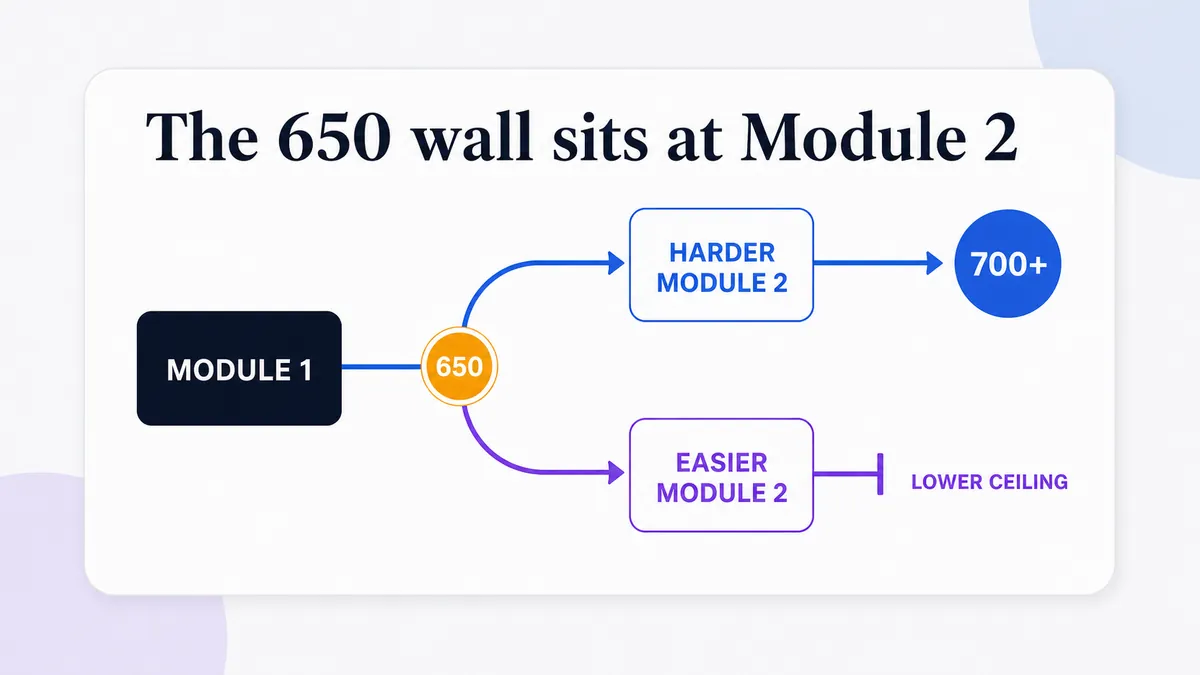
So the real question isn't "why can't I get past 650?" It's "why can't I get the hard questions right once I'm there?" And the answer, every time, is the method.
The 4 shortcuts that got you here
Let me be specific about what "the method" actually is. These are the four techniques almost every stuck-at-650 student is using. You may never have named them, but you are almost certainly using them:
- 1.Read only the first and last sentence. The passage is long, so you skim the opening and the closing line and figure you've got the gist.
- 2.Read only around the blank. There's a blank — so why read everything above and below it? You read right before and right after, grab just enough context, and answer.
- 3.Eliminate by pattern. A lot of answer choices follow patterns — especially on grammar and transition questions — so you knock out options before you've even read the passage.
- 4.Keyword-match the question to the choices. You decide a choice can't be right (or must be right) based on a word in the question, without reading the passage at all.
I want to be clear: none of this is cheating. These are smart, efficient techniques, and they genuinely work — up to a point. They're exactly what got you from 500 to 650. The problem is they were never a comprehension strategy. They're a pattern-matching strategy. And the SAT knows it.
Let me show you them working. Then let me show you them failing.
Where the shortcuts work: an easy question
Here's the question. Take 10–15 seconds and try it yourself before you read on.
Due to their often strange images, highly experimental syntax, and opaque subject matter, many of John Ashbery's poems can be quite difficult to ______ and thus are the object of heated debate among scholars.
Which choice completes the text with the most logical and precise word or phrase?
A) delegate B) compose C) interpret D) renounce
— Official College Board digital SAT question.
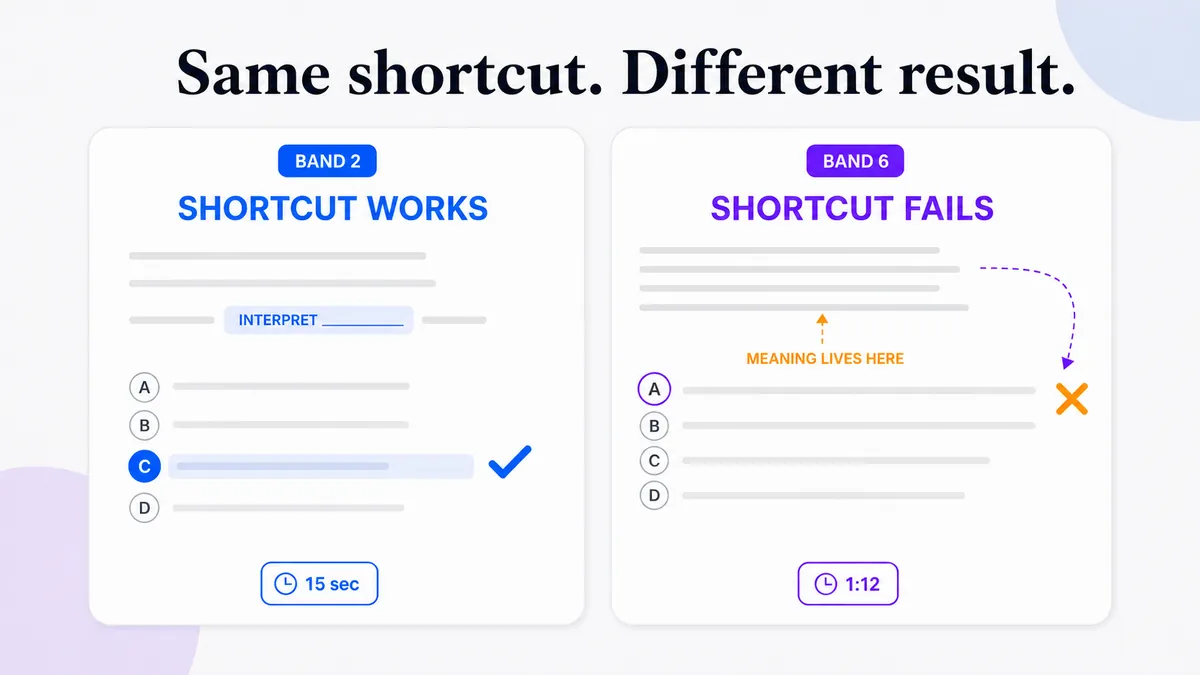
Now watch how I solve it. I'm not going to read the whole passage. There's a blank, so I read right around it: "difficult to ______ … and thus are the object of heated debate." Let me run the choices. Delegate? You don't delegate poems. Compose? These poems already exist — you don't compose something that's already written. Renounce? Makes no sense here. Interpret? Yes — poems that are hard to interpret would absolutely be the object of debate. Answer: C.
And notice — I never read the part about "strange images" or "experimental syntax." Didn't need it. I read before and after the blank, eliminated as I went, and picked the one that made sense. Ten, fifteen seconds, done.
That's not just me. On our platform, students get this one right about 85% of the time, in about 15 seconds. On College Board's difficulty scale it's a Band 2 question — easy. And that's the whole point: easy questions are hackable by design. That's exactly why the shortcut carried you all the way to 650.
(Quick note on the scale: College Board rates every question from 1 to 7 — Bands 1–3 are easy, 4–5 medium, 6–7 hard. You only ever see the broad easy/medium/hard label, but the band underneath is what drives which questions you get and how they're weighted.)
Now take that exact same method and point it at a hard question.
Where the shortcuts fail: the ant question
Here's the next one. I'm going to show you only the sentence with the blank — nothing above it — because that's exactly what a student using the shortcut reads. The sentence with the blank, and nothing else:
By contrast, the researchers observed that uninfected workers in parasitized colonies have shortened lifespans, most likely because the ______
— Official College Board digital SAT question.
So: uninfected worker ants are dying early. Why? Let's look at the choices — and I'll tell you the share of our students who picked each one:
A) uninfected workers are at high risk for direct exposure to A. brevis in the course of providing social care to the infected workers in the nest. — 40%
B) need to compensate for reduced contributions within the colony while also caring for infected workers is burdensome to the uninfected workers. — 21%
C) high level of activity maintained by the uninfected workers makes them better able than infected workers to quickly disperse when the nest is attacked by a predator. — 25%
D) average lifespan of T. nylanderi worker ants in colonies without parasitic activity typically falls well below three years, the range covered by the study. — 14%
Read only around the blank, and choice A looks right, doesn't it? Healthy ants taking care of sick ants would be more exposed to the infection. It's clean, it's intuitive. And it's wrong.
The single most popular answer — 40% of students — is the wrong one. And it's the shortcut that walks them straight into it. Only 21% get it right. So if you picked A, you're not careless and you're not slow. You're in the biggest group in the room, and you got there using the exact method that worked so well on the poem. For the record: this is a Band 6 question, and our students spend about 1 minute 12 seconds on it, versus 15 seconds on the poem — a gap that will matter again in the plateau math below.
Now let me solve it the right way — by actually reading the passage. Here's everything the shortcut told you to skip:
In a three-year study of parasitic infections by Anomotaenia brevis tapeworms in Temnothorax nylanderi ants, entomologist Susanne Foitzik and colleagues found something unexpected: rather than reducing its host's fitness, as is typical of parasites, A. brevis greatly extends the lifespan of a T. nylanderi worker ant and seems to halt the effects of aging. Furthermore, those infected receive special treatment, ceasing their share of labor to sustain the colony and remaining in the nest as uninfected workers feed, groom, and transport them. By contrast, the researchers observed that uninfected workers in parasitized colonies have shortened lifespans, most likely because the ______
— Official College Board digital SAT question.
Read that, and the "by contrast" sentence completely changes. Look at what the passage tells you that the blank sentence alone never could: the infected ants have stopped doing their share of the work, and it's the uninfected ants who are feeding them, grooming them, carrying them. So why are the uninfected workers dying early? Because they're doing double duty — covering the work the infected ants dropped, and taking care of the infected ants on top of it. That's choice B. And once you actually understand the passage, B isn't a tough call. It's a slam dunk.
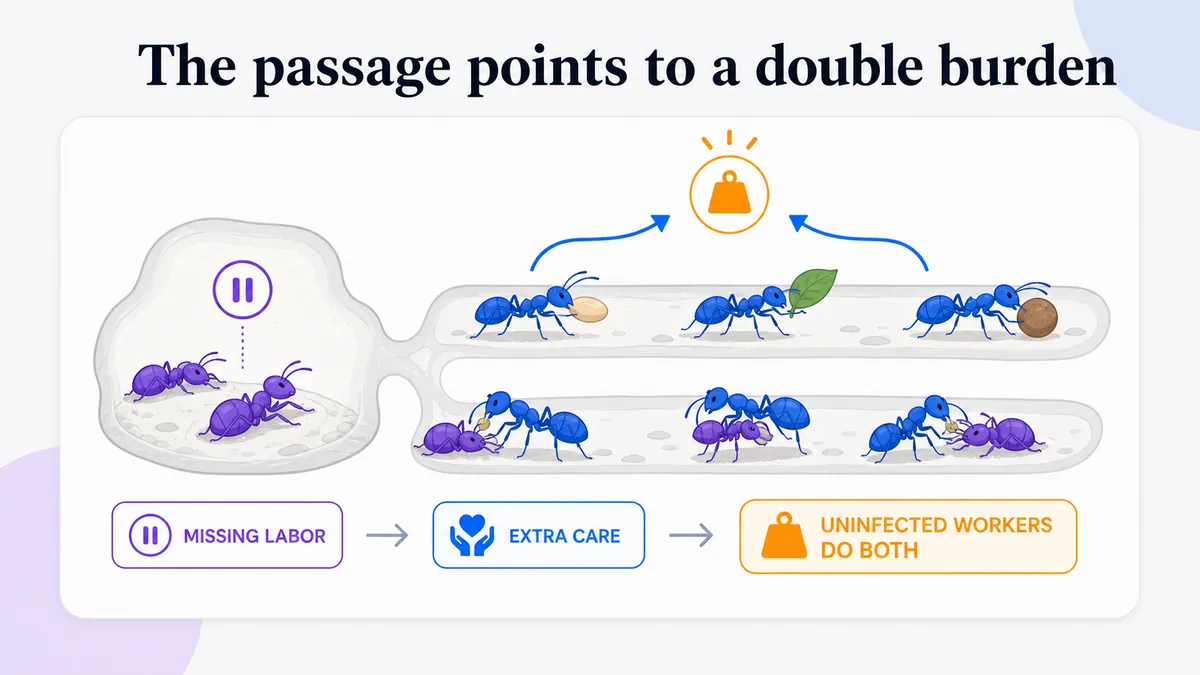
Now go back and look at A. It's not random — part of it is even true; the uninfected workers really do provide care. But the passage never says one word about them being at higher risk of direct exposure. That's a detail your brain filled in to make the shortcut feel complete. The passage hands you the double-burden idea in B, and says nothing about exposure in A. The only way to see that is to read for meaning. The shortcut can't get you there — because everything you needed was sitting in the part of the passage it told you to skip.
The hackability study: 2,845 real questions
Now, you might be wondering — did I just cherry-pick that question? Fair. So let me show you the bigger picture.
We took 2,845 real digital SAT questions — 1,465 Math and 1,380 Reading & Writing, every official question we have real student performance data on — and on every single one we asked one simple thing:
Can you get this right without actually understanding the whole passage?
We called it hackability. And here's what we found:
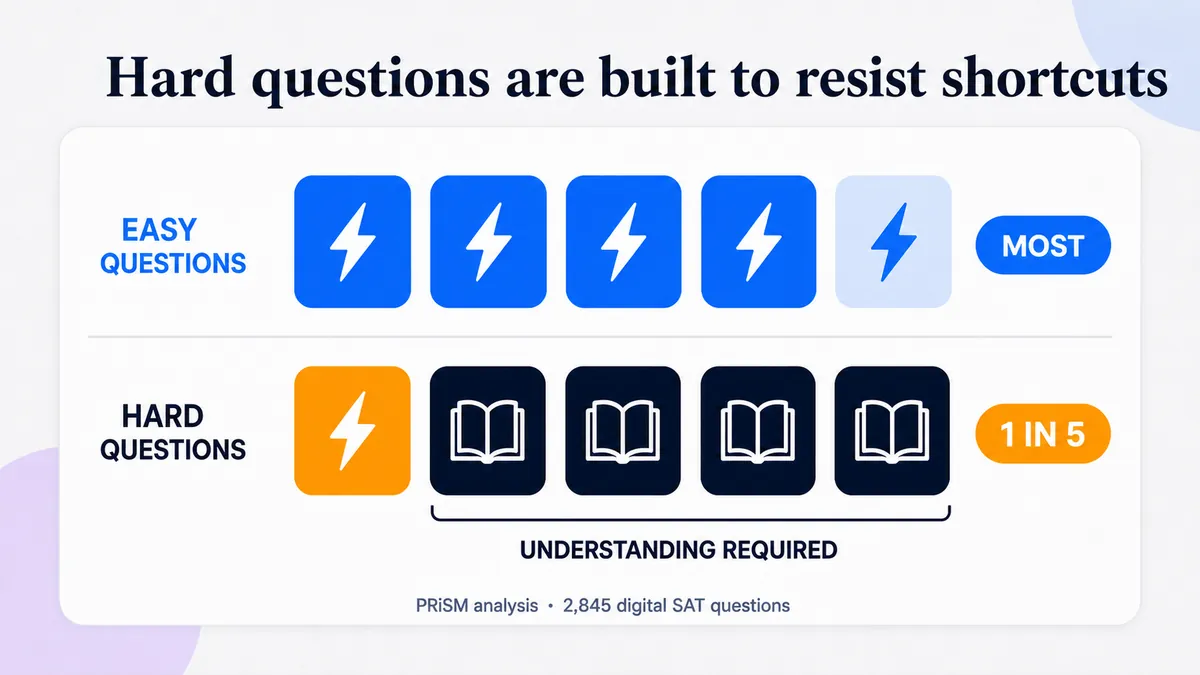
- Easy questions: you can hack almost all of them.
- Hard questions: almost none — only about 1 in 5.
Now flip that around, because the flipped version is the most useful idea in this whole article:
If a question won't let you take a shortcut, it's almost certainly a hard one.
The SAT is basically using hack-resistance as a difficulty filter. And that's not a figure of speech. A big part of what makes a hard question hard is that skimming and pattern-matching lead you to an answer that feels right and isn't. The ant question isn't the exception — it's the rule. And that's exactly why "just do more practice" doesn't fix you: you're drilling a method that, by design, only works on the 1-in-5 hard questions that happen to be hackable.
The plateau math (and how to break it)
Let me put real numbers on this, because this is where the plateau stops being a feeling and becomes math.
To score above 650, you have to earn the hard Module 2. And when we look at what a hard Module 2 actually contains, out of its 27 questions, about 20 are hard. So your score now comes down almost entirely to how many of those ~20 hard questions you get right.
Here's the map. (These are our numbers — exact scaled scores shift from form to form, so treat this as the direction, not a promise.)
| Target R&W score | Hard questions you need right (of ~20) | Most you can miss | Accuracy on hard questions |
|---|---|---|---|
| 700 | 12 | 8 | ~60% |
| 730 | 14 | 6 | ~70% |
| 750 | 16 | 4 | ~80% |
Now bring back the hackability number. Only about 20% of hard questions are hackable. So if you keep leaning on shortcuts, you top out at roughly 20% accuracy on the exact questions that decide your score.
Look at the gap:
- To hit 700, you need 60%. Shortcuts give you about 20%.
- To hit 730, you need 70%. Shortcuts give you about 20%.
- To hit 750, you need 80%. Shortcuts give you about 20%.
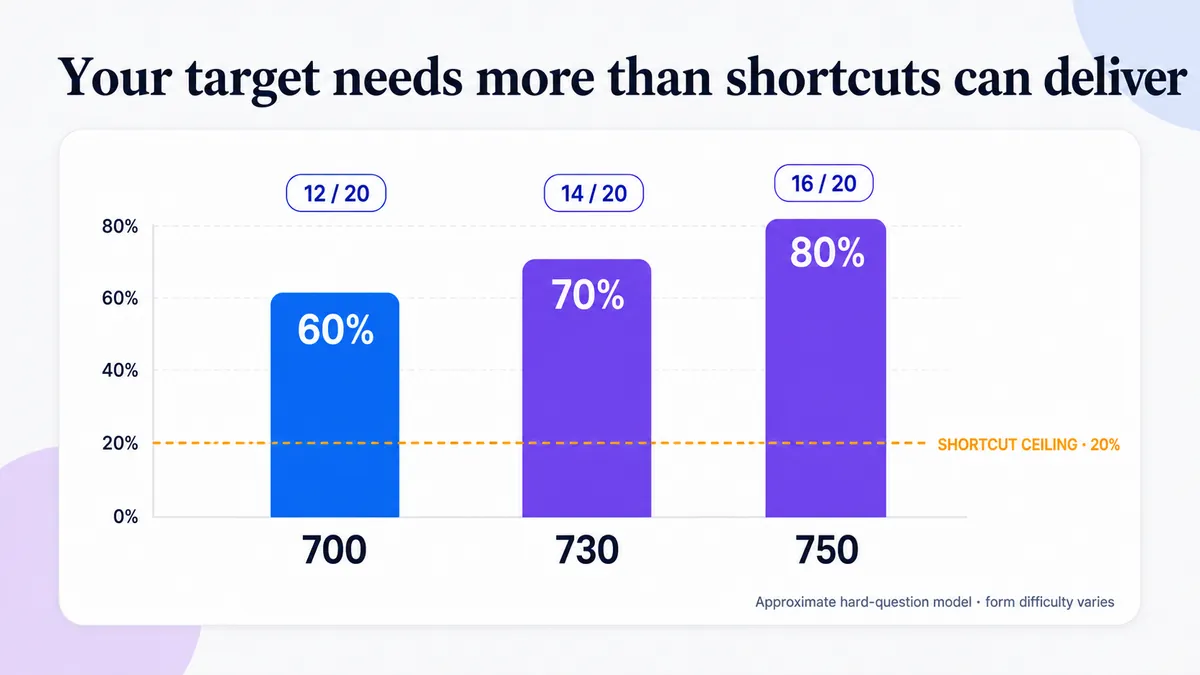
That gap — that's your plateau. It's not your intelligence, it's not your effort, it's not your vocabulary. It's the mismatch between the accuracy your target needs and the ceiling your method allows. And this is the part that matters most: more practice with the same shortcuts cannot close it. That 20% doesn't move because you did more drills. The math is fixed. Doing more of the same just buys you more 650s.
Why more practice — and more tutoring — hasn't worked
If you're a parent watching the score stall even with a tutor and more and more hours, this is your explanation. The money isn't wasted because your child isn't trying, and it isn't wasted because the tutor is bad. It's aimed at the wrong thing. Practice reinforces whatever method you bring to it. If the method is shortcut-based, more reps just make the shortcuts faster and more automatic — which is the last thing you want on hard questions. You get better and better at reaching a ceiling you can't cross.
So the question isn't "how many more hours?" It's "are those hours building comprehension, or drilling shortcuts?" That one distinction is usually the whole reason one student breaks through and another spends another six months at 650.
What actually breaks the plateau
Going from a good score to a great score was never about finding more hacks, or better hacks. It's a completely different skill: reading the passage and truly understanding what it says. Thinking about it, not scanning it. When you understand the ant passage, you don't have to cleverly eliminate your way to B — it just jumps out at you. That's what comprehension buys you: on hard questions, the right answer stops being a guess and starts being obvious.
And here's the part I absolutely love. On your way to a 750+ Reading & Writing score, you're not learning some test trick that dies the day you close Bluebook. You're building a comprehension skill — the ability to read something hard, hold it in your head, and understand what it's really saying. That skill goes with you to college. It goes with you into your career. It's one of the very few things you study for the SAT that you actually keep for the rest of your life.
So here's where that leaves you. Your 650 was never a ceiling on what you're capable of. It was the limit of a method that quietly stopped fitting the questions that matter most. And honestly, that's good news hiding inside a frustrating score — because it means you don't have to become a different person to break 700. You have to change what you do the moment you hit a hard question. Stop hunting for the shortcut. Start reading it for what it actually says.
Learning to do that well — how to read a dense passage under time pressure, how to hold its meaning, how to make the right answer surface on its own the way B did — that's a craft, and it's exactly what I'll walk you through in the next articles in this series. But you can start tonight. The next time a hard question tempts you to skim and pattern-match, don't. Read it. Understand it. Let the answer come to you. That's not a trick. That's the skill that takes you past 650 — and a long way beyond the SAT.
A note on sources and figures
- College Board / digital SAT structure (two adaptive modules of 27; 54 questions; 64 minutes; harder Module 2 = higher score ceiling; 200–800 R&W scale; Bluebook delivery; format in effect since Spring 2024) is drawn from College Board's published digital SAT specifications and scoring documentation.
- Prism Learning platform analysis (2026): the 2,845-question dataset (1,465 Math + 1,380 Reading & Writing — every official question with real student performance data available to us), the ~20% hackability rate for hard R&W questions, the per-question statistics (85% accuracy / ~15 seconds on the poem question; 21% accuracy / ~1 min 12 seconds and the 40% / 21% / 25% / 14% answer distribution on the ant question), the ~20-of-27 hard-question composition of a hard Module 2, and the score→accuracy model (60% / 70% / 80% for 700 / 730 / 750). These are Prism's own findings, not College Board figures. Scaled scores vary by test form; the score→accuracy mapping is directional, not a guarantee.
- Difficulty bands: the 1–7 difficulty scale (Bands 1–3 easy, 4–5 medium, 6–7 hard) is College Board's own question-difficulty scale; the poem question is Band 2 and the ant question is Band 6. Students see only the broad easy/medium/hard grouping in official materials.
- Question text: both questions shown are College Board digital SAT items, reproduced here for educational commentary and analysis, and attributed to College Board.
Put this into practice with PRiSM Learning: the PRiSM SAT prep program and PRiSM's full-length SAT mocks.